
Co-sourcing gets used loosely, often as a stand-in for outsourcing, but the two are genuinely different models with different implications for how much control your business keeps over its own IT work. Getting the distinction right matters before deciding whether co-sourcing is actually the right fit for your situation.
What Co-Sourcing Actually Means
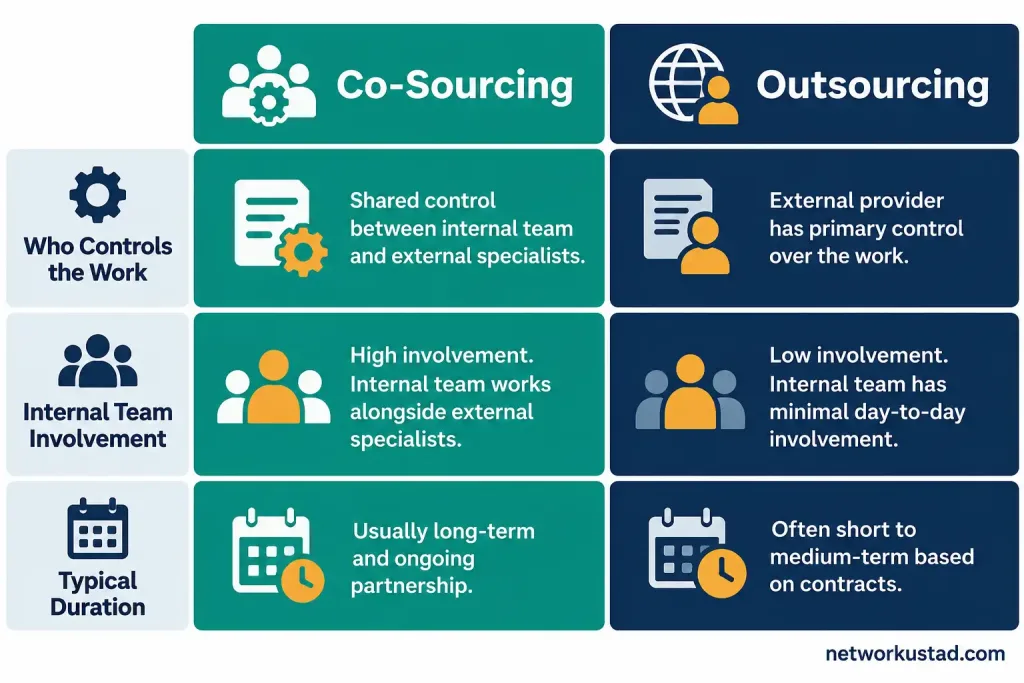
Outsourcing is a full delegation: an outside vendor takes complete responsibility for a function, including staffing, process, and delivery, while your organization mainly manages the contract and receives the finished result. Co-sourcing is different. It’s a shared model where an external provider supplies specialists who join your existing internal team, work within your methods and tools, and typically report to your own project manager or technical lead. Your organization keeps control of the roadmap and daily priorities; the outside specialists act as an extension of your own workforce rather than a separate, independently-managed vendor relationship.
That distinction is the whole reason co-sourcing exists as its own category. If you want to hand a function off entirely, outsourcing is the right word. If you want extra hands and specialized skill working inside your existing team structure, co-sourcing describes that more accurately.
A Concrete Example of IT Co-Sourcing in Practice
Picture a mid-sized company planning a migration from an on-premises system to a cloud platform. The internal IT team knows the business’s systems and workflows well but hasn’t done a migration of this specific kind before. Rather than hiring a permanent cloud migration specialist for a project that will wrap up in a few months, the company brings in two co-sourced specialists who join the internal team for the duration of the project, work inside the same project-management tools, and report to the same internal technical lead running the migration.
The internal team retains ownership of the decisions and the long-term system; the co-sourced specialists supply the specific migration expertise the project needs, then roll off once it’s complete. That’s IT co-sourcing in practice — a defined, embedded, temporary augmentation of an existing team, not a handoff, and it’s the pattern worth keeping in mind across every benefit discussed below.
Why Businesses Actually Choose IT Co-Sourcing
IT Co-Sourcing Can Be Genuinely Cost-Efficient
Hiring a full-time specialist means salary, benefits, paid leave, and the overhead of onboarding someone who may only be needed for a specific project or a temporary surge in workload. Co-sourcing avoids carrying that full-time cost for work that doesn’t justify a permanent headcount increase.
The broader outsourcing and augmented-staffing market backs up why cost is such a common driver: according to Clutch’s small business survey data, 37% of small businesses outsource at least one business process specifically to reduce costs, while another 18% do it mainly to access expertise they don’t have in-house — which is exactly the combination co-sourcing is built to deliver, cost efficiency and specialized skill, in one arrangement rather than forcing a choice between the two.
Flexibility for Defined Projects
A system migration, a security audit, or a platform upgrade often needs specific skills for a defined period, not a permanent new role. Co-sourcing lets you bring in that skill for the length of the project, embedded in your existing team’s workflow, without restructuring your organization chart around a temporary need. When the project wraps, the arrangement can wind down without the complications of adjusting a permanent headcount.
Scaling Without Permanent Headcount Growth
As a business grows, IT demand usually grows with it, but not always in a way that justifies hiring another full-time, expensive specialist immediately. Co-sourcing gives a way to scale technical capacity up when needed and back down when the surge passes, which is particularly useful for growing companies trying to avoid overcommitting to fixed payroll costs before the growth is proven out.
Freeing the In-House Team for Higher-Value Work
When an internal IT team is stretched across routine maintenance and strategic projects simultaneously, both tend to suffer. Bringing in co-sourced specialists for the routine, well-defined work frees the internal team to focus on the work that actually requires deep organizational knowledge — architecture decisions, vendor relationships, and strategic planning that an outside specialist, however skilled, won’t have the context for.
Closing a Genuine Skills Gap
Specific technical skills — certain cloud platforms, security certifications, or niche software expertise — aren’t always available in-house, and hiring permanently for a skill you’ll only need occasionally is rarely efficient. This is a well-documented driver across the broader outsourcing and staffing industry: according to a 2019 YouGov survey, 48% of companies that outsource offshore cite a lack of available talent in their local market as the reason, and a Syntax IT Trends report found that 83% of companies with in-house security teams were considering outsourcing some security work to managed service providers specifically because of the specialized skill required.
A Security Note Worth Taking Seriously With Any IT Co-Sourcing Arrangement
An overworked internal IT team, stretched thin across too many responsibilities, is more likely to miss software updates, leave default configurations unchanged, or let weak password policies slide — not because anyone is negligent, but because there simply isn’t enough time to do everything well. The Queensland Government’s guidance on IT risk management for businesses lists outdated software, unpatched systems, and weak access controls among the common risk factors worth actively managing, which lines up with why relieving pressure on an internal team (whether through co-sourcing or other staffing changes) can have a genuine security benefit, not just a productivity one.
Setting Up an IT Co-Sourcing Arrangement the Right Way
Getting the benefits described above without the downsides depends heavily on how the arrangement is actually set up, not just the decision to pursue co-sourcing in the first place.
Define scope and duration clearly upfront. An open-ended co-sourcing arrangement with no defined end point tends to drift into something closer to permanent outsourced staffing, without anyone deciding that deliberately. Setting a clear project scope and expected timeline keeps the arrangement matched to the actual need.
Assign real internal ownership. Someone on the internal team needs to actually manage the co-sourced specialists day to day — reviewing their work, integrating it with the rest of the team’s output, and making the calls on priority and direction. Co-sourcing without real internal management just becomes outsourcing with extra confusion about who’s actually in charge.
Build documentation into the engagement from day one, not as an afterthought near the end. Requiring co-sourced specialists to document decisions and system changes as they go, rather than relying on a knowledge-transfer session in the final week, meaningfully reduces the gap left behind once they roll off.
Set access controls that match the actual need, and build in a clear process for revoking that access when the engagement ends. This is as much a basic IT hygiene practice as it is specific to co-sourcing, but it’s easy to overlook when the arrangement feels informal because the specialists are working “as part of the team.”
What the Original Case for Co-Sourcing Usually Leaves Out
A fair look at co-sourcing needs to include its real tradeoffs, not just its upside.
Coordination overhead is real. Embedding outside specialists into your team means your own project managers or technical leads now need to manage and onboard people who don’t have your organization’s full context on day one. That management time is a genuine cost, even if it’s smaller than hiring and onboarding a full-time employee.
Data access and security boundaries need deliberate attention. Co-sourced specialists working inside your systems need defined access controls, just like any team member, and that access needs to be reviewed and revoked properly when the arrangement ends. Skipping this step creates exactly the kind of lingering access risk that a well-run co-sourcing arrangement should actually help prevent, not introduce.
Knowledge transfer isn’t automatic. If co-sourced specialists build institutional knowledge about a system during their engagement and that knowledge isn’t documented or transferred to your permanent team before they leave, you can end up with gaps once the arrangement ends. Building documentation requirements into the engagement from the start avoids this.
It’s not free of vendor dependence, even if it’s less than full outsourcing. You still depend on the co-sourcing provider’s ability to supply qualified people reliably. Vetting that provider’s track record matters just as much as it would for a full outsourcing relationship.
When IT Co-Sourcing Makes the Most Sense, and When It Doesn’t
Co-sourcing tends to fit best for defined projects with a clear end point (a migration, an audit, a platform rollout), for closing a specific skills gap your team doesn’t have and won’t need permanently, and for handling a temporary workload spike without committing to permanent headcount. It tends to fit less well for ongoing, undefined, open-ended work, where the coordination overhead of managing embedded outside staff indefinitely may not be worth it compared to either hiring permanently or outsourcing the function entirely.
Common Mistakes When Evaluating IT Co-Sourcing
Treating co-sourcing and outsourcing as interchangeable terms, when they describe genuinely different control structures, is the most common mistake and the one this guide opened with for a reason. Underestimating the internal management time needed to actually integrate outside specialists into a team is another. And failing to define access controls and knowledge-transfer expectations before the engagement starts, rather than figuring it out as problems come up, tends to create exactly the kind of risk co-sourcing is otherwise well-suited to avoid.
Frequently Asked Questions
What’s the actual difference between co-sourcing and outsourcing?
Outsourcing hands a function off entirely to an external vendor who manages it independently. Co-sourcing embeds external specialists into your existing team, under your own management, while you retain control of priorities and daily operations.
Is co-sourcing cheaper than hiring full-time staff?
Often, yes, for work that doesn’t justify a permanent role — you avoid full-time salary, benefits, and onboarding costs for specialized or temporary needs. It’s not automatically cheaper for ongoing, open-ended work, where the coordination overhead adds up over time.
Does co-sourcing create security risks?
It can, if access controls and data-handling boundaries aren’t defined clearly from the start. Done properly, with defined access scope and a revocation plan when the engagement ends, co-sourcing can actually reduce security risk by relieving pressure on an overstretched internal team.
When should a business choose outsourcing instead of co-sourcing?
When the goal is to hand a function off entirely and not manage it directly — co-sourcing still requires your own team to manage and integrate the embedded specialists, which outsourcing doesn’t.
Does IT co-sourcing work for a small business, or only larger organizations?
It works for either, as long as someone internally has the time to actually manage the embedded specialists. A very small business with no one available to provide that oversight may find straightforward outsourcing simpler to manage day to day, even if co-sourcing would otherwise offer more control over how the work actually gets done.
The Bottom Line
Co-sourcing offers real, specific benefits — cost efficiency for work that doesn’t justify permanent headcount, flexibility for defined projects, a way to close skills gaps, and relief for an overstretched internal team — but it isn’t simply a rebranding of outsourcing, and it isn’t without its own real tradeoffs around coordination and access management. Understanding the actual distinction, and going in with clear expectations about management overhead and security boundaries, is what determines whether an IT co-sourcing arrangement delivers on its promise or just adds complexity without the benefit.