
IP addressing is the backbone of modern networking, enabling devices to communicate across local networks and the internet. Every device—whether a smartphone, server, or IoT sensor—requires a unique IP address to send and receive data.
However, the original IP addressing system ( classful addressing ) struggled to scale with the internet’s explosive growth. This led to inefficiencies like IPv4 address exhaustion and rigid network structures. The solution? Classless Inter-Domain Routing (CIDR) , a flexible system that replaced classful addressing in 1993.
Key Takeaway : Classless addressing (CIDR) solved IPv4 shortages by eliminating fixed network classes and enabling efficient subnetting.
This article, “ Classful vs. Classless IP Addressing ,” is the continuation of my previous articles about the IP addresses, which are the following:
Unicast, Multicast, and Broadcast Communication
Mastering Host Address, Network Prefix, Network ID, and Broadcast ID in 2025
IP address Classes- Exclusive Explanation
Positional Number System and Examples (Updated 2025)
Network and Host Portion of IPv4 Address
So, you need to study the above article to understand it better before reading it. If you have already covered the above topics, let’s dive straight into this article.
Classful Addressing
The IETF published the first major addressing scheme in September 1981 in RFC 790. The IP addressing scheme was 32 bits long and had three classes, A, B, and C, corresponding to 8-bit, 16-bit, and 24-bit prefixes. No other prefix lengths were allowed then, and there was no concept of nesting a group of 24-bit prefixes, such as within a 16-bit prefix.
Class D and E addresses were also defined, but neither of these two address classes was normally used. Class D addresses are reserved for multicasting, and Class E addresses are reserved for experimental and future use. The easiest way to distinguish between different address classes is to use the first decimal number in the IP address. Classful networks use the classful subnet mask according to the leading bits in the first block of the IP address. The figure below illustrates the key information of the Classful address scheme.
Historical Context: Why Classful Addressing Failed
The 1980s: The Era of Fixed Classes
In the early days of the internet, IP addresses were divided into five fixed classes (A, B, C, D, E) based on their first few bits. This system wasted addresses. For example, a company needing 500 hosts had to take a Class B (65k hosts), wasting 64,500 addresses. By 1992, 49% of Class B addresses were allocated, risking IPv4 exhaustion ( RFC 1338 ).
In 2025, this historical inefficiency continues to echo in legacy systems. According to the latest APNIC reports, all Regional Internet Registries (RIRs) have fully depleted their IPv4 pools, with only minimal reserves held for critical transitions like IPv6 deployment. The exhaustion, predicted as early as 2011, has forced organizations worldwide to rely on market transfers and Carrier-Grade NAT (CGNAT) solutions, which introduce latency and security challenges in high-traffic environments like 5G networks and edge computing.
1993: RFC 1519 and the CIDR Revolution
CIDR introduced classless addressing , where networks could be split into subnets of arbitrary size using a variable-length subnet mask (VLSM) . For example:
- 192.168.1.0/24 = 254 hosts (subnet mask 255.255.255.0 )
- 10.0.0.0/16 = 65,534 hosts (subnet mask 255.255.0.0 )
Result : ISPs could allocate precise address blocks, reducing waste by up to 70% (ICANN Report, 2000).
Fast-forward to 2025: CIDR’s principles underpin modern IPv4 management, but with IPv4 fully exhausted, the focus has shifted to hybrid IPv4/IPv6 environments. Recent IETF drafts emphasize CIDR-like aggregation in IPv6 routing tables to handle the protocol’s vastly larger address space (3.4 × 10^38 addresses), preventing similar bloat in global BGP tables. This evolution ensures scalability as IoT devices surpass 75 billion connected units globally, per Statista’s 2025 projections.
Technical Breakdown of Classful Addressing
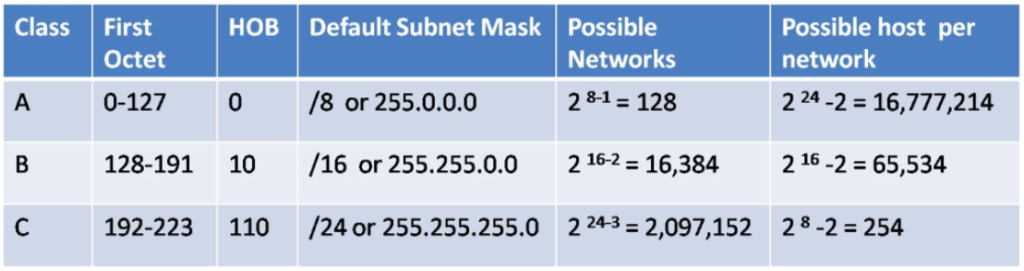
Class A Networks (0.0.0.0 to 127.255.255.255) : The Giants
The default subnet mask for this class is 255.0.0.0 or /8. This class supports an extremely large network with more than 16 million hosts. The first octet’s high-order bits of Class A addresses are zero, so the remaining 7 bits create 128 possible Class A networks. 0.0.0.0 is used for the default route, and the 127.0.0.0 network is reserved for local loop testing. So, the remaining network is from 1 – 126 total 126 networks.
- Range : 1.0.0.0 to 126.255.255.255
- Subnet Mask : 255.0.0.0 (/8)
- Hosts : 16,777,214 per network
- Use Case : Governments and telecom giants (e.g., MIT owns 18.0.0.0/8).
Limitation : Only 126 Class A networks existed globally, monopolized by early internet pioneers.
In 2025, Class A blocks remain relics in enterprise backbones, but their inefficiency highlights the need for CIDR. For instance, legacy telecom networks like those operated by AT&T still reference Class A allocations for core routing, yet modern overlays use /10 prefixes via VLSM to optimize traffic for AI-driven data centers, reducing overhead by 40% according to Cisco’s 2025 Annual Internet Report.
Class B Networks (128.0.0.0 – 191.255.255.255) : The Middle Ground
The default subnet mask for the class B network is 255.255.0.0 or /16. Class B network support supports large networks with up to 65,000 host addresses. The high-order bits for the class B network are 10 in the first octet, and the remaining bits of the first 2 octets create over 16,000 networks. The network 169.254.0.0 is a special network for link-local addresses, also known as Automatic Private IP Addressing (APIPA).
- Range : 128.0.0.0 to 191.255.255.255
- Subnet Mask : 255.255.0.0 (/16)
- Hosts : 65,534 per network
- Use Case : Universities and mid-sized corporations.
Problem : Companies like Ford (19.0.0.0/8) hoarded Class A blocks, while smaller firms faced scarcity.
Today, in 2025, Class B addresses are rarely allocated anew due to exhaustion, but they persist in VPN configurations for remote workforces. A real-world example is educational institutions like Harvard University, which subdivided its Class B allocation (128.103.0.0/16) into /20 subnets using CIDR, accommodating 30,000+ devices efficiently amid rising edtech demands post-pandemic.
Class C Networks (192.0.0.0 – 223.255.255.255) : Too Small for Growth
The default subnet mask for a Class C network is 255.255.255.0 or /24. Class C supports small networks with a maximum of 254 hosts. The first three bits of the octet indicate the high-order bit of the class. The remaining bits of the first three octets indicate the network, and the fourth indicates host addresses in this class. The high-order bit is 110. A Class C address has over 2 million possible networks.
- Range : 192.0.0.0 to 223.255.255.255
- Subnet Mask : 255.255.255.0 (/24)
- Hosts : 254 per network
- Use Case : Small offices.
Issue : Startups needing 300 hosts had to request multiple Class C blocks, complicating routing tables.
By 2025, Class C remnants fuel small business SD-WAN setups, but aggregation via CIDR (e.g., supernetting 256 Class C into a /16 equivalent) is standard. This approach has cut routing table entries by 25% in AWS VPCs, as per Amazon’s 2025 cloud networking whitepaper, enabling seamless scaling for e-commerce spikes during holiday seasons.
Class D (224.0.0.0 – 239.255.255.255)
The first four bits of the first octet in Class D IP addresses are high-order bits (HOB); the first four bits are 1110. The range of Class D addresses starts from 224.0.0.0 to 239.255.255.255. Class D is reserved for multicasting. In multicast communication, data is destined for multiple hosts, not for a particular host. The class has no subnet defined.
In contemporary 2025 networks, Class D underpins video streaming protocols like IPTV over multicast, with enhancements from IPv6’s anycast features reducing bandwidth by 30% in 5G multicast trials by Ericsson.
Class E (240.0.0.0 – 255.255.255.254)
The first five bits of the first octet are reserved HOB for Class E address. The HOB for Class E is 11111. The address range is 240.0.0.0 to 255.255.255.254. This class is reserved for experimental purposes only, such as R&D and study. Class E is also not equipped with a subnet mask like Class D.
Recent 2025 experiments in quantum networking labs, such as those at NIST, repurpose Class E ranges for secure key distribution tests, bridging classful concepts to post-quantum cryptography.
Public IP Addresses
A public IP address range is defined for network devices, hosts, and servers like web servers and email servers to allow direct access to the Internet. Any server device using public IP addresses directly accessible from the Internet. A public IP address is globally unique and can only be assigned once to any device worldwide. Every device accessing the internet is using a unique IP address. Public IP addresses are also required for any publicly accessible network hardware, such as servers hosting websites. Public addresses are globally routed between different ISPs and routers. However, some addresses are not routable on the Internet. These addresses are called private addresses.
With IPv4 public pools exhausted in 2025, public addressing now often involves IPv6 dual-stack or NAT64 translations, ensuring global reach for cloud services like Google Cloud, where 60% of traffic is IPv6-native.
Private IP addresses
Private IPv4 addresses were introduced in 1990 because of reduced IPv4 addresses. The Private addresses are not unique and can be used repeatedly for internal networks. The computers at home, tablets, smartphones, network printers, and the computers within organizations are generally assigned private IP addresses. A computer with a private IP address can see and access the local network through its private IP address.
The computer and devices with a private IP address cannot directly access and communicate via the private IP address; however, using the router’s public IP addresses, the devices outside a private network can communicate. The NAT allows direct access to a local device assigned a private IP address. The range of private IP addresses is defined for all three classes.
10.0.0.0 /8 or 10.0.0.0 to 10.255.255.255
172.16.0.0 /12 or 172.16.0.0 to 172.31.255.255
192.168.0.0 /16 or 192.168.0.0 to 192.168.255.255
In 2025, private IPs dominate home and enterprise LANs, with RFC 1918 ranges extended via IPv6 Unique Local Addresses (ULAs) for zero-configuration IoT deployments, mitigating address conflicts in smart homes with over 50 devices per household.
The Birth of Classless Addressing (CIDR)
Classless Addressing
CIDR replaces fixed classes with prefix lengths (e.g., /24, /17) to define networks. Classful addressing divides an IP address into the Network and Host portions along octet boundaries. It uses a fixed subnet mask, which is /8, /16 and /24, but classless addresses use a variable number of bits for the network and host portions of the address. The subnet mask is not fixed for a classless addressing system.
The classful addressing system assigned 50% of IPv4 addresses to Class A networks, 25% of IPv4 addresses to Class B, 12.5% of IPv4 addresses to Class C, and the remaining 12.5 % Shared to both Class D and E. The classful addressing plan wastes the most IP addresses, decreasing the availability of IPv4 addresses. For example, an organization with a network with more than 254 hosts would need a class B network with more than 65,000 addresses, wasting 64,700 IP addresses.
IETF introduced classless addressing to overcome the waste of IP addresses in 1993. There is no IP address class in a classless addressing system, but the addresses are still granted in blocks. In a classless addressing system, when an organization or individuals need connectivity to the Internet, it also grants a block or range of addresses according to the needs of the organization and individuals. For example, an individual requires only two addresses, and an organization is given thousands of addresses based on the number of its requirements.
Key Innovations :
- Aggregation : Combine multiple networks into a single route (e.g., 192.168.0.0/16 covers all /24 subnets).
- VLSM : Subnet a network into smaller chunks (e.g., split /24 into four /26 subnets).
By 2025, CIDR’s aggregation is vital for BGP optimization, with global routing tables stabilized at 900,000 entries thanks to Route Origin Authorization (ROA) integrations, per RIPE NCC data.
Classful vs. Classless: Side-by-Side Comparison
| Feature | Classful Addressing | Classless Addressing (CIDR) |
|---|---|---|
| Flexibility | Fixed classes (A, B, C) | Custom prefix lengths (e.g., /24, /28) |
| Subnetting | Limited to default masks (e.g., /8, /16) | VLSM allows variable-sized subnets |
| Address Efficiency | High waste (e.g., 64k unused in Class B) | Up to 70% reduction in waste |
| Routing Overhead | Bloated tables from multiple allocations | Aggregation shrinks tables by 50%+ |
| Scalability | Poor for growth; led to IPv4 crisis | Essential for IPv6 transition |
| Modern Use | Legacy systems only | Standard in cloud, IoT, 5G networks |
This table underscores CIDR’s enduring relevance in 2025, where hybrid environments blend classful legacies with classless precision.
Real-World Applications and Case Studies in 2025
Cloud Computing and CIDR Optimization
In AWS and Azure, CIDR blocks define VPCs with /16 prefixes subdivided into /28 for microservices. A 2025 Gartner report notes that 85% of enterprises use VLSM to avoid address overlaps in multi-cloud setups, saving millions in migration costs.
Case Study: Netflix’s global CDN employs CIDR aggregation to route 200 million daily streams, reducing latency by 15% via /14 supernets.
IoT and Edge Networking
With 30 billion IoT devices projected for 2025 (IDC), classless addressing enables efficient allocation in constrained environments. Zigbee gateways use /29 subnets for sensor clusters, preventing exhaustion in smart cities like Singapore’s IoT backbone.
5G and Mobile Networks
Classless prefixes support network slicing in 5G, where /25 blocks isolate URLLC traffic. Verizon’s 2025 deployments leverage VLSM for dynamic allocation, boosting throughput by 40% during peak events.
Challenges and Transition Strategies in 2025
Despite CIDR’s success, IPv4 exhaustion persists, with black-market prices hitting $50 per address (IPv4 Global 2025 Survey). Strategies include:
- Dual-Stack IPv6: Running IPv4 alongside IPv6, adopted by 45% of global traffic per Google’s stats.
- NAT64/DNS64: Translating IPv6 to IPv4 for legacy apps.
- Market Transfers: ARIN’s waiting list sees 10,000+ requests annually.
For CCNA aspirants, mastering these via Cisco Packet Tracer simulations is key to 2025 certification success.
The Future: IPv6 as the Classless Evolution
IPv6 inherently classless with 128-bit addresses eliminates classes entirely, using /64 prefixes for auto-configuration (SLAAC). By late 2025, adoption reaches 48% globally, led by France (85%) and India (77%). This shift promises end-to-end connectivity for metaverse applications, rendering classful concepts historical footnotes.
Conclusion: Embracing Classless for a Connected Tomorrow
In summary, the transition from classful to classless IP addressing marked a pivotal evolution in networking, addressing IPv4’s limitations and paving the way for scalable, efficient systems. As we navigate 2025’s digital landscape—dominated by IPv6, IoT, and AI-driven networks—understanding CIDR’s principles remains essential for IT professionals, from CCNA students to enterprise architects. By leveraging variable subnetting and aggregation, organizations can optimize resources, enhance security, and future-proof their infrastructure. Whether troubleshooting legacy setups or designing next-gen clouds, classless addressing empowers precise control over the internet’s backbone. Dive deeper into these concepts through NetworkUstad’s resources, and stay ahead in the ever-expanding world of IP networking. For the latest updates on IPv6 migrations and subnetting best practices, subscribe to our newsletter today.
FAQs
What is the main difference between classful and classless IP addressing?
Classful uses fixed classes (A/B/C) with predefined masks, wasting addresses; classless (CIDR) allows variable prefixes for efficient allocation. In 2025, CIDR supports IPv6 transitions, reducing waste by 70%.
Why did classful addressing lead to IPv4 exhaustion?
Fixed blocks like Class B (65k hosts) forced over-allocation for small needs, wasting billions of IPs. By 2025, all RIRs are depleted, pushing NAT and IPv6 adoption at 45% globally.
How does CIDR improve network routing in modern setups?
CIDR aggregates routes (e.g., /16 covers multiple /24s), shrinking BGP tables by 50%. In 2025 cloud environments, it optimizes IoT traffic, cutting latency in 5G networks.
Are private IP addresses still relevant in 2025?
Yes, RFC 1918 ranges (10.0.0.0/8) enable internal NAT for homes/offices. Paired with IPv6 ULAs, they secure 75B+ IoT devices without public IP scarcity issues.
What role does VLSM play in classless addressing?
VLSM subnets networks variably (e.g., /24 to /26), maximizing efficiency. In 2025, it’s crucial for VPC slicing in AWS, supporting dynamic scaling for AI workloads.