Domain 1.7 | Network Fundamentals — 20% of exam
Learning Objectives
By the end of this lesson, you will be able to:
- Explain why IPv4’s address space ran out faster than originally anticipated
- Identify the three RFC 1918 private address ranges and their sizes
- Explain how NAT allows privately addressed hosts to reach the public internet
- Describe the real-world problems that arise from overlapping private address space
- Distinguish common misconceptions about what private addressing actually provides
Key Terms
| Term | Definition |
|---|---|
| RFC 1918 | The internet standards document reserving three IPv4 ranges for private use |
| Public IP address | A globally unique, internet-routable address |
| Private IP address | A non-internet-routable address reserved for internal use, reusable across separate networks |
| NAT | Network Address Translation; translates private addresses to public ones for internet access |
| Classful addressing | The original IPv4 addressing scheme dividing address space into fixed-size Class A, B, and C blocks |
| Address exhaustion | The depletion of available public IPv4 addresses as internet adoption scaled |
| CGNAT | Carrier-Grade NAT; an ISP-level NAT layer using a separate reserved address range |
Explanation
An Address Space That Ran Out Faster Than Anyone Planned
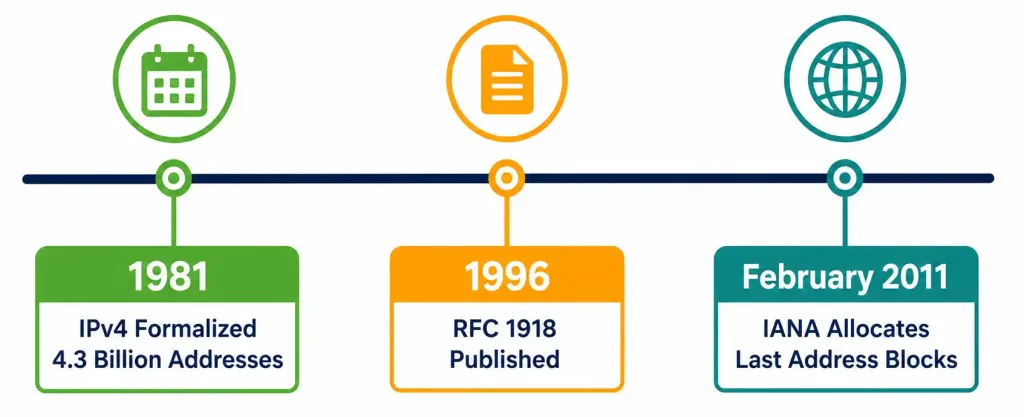
IPv4 uses 32-bit addresses. That gives roughly 4.3 billion possible combinations — a genuinely enormous number by the standards of 1981, when the protocol was formalized. Nobody involved in that design process seriously expected the internet to eventually connect billions of individual devices, let alone the phones, sensors, cameras, and smart appliances that now routinely carry their own IP address.
The math simply didn’t hold up against how the internet actually grew. IANA, the body overseeing the global pool of IPv4 addresses, allocated its last remaining blocks to regional registries in February 2011. Individual regional registries ran out over the following years at different rates — Asia-Pacific’s registry exhausted its free pool first, given the region’s explosive internet growth, with others following. This wasn’t a distant, theoretical problem solved once and forgotten. It’s the current, ongoing reality the internet still operates within, which is exactly why private addressing and NAT remain absolutely central to how nearly every network functions today, rather than a legacy workaround nobody actually still uses.
This lesson builds on the addressing fundamentals from IPv4 addressing and subnetting. That lesson covered how to calculate and assign addresses within a given block. This one covers why an entire category of addresses exists that were deliberately designed to never appear on the public internet at all.
The Three RFC 1918 Ranges
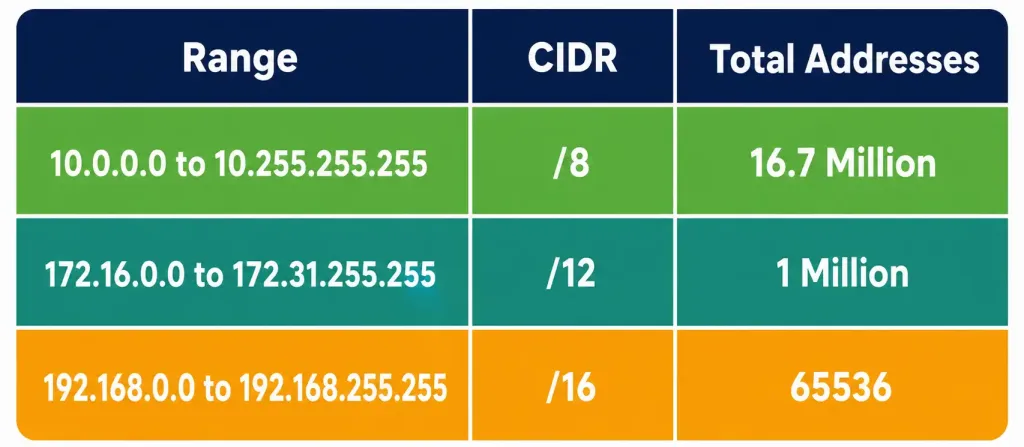
RFC 1918, published in 1996, formally reserved three specific address ranges for private use — meaning any organization can use addresses from these ranges internally, and no internet service provider or backbone router will forward traffic to or from them across the public internet.
- 10.0.0.0/8 — 10.0.0.0 through 10.255.255.255. A single, enormous block covering just over 16.7 million addresses.
- 172.16.0.0/12 — 172.16.0.0 through 172.31.255.255. A mid-sized block covering just over 1 million addresses.
- 192.168.0.0/16 — 192.168.0.0 through 192.168.255.255. The smallest of the three, covering 65,536 addresses.
Notice these three ranges are wildly different sizes — not an arbitrary design choice. It traces directly back to the original classful addressing scheme IPv4 launched with, before CIDR (classless addressing, covered conceptually elsewhere in this domain) became standard. The original design split all IPv4 address space into Class A, B, and C blocks, each with a different fixed split between network and host bits, intended for organizations of correspondingly different sizes.
RFC 1918’s authors specifically carved one reserved private range out of each class: one Class A block (10.0.0.0/8, hence its enormous size — a single Class A block was always intended for the very largest organizations), sixteen contiguous Class B blocks (172.16.0.0 through 172.31.0.0, combined and expressed as the single /12 range), and 256 contiguous Class C blocks (192.168.0.0 through 192.168.255.0, expressed as the single /16 range).
This history is worth knowing not as trivia, but because it directly explains something that otherwise looks arbitrary: why would anyone design three separate private ranges of such different sizes, instead of just one range large enough to cover everyone’s needs? The answer is that RFC 1918 wasn’t designed from scratch — it was retrofitted onto an existing classful structure, preserving a private option at every size tier that structure already provided.
Why Private Addressing Actually Solves the Exhaustion Problem
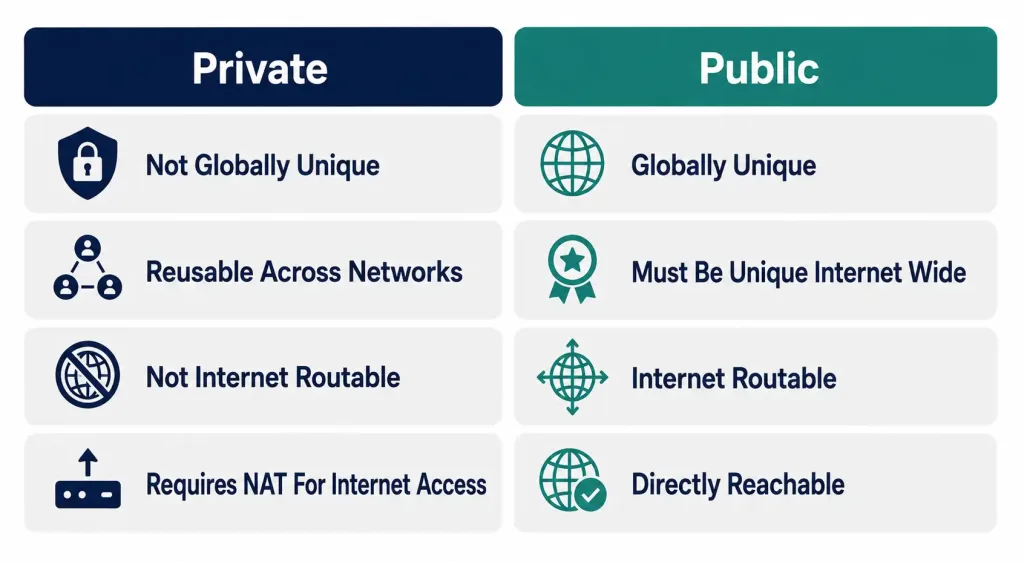
Here’s the mechanism that makes this work, and it’s a genuinely elegant solution once you see it clearly: private address ranges are not globally unique. Every single organization on earth can use 192.168.1.0/24 internally, simultaneously, with zero conflict between them — because none of those addresses ever need to be distinguished from each other on the public internet. They only need to be unique within each organization’s own internal network.
Compare that to public addresses, which absolutely must be globally unique — if two different networks both tried to use the same public address, routers across the internet would have no way to determine which one a given piece of traffic was actually meant for. Public address space is a finite, shared, must-be-unique resource. Private address space isn’t shared at all — it’s reused, in full, by every single network that chooses to use it, without any coordination or registration required between them.
This is the entire point. An organization with 50,000 internal devices doesn’t need 50,000 unique public IP addresses — a resource that, given exhaustion, likely wouldn’t even be available to allocate. It needs 50,000 addresses that are unique among themselves, which private address space provides in unlimited supply, reused freely across every other organization doing exactly the same thing.
NAT: The Bridge Between Private and Public
Private addressing alone doesn’t get a device onto the internet — since, by definition, private addresses aren’t routable there at all. Network Address Translation (NAT), covered in configuration depth in Domain 4 (IP Services), is what bridges this gap.
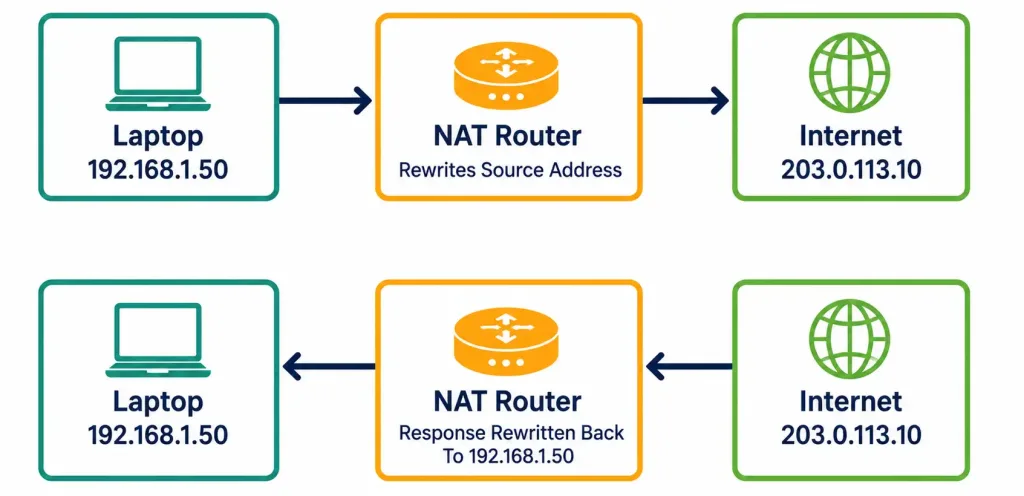
The mechanism, at a conceptual level appropriate for this lesson: a router or firewall sitting at the boundary between an organization’s private network and the public internet maintains one or more actual public IP addresses. When an internal device with a private address sends traffic destined for the internet, the NAT device rewrites the packet’s source address — swapping the private address for one of its own public addresses — before forwarding it onward. When a response comes back, NAT reverses the translation, rewriting the destination address back to the original private address, and delivers it to the correct internal device.
Worked example, made concrete. A laptop on an office network, addressed 192.168.1.50, requests a webpage from a public server. That request reaches the office’s NAT-enabled router, which rewrites the source address to the router’s own public address — say, 203.0.113.10 — before sending the request onward across the internet. The web server responds to 203.0.113.10, since that’s the only address it ever saw. The router receives that response, recognizes it corresponds to the earlier request from 192.168.1.50, rewrites the destination address back accordingly, and delivers it to the correct laptop. The web server never knew, and never needed to know, that 192.168.1.50 existed at all.
This is precisely why an entire office, or an entire household, can share a single public IP address for internet access — a technique specifically called PAT (Port Address Translation) or NAT overload, distinguishing many internal devices from each other using different port numbers rather than requiring a separate public address per device. One public address, potentially thousands of simultaneously connected private devices behind it.
A Related but Distinct Concept: Carrier-Grade NAT
Address exhaustion pressure hasn’t stopped at the level of individual organizations — it’s pushed all the way up to internet service providers themselves. Some ISPs, particularly those provisioning large numbers of new customers with limited remaining public address inventory, now apply NAT at their own infrastructure level, using a separate reserved range specifically for this purpose: 100.64.0.0/10, defined by RFC 6598 specifically to avoid colliding with a customer’s own private RFC 1918 addressing inside their home network.
This means some home internet connections today are actually double-NATed: the home router translates a device’s RFC 1918 private address to the router’s own address on the 100.64.0.0/10 range, and the ISP’s own carrier-grade NAT infrastructure then translates that address again to an actual public internet address. This is worth knowing conceptually — it’s not itself a CCNA configuration objective, but it’s a direct, current-day extension of the exact exhaustion problem this lesson covers, and it occasionally surfaces in scenario questions describing unusual double-translation behavior.
The Real-World Problem: Overlapping Private Address Space
Private addressing’s biggest strength — unlimited reuse, no coordination required — is also the source of one of the most common, genuinely disruptive networking problems in the real world: address overlap when two separately addressed private networks need to connect to each other directly.
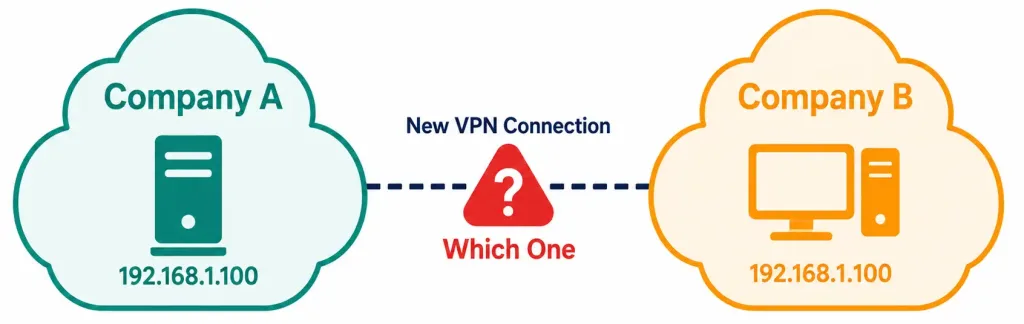
Picture two companies merging, each having independently built out its internal network using 192.168.1.0/24 — an extremely common default choice, since it’s the range most consumer and small-business routers ship with out of the box. Individually, both networks function perfectly. The moment IT tries to connect them — through a site-to-site VPN, a direct network merger, or simply acquiring one company’s infrastructure into the other’s — routing breaks immediately. A router has no way to distinguish “192.168.1.50 on network A” from “192.168.1.50 on network B” once both ranges exist within the same connected routing domain. Traffic intended for one frequently ends up misdirected to the other, or simply fails to route at all.
This is not a rare edge case. It’s one of the most common real-world consequences of private addressing’s design, and it’s a genuine, recurring pain point in mergers, acquisitions, and any scenario connecting two independently built private networks. The typical fixes are re-addressing one or both networks entirely (disruptive, but permanent), or deploying NAT specifically between the two networks to translate one side’s addresses into a range that doesn’t conflict with the other’s (faster to implement, but adds ongoing complexity to the merged network’s operation).
Worked example: Company A uses 192.168.1.0/24 throughout its offices. Company B, entirely independently, also uses 192.168.1.0/24. After an acquisition, both networks need to share resources over a new site-to-site VPN. Without intervention, a server at 192.168.1.100 on Company A’s side is completely indistinguishable, from the router’s perspective, from a workstation at the same address on Company B’s side.
The practical fix chosen in a case like this is usually NAT applied specifically at the VPN boundary, translating Company B’s addresses into a distinct, non-conflicting range purely for the purposes of that interconnection — Company B’s internal network can keep its original addressing unchanged for all of its own internal purposes, with translation happening only at the specific point where the two networks actually meet.
Common Misconceptions Worth Correcting Directly
“Private addressing means my network is secure.” This is one of the most persistent and most incorrect assumptions in networking, and it’s worth stating plainly: NAT and private addressing provide a byproduct of obscurity — an external attacker generally can’t directly address a specific internal device without some form of translation already configured to allow it — but this is fundamentally different from actual security.
NAT is not a firewall. It doesn’t inspect traffic content, doesn’t enforce access policy, and doesn’t prevent an internal device from initiating an outbound connection to something malicious. Conflating “my internal addresses aren’t directly reachable from outside” with “my network is secure” is a real, sometimes costly misunderstanding — genuine security requires actual security controls (firewalls, IPS, access policy), not just the incidental side effect of an addressing scheme designed to solve a completely different problem.
“Private IP addresses are somehow lower quality or slower than public ones.” There’s no technical difference in how a private address functions internally compared to a public one — the distinction is entirely about internet routability, not about the address’s technical properties, speed, or capability. A device addressed with 10.0.0.5 communicates on its local network exactly as effectively as a device addressed with a public address would.
“All private networks must use the same specific range.” Untrue, and this misconception sometimes leads to unnecessary hesitation when choosing internal addressing. Any of the three RFC 1918 ranges is equally valid for any organization, regardless of size — a small five-person office can use the enormous 10.0.0.0/8 range if it wants to (though it typically wouldn’t need anywhere near that much space), and a large enterprise could technically use 192.168.0.0/16 if that fits its actual VLSM planning better, even though 10.0.0.0/8’s much larger space is more commonly chosen for genuinely large organizations specifically because it leaves more room for future growth and more flexible subnetting.
Choosing Which RFC 1918 Range to Actually Use
While any of the three ranges is technically valid for any organization, real-world convention has settled into some fairly consistent patterns, worth knowing both for the exam and for genuine network design judgment:
10.0.0.0/8 is the common default for larger enterprises specifically because of its sheer size — over 16.7 million addresses gives enormous flexibility for VLSM planning across many sites, departments, and device categories without ever approaching exhaustion of the internal space itself.
172.16.0.0/12 sees less universal adoption than the other two, but is frequently chosen specifically to avoid a very practical, very common real-world collision: since 192.168.0.0/16 is the default range baked into most consumer and small-business router firmware, organizations that anticipate connecting to numerous third-party networks via VPN (a services company connecting to many different clients’ networks, for instance) sometimes deliberately choose 172.16.0.0/12 specifically because it’s statistically less likely to already be in use on whatever network they’re connecting to.
192.168.0.0/16 is overwhelmingly the default for home networks and small offices, precisely because it’s what most consumer routers ship pre-configured with. This convenience is exactly what creates the overlap problem discussed above — its sheer prevalence as an unchanged default is precisely why so many independently built small networks collide when they’re later connected to each other.
Identifying Whether an Address Is Private or Public
This is a practical skill worth being fast at, since it resurfaces throughout scenario questions elsewhere in the exam: given an arbitrary IP address, can you quickly tell whether it falls inside one of the three RFC 1918 ranges?
The quick check for each range:
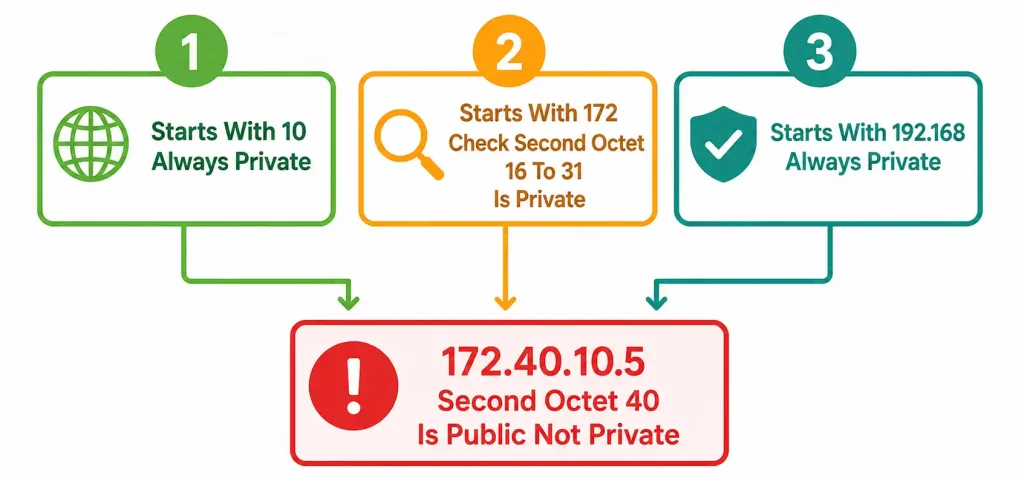
- 10.x.x.x — anything starting with 10 in the first octet is private, full stop. The entire first octet is dedicated to this one range.
- 172.16.x.x through 172.31.x.x — this one requires checking the second octet specifically, since not all 172.x.x.x addresses are private. Only second-octet values from 16 through 31 fall inside the reserved /12 block; 172.15.x.x and 172.32.x.x are both public address space, despite looking superficially similar to the private range.
- 192.168.x.x — anything starting with 192.168 in the first two octets is private, full stop.
Worked example, testing the boundary case specifically, since it’s exactly where mistakes happen: is 172.20.5.10 private? Check the second octet: 20 falls between 16 and 31, so yes, this is private. Is 172.40.5.10 private? Second octet is 40, which falls outside the 16–31 range — this is a public address, despite starting with 172, the same first octet as the genuinely private range. This exact boundary — confusing “starts with 172” for “is automatically private” — is one of the most commonly tested traps in this specific objective, precisely because the 172.16.0.0/12 range doesn’t cleanly align with a whole first-octet or whole-second-octet boundary the way the other two ranges do.
Verifying Addressing on a Real Device
Confirming whether a device is using private or public addressing is a quick, practical check worth knowing in both a Windows and Cisco IOS context, since it comes up constantly in real troubleshooting.
On a Windows or Linux end device, ipconfig (Windows) or ip addr (Linux) shows the device’s currently assigned address directly — checking that output against the ranges above tells you immediately whether that specific device is privately or publicly addressed.
On a Cisco device, show ip interface brief shows the address assigned to each interface, and the same range-checking logic applies. It’s common, and expected, for a router to show a private address on its LAN-facing interface and a public address on its internet-facing interface simultaneously — that’s precisely the NAT boundary in action, visible directly in the device’s own interface addressing.
Router# show ip interface brief
Interface                  IP-Address      OK? Method Status                Protocol
GigabitEthernet0/0         192.168.1.1     YES manual up                    up
GigabitEthernet0/1         203.0.113.10    YES manual up                    up
Reading this output: GigabitEthernet0/0, facing the internal LAN, carries a private address (192.168.1.1). GigabitEthernet0/1, facing the internet, carries a public address (203.0.113.10). This single router straddles both worlds simultaneously — exactly the role a NAT-enabled boundary device plays, and exactly the pattern worth recognizing quickly when a scenario question describes a device with two interfaces addressed this differently.
Looking Ahead: IPv6 and the Long-Term Fix
It’s worth situating private IPv4 addressing honestly within the broader arc of internet addressing history. IPv6, with its vastly larger 128-bit address space, was specifically designed to make address exhaustion — and by extension, the entire private-addressing-plus-NAT workaround this lesson covers — permanently unnecessary. IPv6’s address space is large enough that genuinely every device on earth, many times over, could receive its own globally unique, directly routable address, with room to spare for the foreseeable future.
And yet private IPv4 addressing and NAT remain thoroughly, overwhelmingly prevalent today, years after IPv6 became a mature, available standard. This isn’t a failure of the underlying idea — it’s a reflection of how much existing infrastructure, tooling, documentation, and institutional habit is built around IPv4 addressing, and how gradually large-scale infrastructure transitions actually happen in practice, even when a better long-term alternative genuinely exists. Understanding RFC 1918 and NAT isn’t studying a historical curiosity being phased out — it’s studying the addressing reality still governing the overwhelming majority of networks in active production use today, IPv6’s technical superiority notwithstanding.
The Exhaustion Timeline, in Concrete Terms
It’s worth anchoring the abstract “IPv4 ran out” narrative with the actual sequence of events, since specific milestones make the scale of the problem concrete rather than abstract.
IPv4 was formalized in 1981. For roughly two decades, the roughly 4.3 billion available addresses seemed effectively inexhaustible, given the internet’s much smaller scale at the time. That changed as consumer internet adoption accelerated through the 1990s and 2000s, and the growth curve simply outran the available supply far faster than early designers had modeled.
IANA — the body sitting at the very top of the global address allocation hierarchy — allocated its last remaining unassigned blocks to the five regional internet registries in February 2011, a widely reported milestone at the time. Individual regional registries then exhausted their own remaining free pools at different rates over the following years, driven by regional growth patterns — Asia-Pacific’s registry, covering by far the fastest-growing internet population at the time, ran out first, with other regions following at their own pace afterward.
This is precisely why RFC 1918 private addressing and NAT aren’t a niche or optional technique today — they’re load-bearing infrastructure that the entire internet has depended on for continued growth well past the point where the original public address supply alone could have supported it. Without private addressing and NAT, the practical growth of the internet as it actually happened — hundreds of millions of home networks, billions of connected mobile devices, an ever-expanding universe of IoT devices — would have run headlong into a hard numerical wall years earlier than it did.
Private vs. Public Addressing: Full Comparison
Frequently Asked Questions
Can two devices on completely different private networks have the exact same IP address without any problem? Yes, and this is precisely the intended design, not a coincidence or edge case. As long as the two networks never need to communicate directly with each other without translation in between, identical private addresses on separate networks cause zero conflict — this is the entire mechanism that makes private address reuse possible at global scale.
Is it possible to use a public IP address on an internal, private network by mistake? Technically yes, though it’s a design mistake worth avoiding — assigning a real public address (one actually owned and routed by someone else on the internet) to an internal-only device can create genuine confusion if that network later connects to the internet, since traffic intended for the real owner of that public address could be misrouted internally instead. This is exactly why sticking to the RFC 1918 ranges specifically, rather than an arbitrary internal numbering scheme, matters — those ranges are guaranteed never to be legitimately routed on the public internet, removing this risk entirely.
Does every device behind NAT share the exact same public IP address? Typically yes, when using PAT (NAT overload) — the common setup for a home network or small office, where one public address serves potentially hundreds of internal devices simultaneously, distinguished from each other by port number rather than by a separate public address each. Larger organizations sometimes use a small pool of several public addresses rather than just one, but even then, many internal devices typically still share each available public address.
Can private addressing coexist with IPv6 on the same network right now? Yes, and this is actually a common real-world configuration called dual-stack — a device or network running both IPv4 (potentially with private addressing and NAT) and IPv6 (with globally unique addresses and no NAT required) simultaneously, during the extended transition period the industry is still working through. Dual-stack lets a network gain IPv6’s benefits for the traffic and destinations that support it, while retaining IPv4 private addressing and NAT for everything that still depends on the older protocol.
Why doesn’t the exhaustion problem get solved by simply reserving more private address space? Because private address space was never the actual scarce resource — public address space was. Reserving additional private ranges wouldn’t create a single additional public address, and public addresses are specifically what’s required for anything that needs to be independently, globally reachable across the internet without NAT translating on its behalf (a public-facing web server, for instance, still needs a genuine public address, regardless of how much private space exists elsewhere).
If IPv6 solves this problem permanently, why hasn’t the industry fully switched over yet? Primarily due to the scale and cost of migrating existing infrastructure, tooling, and institutional processes built around IPv4 over more than four decades, combined with the fact that NAT and private addressing, while not the elegant long-term solution IPv6 represents, do genuinely work well enough in practice to remove the urgent pressure that might otherwise force a faster transition. IPv6 adoption continues to grow steadily, but IPv4 with private addressing and NAT remains the dominant addressing reality most networks — and most of this exam — are built around today.
Private IPv4 Addressing: Practice Quiz
Test your knowledge of IPv4 address space, RFC 1918 private addressing, NAT, PAT, CGNAT, address exhaustion, and dual-stack networking.
Summary
- IPv4’s roughly 4.3 billion addresses were exhausted far faster than expected once the internet scaled globally, with IANA allocating its last blocks to regional registries in February 2011.
- RFC 1918 reserves three private ranges — 10.0.0.0/8, 172.16.0.0/12, and 192.168.0.0/16 — sized differently based on their origins in the original classful (Class A/B/C) addressing scheme.
- Private addresses aren’t globally unique and can be reused freely across unrelated networks, which is exactly what makes private addressing solve the exhaustion problem.
- NAT bridges private and public addressing, rewriting source addresses on the way out and reversing the translation on the way back; PAT/NAT overload lets many devices share one public address.
- Overlapping private address space is a common, genuine real-world problem when two independently addressed networks need to connect directly.
- Private addressing and NAT provide incidental obscurity, not real security — don’t confuse the two.
- 172.16.0.0/12 requires checking the second octet (16–31) specifically, since not all 172.x.x.x addresses are private — a frequently tested boundary case.