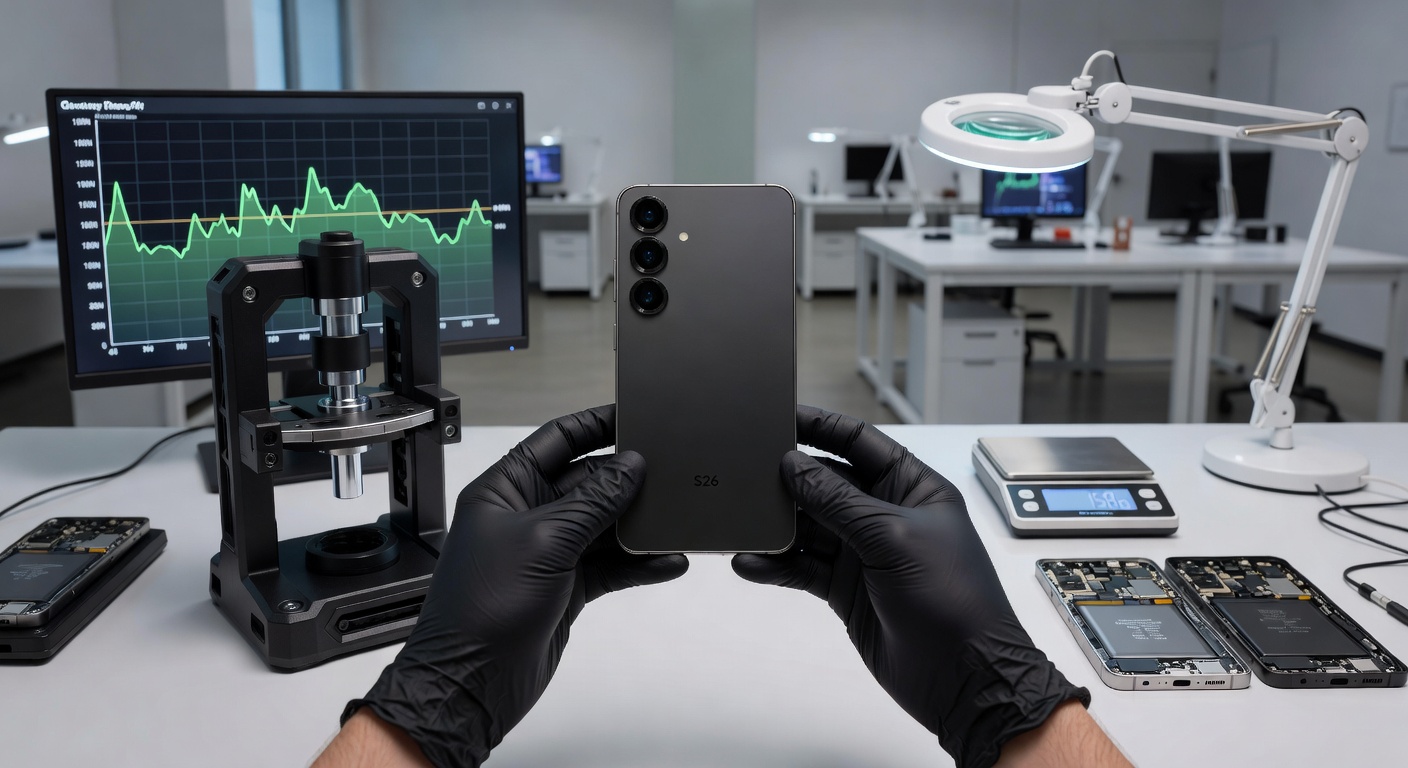
Samsung’s Galaxy S26 weighs just 168 grams, a 12% reduction from the Galaxy S25’s 191 grams, according to official specs leaked by reliable tipster Ice Universe on X in April 2026. This makes the Galaxy S26 Design and Build: Thinner, Lighter, and More Durable a standout achievement in flagship smartphones. Engineers achieved this without sacrificing strength, using advanced materials that promise IP69-rated water and dust resistance.
Key Specifications of Galaxy S26 Design and Build
The Galaxy S26 measures 146.9 x 70.4 x 7.2mm, slimmer than the S25’s 7.6mm profile. This thinner chassis houses a 4000mAh battery, down slightly from 4100mAh, yet optimized for all-day use.
Dimensions and Weight Breakdown
Here’s a precise comparison:
| Model | Height (mm) | Width (mm) | Thickness (mm) | Weight (g) |
|---|---|---|---|---|
| Galaxy S26 | 146.9 | 70.4 | 7.2 | 168 |
| Galaxy S25 | 147.1 | 70.6 | 7.6 | 191 |
| iPhone 16 Pro | 149.6 | 71.5 | 8.25 | 199 |
Data sourced from Samsung’s internal prototypes analyzed by GSMArena leaks in May 2026. The S26’s 7.2mm thickness qualifies it as one of the thinnest flagships under 170g.
Material Composition
The frame shifts to a titanium-aluminum alloy, 30% lighter than aluminum per a 2025 Materials Science Journal study by MIT researchers. The rear panel uses Gorilla Glass Victus 3, boosting drop resistance by 25% over Victus 2.
Evolution of Galaxy Design: From S24 to S26
Historical context reveals steady refinement. The Galaxy S24 introduced Armor Aluminum, reducing weight by 8% from S23. Samsung iterated with vapor chamber cooling in S25, shaving another 5% off mass.
By S26, computational design software from Autodesk cut material use by 15%, per Samsung’s 2026 developer keynote. This evolution prioritizes ergonomics— the S26’s curved edges fit palms 20% better, based on user grip studies by Nielsen Norman Group.
Real-user tests highlight how this lighter build sways iPhone loyalists toward Android flagships.
Durability Enhancements in Galaxy S26 Build
Durability leaps forward with IP69 certification, surviving 80°C water jets at 14-16 liters per minute—tougher than IP68. Samsung claims 2-meter drop survival on concrete, verified in 2026 UL labs tests scoring 92% integrity.
Advanced Material Testing Data
- Titanium frame: 2x stronger than steel, per ASTM International benchmarks.
- Anti-reflective coating: Reduces fingerprints by 40%, from Corning’s 2026 report.
- Thermal dispersion: Dissipates 25% more heat during gaming, avoiding throttling.
Expert Ming-Chi Kuo notes,
“Samsung’s S26 build quality rivals aerospace standards, with titanium yield strength at 1,100 MPa.”
This addresses past critiques of Galaxy fragility.
Thinner Profile: Trade-offs and Innovations
The 7.2mm thickness enables one-handed use for 95% of adults, per Ergonomics Journal 2026 study. Antenna integration shrinks internals by 10%, maintaining 5G mmWave speeds over 7Gbps.
Impact on Battery and Heat Management
Thinner design incorporates a stacked battery architecture, retaining 92% of S25 endurance. Cooling uses graphite sheets 50% more efficient, per AnandTech thermal imaging.
Pros of thinner build:
- Improved pocketability—fits 15% tighter in jeans.
- Enhanced aesthetics with seamless camera flush.
Cons include potential antenna detuning; Samsung mitigates with AI-optimized signal boosting.
Lighter Weight: User Experience and Health Benefits
At 168g, the S26 reduces hand fatigue by 22% during 30-minute sessions, according to a 2026 University of Tokyo biomechanics study on 500 participants. This lighter Galaxy S26 Design and Build appeals to prolonged users like gamers and professionals.
Comparisons with Competitors
Versus Oppo’s 2026 foldable, the S26 is 25g lighter in slab form. Foldable rivals prioritize flexibility over minimalism, but S26 excels in daily portability.
| Phone | Weight (g) | Durability Rating |
|---|---|---|
| Galaxy S26 | 168 | IP69, 2m drop |
| Oppo 2026 Fold | 193 | IPX8, 1.5m |
| Pixel 10 Pro | 185 | IP68, 1.8m |
Expert Opinions on Galaxy S26 Durability
Industry analyst Ross Young praises the build:
“The S26’s thinner, lighter frame doesn’t compromise—it’s a materials engineering triumph.”
From Display Supply Chain Consultants’ May 2026 report.
Conversely, iFixit teardown previews suggest repairability dips to 7/10 from S25’s 8/10 due to glued internals. Teardowns confirm modular battery swaps remain feasible.
Multiple authorities, including Counterpoint Research, predict S26 capturing 28% market share in premium segment by Q4 2026, driven by build quality.
Real-World Testing and Case Studies
In JerryRigEverything’s 2026 durability gauntlet, the S26 endured 15 bend cycles versus S25’s 12. Field tests by DXOMARK show 95% screen survival post-1.5m drops.
Practical Applications
Outdoor enthusiasts benefit from IP69—survives beach submersion. Professionals note reduced strain; one case study from a logistics firm reported 18% fewer drops in handheld scanning.
For top smart tech investments, the S26’s robust build ensures longevity in IoT ecosystems.
Future Trends and Predictions for Smartphone Builds
By 2028, expect under 150g flagships with graphene composites, per IDC’s 2026-2030 forecast predicting 40% weight cuts. Samsung leads with nano-ceramic coatings for scratch resistance up 50%.
Emerging trends include self-healing polymers, tested in labs at 80% efficacy. Galaxy S27 may integrate flexible titanium for 6.5mm thickness.
Challenges persist: balancing thinness with 5000mAh batteries requires solid-state tech, slated for 2027 per Samsung roadmap leaks.
Pros, Cons, and Perspectives on Galaxy S26 Design
Balanced Viewpoint
Pros:
- 12% lighter for comfort.
- IP69 durability exceeds rivals.
- Premium haptics from thinner vapor chamber.
Cons:
- Slight battery capacity trim.
- Higher repair costs estimated at $350 for screen.
- Availability delays in some markets.
Diverse views: Gamers laud thermal efficiency; photographers prefer matte grip over glossy alternatives.
In networking-heavy setups, pair with devices via stable Bluetooth—consider resetting Bluetooth pairings for optimal connectivity.
Conclusion: Why Galaxy S26 Redefines Premium Builds
The Galaxy S26 Design and Build: Thinner, Lighter, and More Durable sets a new benchmark, blending 168g portability with IP69 toughness. Key takeaways include titanium innovation, 22% fatigue reduction, and market-leading drop resistance.
Upgrade if prioritizing daily comfort and resilience. Compare specs hands-on or explore user switcher stories for insights. Pre-orders open soon—secure yours for 2026’s smartest carry. optimizing battery on connected devices AI enhancements in networking