ospfv3
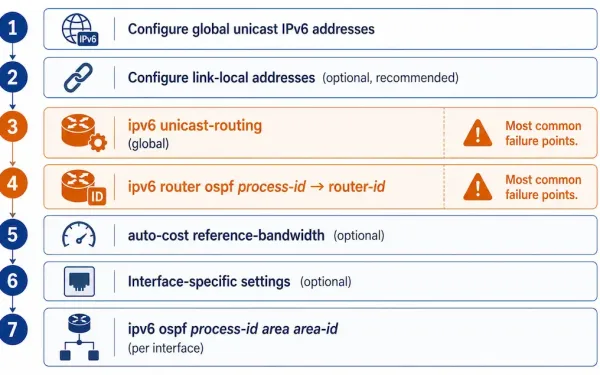
How to Configure OSPFv3: Complete Guide
Figure 1 shows the reference topology for this guide: Router1 through Router4, connected via a mix of GigabitEthernet, FastEthernet, and Serial interfaces. This walkthrough configures OSPFv3 on Router1 step by step; assume Router2, Router3, and Router4 already have their global IPv6 and link-local addresses configured. This topology is IPv6-only, no dual-stack, to keep the focus...
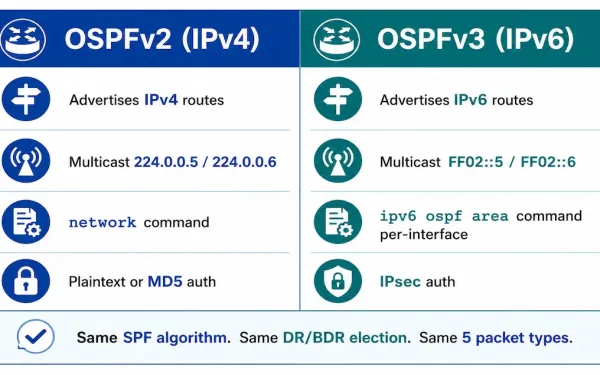
OSPFv2 vs OSPFv3: Key Differences and Similarities
OSPFv3 is a routing protocol for IPv6, just as OSPFv2 is for IPv4. While both share core principles, there are vital differences in their operation. OSPFv3 serves as the IPv6 equivalent to OSPFv2 for exchanging prefixes, making it essential for modern networks handling dual-stack environments. In IPv6, the network address is referred to as the...
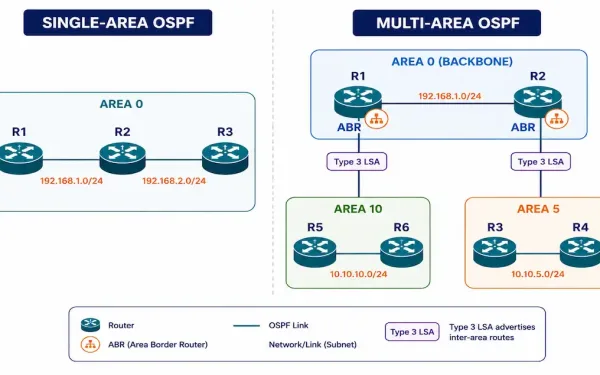
Single-Area OSPF vs. Multi-Area OSPF
Open Shortest Path First (OSPF) is a link-state routing protocol widely used in enterprise IP networks for its efficiency and scalability. Unlike distance-vector protocols like RIP, OSPF uses a hierarchical design, segmenting networks into areas to optimize routing. Each area consists of routers sharing identical Link-State Databases (LSDBs), containing topology information. For CCNA and CCNP...
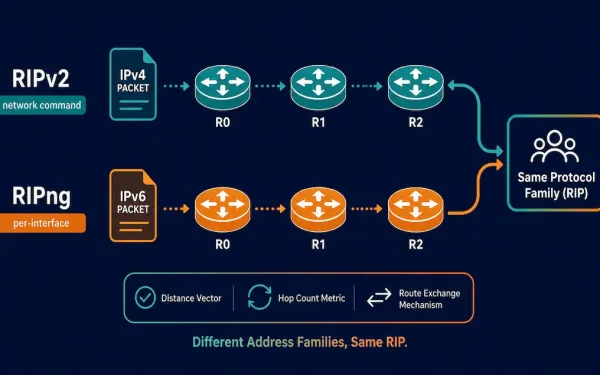
RIPng Configuration: Advertising IPv6 Networks with RIP Next Generation
RIPng (RIP Next Generation) is the IPv6 adaptation of RIP, defined in RFC 2080. It’s a distance-vector protocol that keeps RIP’s core simplicity — hop count as the metric, a 15-hop maximum, periodic updates — while adapting the protocol’s mechanics for IPv6 addressing. This guide covers how RIPng differs from RIPv2, how to configure it,...
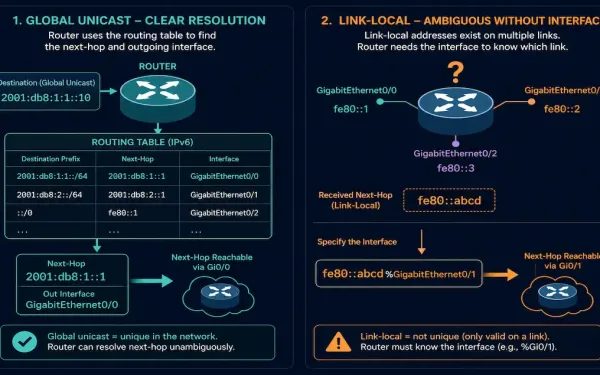
The IPv6 Route Next-Hop Option: Global vs. Link-Local, Explained
Configuring a static IPv6 route looks almost identical to configuring a static IPv4 route — but IPv6 has one real syntax wrinkle that trips up a lot of people moving from IPv4: whether the next hop needs an interface specified alongside it depends entirely on whether that next hop is a global unicast address or...