Routing Protocols

Where Bandwidth Lives in the Routing Table Decision
Bandwidth metric underpins routing decisions and QoS guarantees. This article covers EIGRP composite calculation, OSPF cost, BGP limitations, and CLI troubleshooting — essential for CCNA through CCIE.
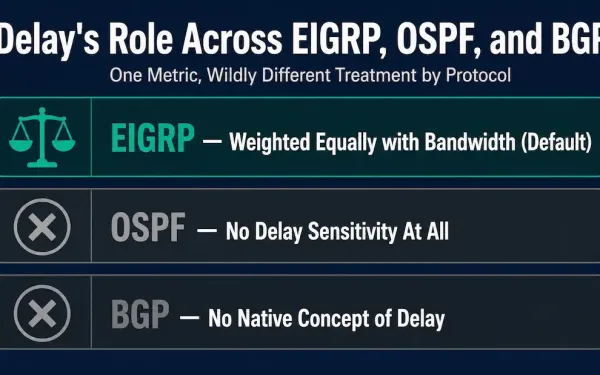
Delay Metric: How Routing Protocols Actually Use It
Delay measures the time it takes for a packet to traverse a path, and it plays a very different role depending on which routing protocol is doing the measuring. EIGRP weighs delay directly in its composite metric by default. OSPF’s cost calculation, by contrast, is purely bandwidth-based and doesn’t factor in delay at all. This...
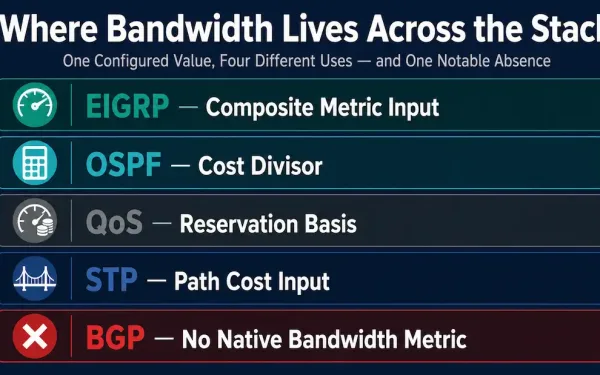
Bandwidth Metric: How Routing Protocols and QoS Use It
A network engineer stares at a traceroute that defies logic — traffic flows across a 10 Mbps satellite link while a 1 Gbps fiber path sits idle. The root cause isn’t a hardware fault. It’s a misconfigured bandwidth metric. Across every major routing protocol and QoS framework, the bandwidth metric quietly dictates which path packets...
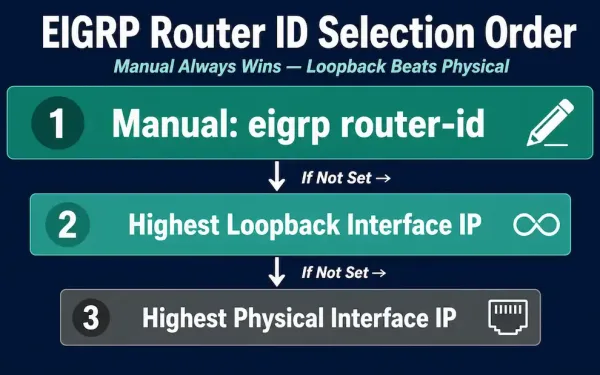
EIGRP Router ID: Selection Rules and Configuration
An EIGRP router ID is a 32-bit unique identifier assigned to each router in the EIGRP domain, represented in the same dotted-decimal format as an IPv4 address. This guide covers exactly how EIGRP selects a router ID automatically, how to configure one manually, a genuinely useful “sticky” behavior that catches people off guard when they...
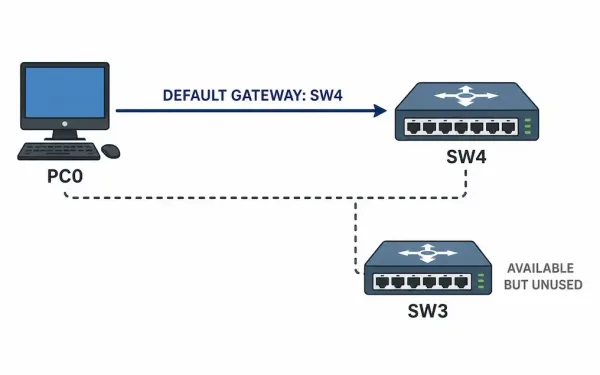
Default Gateway Limitations: Why One Static Gateway Isn’t Enough
A host doesn’t route. It knows its own subnet, and for everything outside that subnet, it sends traffic to exactly one configured address: its default gateway. That single point of dependency is the limitation this article covers — and understanding it is what motivates every First Hop Redundancy Protocol (FHRP) that exists, from HSRP to...
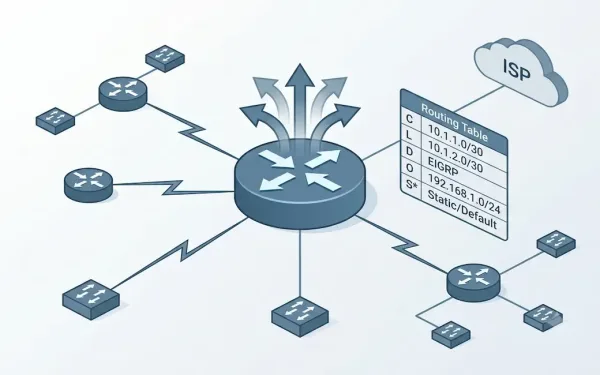
What is a Routing Table – Explained
Routing tables are the backbone of IP networking, guiding routers in forwarding data packets to their intended destinations efficiently. For CCNA and CCNP students, mastering routing tables is essential, as they form a core component of Cisco certification exams and real-world network administration. A routing table contains critical information about network paths, including directly connected...
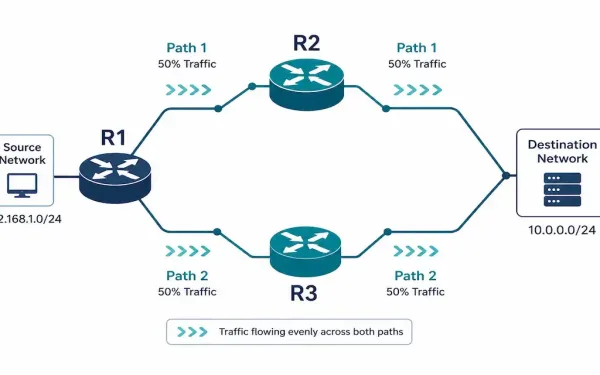
Network Load Balancing: Equal-Cost and EIGRP Unequal-Cost Routing
When a router has more than one valid path to the same destination, it needs a way to decide what to do with all of them — use only the best one, or spread traffic across several. That decision is network load balancing, and understanding exactly how routers make it, right down to which paths...