
Network engineers know that when a system runs without monitoring it typically fails quietly, then all at once. Latency creeps up for weeks before anyone notices. Disk usage climbs steadily until the night it hits 100%. Packet loss hides in the noise until a customer calls. The entire discipline of systems administration is built on a single premise — you do not wait for the outage, you watch the trend and intervene before it becomes one.
It is one of the more curious blind spots in a technical career that this instinct almost never gets turned inward. The same person who would never run production infrastructure without dashboards, alerting, and baseline metrics will go a decade without ever measuring their own grip strength, body composition, or cardiorespiratory fitness. Finding the best personal training studio in Singapore can be one practical way to bring that same culture of monitoring and measurable improvement into your own physical health. The body is the one system in a network engineer’s life that gets zero monitoring, and it is arguably the system with the highest cost of failure.
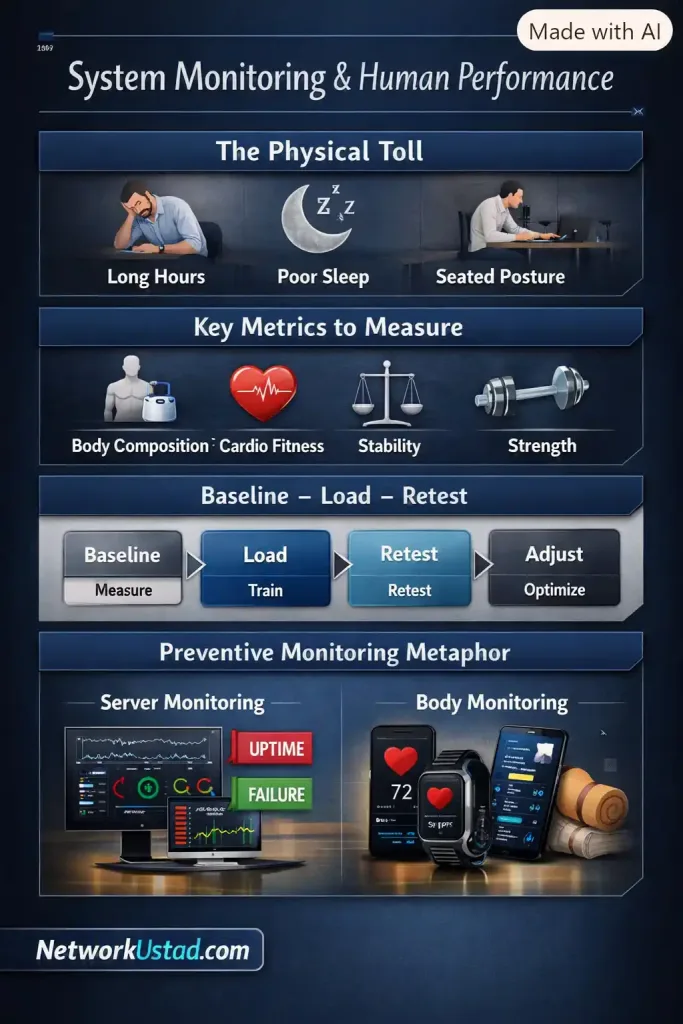
The Physical Toll of a Career Spent Behind the Console
The job has a physical signature that most people in it never stop to name. Long seated hours stacked across shift patterns. Sleep that gets rearranged around migrations, patch windows, and 3 a.m. incident calls. Meals that fit around whatever gap exists in a maintenance window rather than around actual hunger. None of this is dramatic on any single day. It becomes a problem only when you add years to it.
What makes this especially easy to miss is that the effects rarely announce themselves with a clear signal. There is no single moment where a network engineer notices they have lost strength or endurance the way they would notice a server going down. Instead, capacity erodes a little at a time, and by the time it is obvious, it has usually been mislabeled as
something else entirely — usually as “just getting older.” A meaningful share of that decline is not age. It is the compounding effect of years spent sitting, sleeping poorly, and never loading the body in any structured way.
The Trend Line Nobody Is Graphing
If you applied the same monitoring mindset used in infrastructure work to the human body, four figures would show up as flashing red on any dashboard.
Muscle mass starts declining in your thirties
Skeletal muscle mass begins a gradual decline from roughly the fourth decade of life onward, and it does not reverse on its own. Without deliberate resistance loading, that decline continues quietly for decades, and it accelerates with age rather than levelling off.
Grip strength is a cheap but powerful predictor
Grip strength is one of the least expensive measurements available, and it tracks closely with functional capacity decades down the line. It is a proxy for overall strength reserve, and a weakening grip in your forties or fifties is a genuine early warning sign, not a trivial detail.
Cardiorespiratory fitness fades without a symptom
Cardiovascular fitness declines steadily with inactivity, and it typically produces no obvious day-to-day symptom until the moment something actually demands it — a flight of stairs, a sprint for a train, a physically demanding weekend. By then, the deficit has usually been building for years.
None of these three trends is dramatic when measured over a single quarter. That is precisely the failure mode that monitoring exists to catch elsewhere in a network engineer’s professional life. A slow drift that nobody is graphing is exactly the kind of problem that turns into a much bigger one, later, without warning.
What the Data Actually Shows: The Activity Paradox
Population-level data illustrates the gap between being active and being strong. In cities with strong public transport and walkable infrastructure, data often shows a large majority of residents technically meeting physical activity guidelines — frequently in the 80 percent range — while only a small fraction of that activity, sometimes under a quarter, comes from deliberate leisure-time exercise. The remainder is largely incidental movement: commuting, walking between meetings, daily errands.
This produces a group of people who are, on paper, active — hitting national activity guidelines through the walk to a train station and back — while still losing muscle mass and cardiorespiratory capacity every single year. Walking is movement, and movement is genuinely valuable. But walking is not a load, and the body only adapts and strengthens in response to load. A network engineer who walks ten thousand steps a day and never does anything resembling resistance training is still on the same downward trend line as someone fully sedentary — just moving along it slightly more slowly.
Four Metrics Worth Measuring on Yourself
If you would not run production infrastructure on guesswork and gut feeling, there is no good reason to run your own body that way either. Four measurements carry most of the useful signal, and every one of them can be objectively tested rather than estimated.
1. Body composition, not scale weight
Scale weight hides the number that actually matters. Muscle and fat can move in opposite directions at the same time — someone can lose fat and gain muscle and see almost no change on the scale, while someone else can lose weight that is mostly muscle and call it progress. Body composition testing separates the two and tells you what is actually changing.
2. Cardiorespiratory fitness, tested consistently
A sub-maximal fitness protocol, repeated identically each time, lets you compare like with like across months instead of guessing based on how a workout felt. Consistency of method matters more than the specific test chosen — what you want is a number you can trust to move honestly over time.
3. Stability
Stability is the metric almost no general fitness programme ever tests, and it is quietly one of the most important predictors of how well someone moves decades from now. Poor stability does not show up as a problem at thirty-five. It shows up as falls, injuries, and lost independence much later — and by then it is far harder to rebuild.
4. Strength, measured directly
Strength should be tested, not inferred from what you used to be able to lift, what you assume you can still do, or how your job “keeps you active.” A direct strength assessment removes the guesswork and gives you an honest number to build a programme against.
Take a baseline reading on all four. Write the numbers down somewhere durable — not memory, an actual record — and repeat the same four tests after a fixed period. That is the entire method. It is not complicated, and it is still more than the overwhelming majority of technical professionals ever do for themselves.
Why the Retest Date Matters More Than the Plan
Almost any training plan looks reasonable on the first day. The real difference between a plan that produces results and one that simply fills a calendar only becomes visible when you retest against the original baseline.
Set the retest date before you begin, not once motivation starts to fade. Sixteen weeks is a useful default — long enough to produce a real, measurable change in body composition, cardiorespiratory fitness, stability, and strength, and short enough that it stays interesting rather than becoming an abstract, distant goal. Put that date in a calendar with the same seriousness given to a planned change window, because the actual purpose of the exercise is to find out, with evidence, whether the intervention worked — not to feel busy or virtuous about having “done something.”
If the numbers move in the right direction, the plan is validated and the sensible move is to continue it. If one of the four pillars does not move, that is not a failure — it is information, and it tells you precisely what needs to change in the next cycle. Both outcomes are genuinely useful. The only outcome that produces nothing of value is never testing at all and simply hoping the plan is working.
Fitting Training Around an On-Call Schedule
A realistic version of this for someone carrying a pager, rotating through on-call weeks, or working irregular shift patterns is two to three structured sessions a week, each built around compound, multi-joint movements rather than high training volume or long sessions. Compound lifts give the most return per minute spent, which matters enormously when time is the scarcest resource in the week.
Consistency matters far more than intensity in this context. The real failure mode for a network engineer is rarely a single bad or skipped session — it is three weeks lost entirely to a major incident, followed by never quite restarting afterward. A programme that assumes a technologist’s schedule will always cooperate is a programme built to fail during the exact weeks it is needed most.
Protect sleep wherever it is genuinely possible to do so, and accept that during a migration week or a major incident, the realistic goal is maintenance rather than progress. Maintenance is a legitimate, deliberate training goal in its own right — the mistake is not choosing to maintain during a hard week, it is failing to notice that a maintenance week has quietly turned into a maintenance quarter.
Choosing a Personal Training Studio That Measures Before It Prescribes
For technical professionals who want this approach run properly rather than improvised week to week, the standard worth applying to any personal training studio is simple: does it measure the four pillars — body composition, cardiorespiratory fitness, stability, and strength — before writing a programme, and does it commit to a fixed retest date to check whether that programme actually worked?
A studio that cannot tell you what it measures, or that skips straight to handing out a generic programme on day one, is effectively asking a client to take the outcome on faith — the exact opposite of the evidence-based approach a network engineer would insist on for any other system they were responsible for. In Singapore, Catalyst Performance, based at Manulife Tower on 8 Cross Street in the city centre, structures its programmes around this exact model: every member is scored on the same four pillars before training begins, with the process overseen by Dr Luqman Haris, MBBS, and progress checked against a fixed retest date rather than left to guesswork.
A Real-World Pattern: The 2 a.m. Incident and the 2 p.m. Slump
Anyone who has worked a genuine on-call rotation recognises the pattern even if they have never named it. A page comes in at 2 a.m. The incident resolves by 4. The next morning’s stand-up still happens at 9, and by early afternoon there is a wall — not a mild dip in focus but a full stall, the kind that used to be manageable in your twenties and somehow is not anymore in your late thirties. Most engineers file this under “getting older” and reach for more coffee. Very few connect it back to declining cardiorespiratory fitness, poor sleep architecture, and a body that has spent years being fed convenience food during maintenance windows rather than anything resembling recovery-oriented nutrition.
This is not a call to eliminate on-call work or pretend irregular hours can be engineered away — for most technologists, they cannot. It is a reminder that the recovery capacity to absorb those disruptions is not fixed. It is trainable, and it degrades in exactly the same slow, unmonitored way as the four metrics covered above when nothing is done to maintain it.
The Cost of Treating the Body Like Unmonitored Legacy Infrastructure
Every network engineer has inherited at least one piece of legacy infrastructure nobody wanted to touch — undocumented, unmonitored, running on borrowed time, and quietly becoming more expensive to fix with every year that passes without intervention. Left unmanaged long enough, a body follows the same trajectory. Small, unaddressed issues compound. What would have been a straightforward fix at thirty-five becomes a much larger, slower, and more expensive project at fifty.
The financial parallel holds up surprisingly well. Preventive monitoring in infrastructure exists because catching a failing disk before it dies is dramatically cheaper than an unplanned outage, a data recovery effort, and the reputational cost that follows. Preventive health monitoring works on the same economics. A structured strength and mobility programme in your late thirties or forties is a fraction of the cost — in money, time, and quality of life — of rehabilitating a back injury, managing a preventable metabolic condition, or losing independence decades later because stability and strength were never trained when there was still time to build them.
A Simple Framework: Baseline, Load, Retest
Reduced to its essentials, the entire approach mirrors a change-management process any systems administrator would already recognise.
| Stage | What It Looks Like |
| Baseline | Test body composition, cardiorespiratory fitness, stability, and strength. Record the numbers. |
| Load | Two to three structured sessions a week, built around compound movements, for a fixed period. |
| Retest | Repeat the exact same four tests on a pre-set date, typically around sixteen weeks later. |
| Adjust | Keep what moved the numbers. Change what didn’t. Repeat the cycle. |
There is nothing exotic about this framework. Its entire value comes from actually running it rather than skipping straight to the load stage, which is what almost everyone in a demanding technical career defaults to — jumping into a programme with no baseline and no fixed point of evaluation, then quietly abandoning it a few months later without ever knowing whether it was working.
Start With the Baseline
None of this requires an overhaul of a network engineer’s life, and it does not require becoming someone who lives in a gym. It requires the same discipline already applied every working day to servers, networks, and infrastructure: establish a baseline, apply a deliberate intervention, and retest on a fixed schedule to see whether it actually worked.
The body does not send an alert when it starts to fail. There is no dashboard, no threshold breach notification, no on-call page. The only way to catch the slow drift before it becomes a real problem is to start measuring it — and the best time to take that first baseline reading is before the next incident, not after.
Frequently Asked Questions
Why do IT professionals lose fitness even when they feel “active enough”?
What is the single cheapest health metric a network engineer can track?
How often should the four fitness pillars be retested?
Can someone on an unpredictable on-call schedule still train effectively?
What should a good personal training studio measure before writing a programme?
Disclaimer
This article is for general informational purposes only and is not medical advice. Readers with existing health conditions, injuries, or concerns about starting a new training programme should consult a qualified physician before beginning any fitness regimen.