
An employee-centric work culture isn’t a perk program bolted onto an existing management style — it’s a shift in what gets measured and rewarded in the first place. Most companies still default to tracking hours, meeting attendance, and visible busyness, even though none of those things reliably predict whether real work is getting done. The gap between what gets rewarded and what actually produces results is exactly where burnout, disengagement, and quiet quitting tend to take root, and closing that gap is what an employee-centric work culture is actually trying to do.
Why Employee-Centric Work Culture Matters More Than Ever
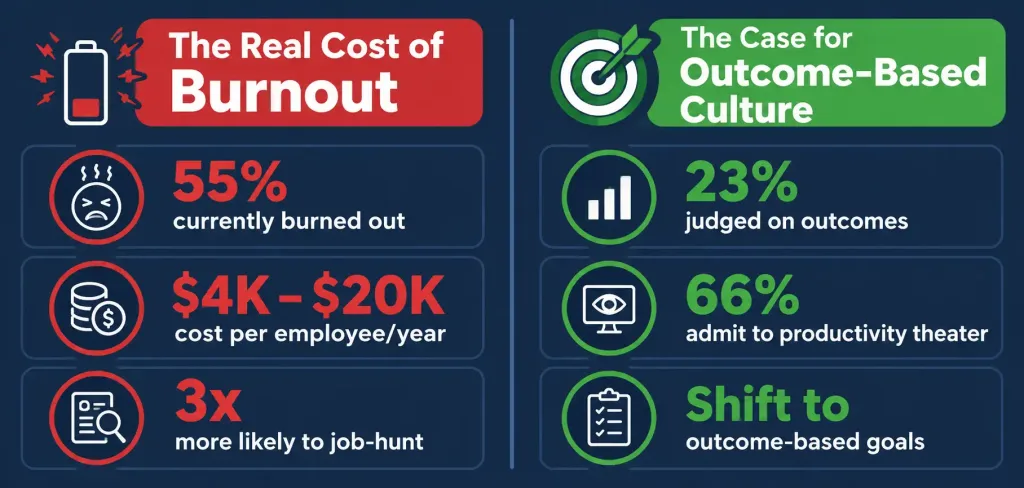
The case for this isn’t abstract — current workplace research shows the cost of getting it wrong. A 2025 Eagle Hill Consulting workforce survey found 55% of US employees currently experiencing burnout, a six-year high, and separate research from the American Psychological Association found 67% had experienced at least one burnout-associated symptom in the past month. The remote and hybrid connection is notable for any company building a distributed or flexible workforce specifically: Eagle Hill’s data shows 61% of fully remote and 57% of hybrid employees reporting burnout, both higher than on-site workers.
This isn’t just a wellbeing issue — it’s a measurable cost. Research published in the American Journal of Preventive Medicine estimates burnout costs employers roughly $4,000 per non-manager employee, $10,824 per manager, and $20,683 per executive annually, working out to about $5 million a year per 1,000 employees. Burned-out employees are also roughly three times more likely to be actively job-hunting within the next year, according to Eagle Hill’s research — which turns a wellbeing problem directly into a retention and hiring-cost problem.
The “Productivity Theater” Problem
A 2025 Connext Global survey of 1,000 full-time US employees put a name to something many managers suspect but rarely measure directly: “productivity theater,” meaning the optics of working rather than the work itself. The survey found 66% of employees admit to some form of it — staying visibly late, taking on extra tasks mainly to be noticed, or otherwise performing busyness rather than focusing purely on output. Separately, 64% of respondents said visibility is at least sometimes rewarded over actual results, and only 23% said their performance is judged against clear, outcome-based metrics.
That gap matters for any company trying to build a genuinely employee-centric work culture, because it reveals a mismatch between stated values and actual incentives. If a company says it values results but its management behavior visibly rewards hours and visibility instead, employees respond rationally by optimizing for what’s actually measured — which is productivity theater, not better output. Fixing that mismatch is a management and measurement problem first, and only secondarily a tooling problem.
Restoring Real Work-Life Balance, Not Just Stating It as a Value
A stated commitment to work-life balance means little if deadline pressure routinely overrides it in practice. Concretely, that means holding to set working hours even as deadlines approach, rather than treating crunch time as an unstated expectation, and being explicit that weekend availability isn’t a quiet requirement for being seen as a committed employee. Companies that say they value balance but consistently reward after-hours responsiveness are sending a contradictory signal that employees notice quickly — and that contradiction is itself a driver of the burnout numbers above.
Paying Attention to When Employees Actually Work Best
Not every team member does their best work on the same schedule, and an employee-centric approach treats that as useful information rather than a scheduling inconvenience. Where teams track general activity patterns (not surveillance-level monitoring, but general availability and focus-time patterns), that data is genuinely useful for scheduling meetings outside employees’ typical deep-work windows rather than fragmenting their most productive hours with recurring check-ins that could be asynchronous updates instead.
Setting Outcome-Based Expectations Instead of Hours Tracking
This is the structural fix for the productivity-theater problem described above: shifting what actually gets measured and rewarded from hours and visibility to defined outcomes. In practice, that means:
- Reducing low-value synchronous overhead — unnecessary status meetings, excessive notification-driven chat culture, and recurring check-ins that could be a two-line async update instead.
- Defining success by outcome, not activity. A clear deliverable with a clear deadline, evaluated on whether it was delivered well, rather than on how many hours or how much visible activity went into it.
- Making recognition follow results, not responsiveness or after-hours availability — directly addressing the Connext finding that managers are currently seen as rewarding speed and visibility (45%) more than actual results (40%) or original thinking (30%).
- Keeping performance targets stable. The same research found 55% of employees report their goals shift at least occasionally, and 42% say unclear or moving targets specifically drain motivation — a fixable problem through clearer goal-setting processes, not more tooling.
Choosing a Tool to Support an Employee-Centric Work Culture, Not Undermine It
Project and task management software can genuinely support an employee-centric culture, or quietly work against it, depending entirely on what it’s configured to surface. A tool that only shows project-completion percentages and deadline countdowns reinforces the same hours-and-visibility dynamic described above. A tool that surfaces workload distribution across a team, flags when the same person is consistently overloaded, and lets outcomes get tracked against defined goals rather than logged hours is doing something structurally different — it’s making the outcome-based approach measurable and visible to managers, not just an aspiration.
Rather than naming a single “best” tool — since the right fit genuinely depends on team size, existing workflow, and budget — a more useful approach is evaluating any candidate against specific questions:
- Does it surface workload balance across the team, or only individual task status? A tool that only shows task completion per person misses the team-wide view needed to catch burnout risk before it shows up in attrition numbers.
- Can success be tracked against outcomes rather than just deadlines? Look specifically for the ability to define and track deliverable quality or goal completion, not just whether a task was closed on time.
- Does it reduce meeting and notification overhead, or add to it? A tool that generates more status-update pings than it eliminates is working against the “reduce low-value overhead” goal above, regardless of its other features.
- Is it something the team will actually use consistently? The most feature-rich tool provides no benefit if adoption is inconsistent — running a short pilot with the actual team before a full rollout is a more reliable signal than a features comparison alone.
Warning Signs a Company’s “Employee-Centric” Language Is Just a Slogan
A few recurring patterns separate a genuine employee-centric work culture from one that only uses the phrase in a values document or careers page:
- Recognition consistently follows visibility, not results. If the employees who get praised in team meetings are reliably the ones who respond fastest after hours rather than the ones who shipped the hardest work, the stated values and the actual incentives have diverged — and employees notice the gap quickly, usually faster than management does.
- Performance goals shift without explanation. Current survey data found 55% of employees report their targets change at least occasionally, and nearly half of those say the instability itself is what drains motivation — not the difficulty of the goals, but the unpredictability of what’s actually being measured.
- Wellbeing initiatives exist alongside unchanged workload expectations. A wellness stipend or an optional meditation app doesn’t offset a culture where deadlines routinely require after-hours work; employees generally read the mismatch as performative rather than substantive.
- Managers themselves show signs of strain. Research on workplace burnout consistently finds manager-level burnout running higher than entry-level burnout, which tends to cascade directly into how teams below them are managed, whatever the official culture documents say.
- Tooling tracks activity, not outcomes. A project management system configured to highlight logged hours, message responsiveness, or task-completion counts — rather than the quality or impact of what got delivered — quietly reinforces exactly the dynamic an employee-centric culture is supposed to move away from.
Spotting these patterns early is more useful than waiting for attrition data to confirm a problem that was already visible in day-to-day management behavior. None of these signs alone proves a culture isn’t employee-centric — a single shifted deadline or one visible late night isn’t evidence of a pattern — but when several of them show up consistently across a team, they’re a reliable early indicator worth addressing directly with managers rather than leaving for an annual engagement survey to eventually surface.
A Practical Starting Point for Teams Building This Out
For a team or company genuinely trying to shift toward an employee-centric work culture, a reasonable sequence looks like this: start by auditing what’s currently actually rewarded in practice, not just what’s stated in a values document — ask several employees directly what gets noticed and praised day to day. Then identify the specific low-value synchronous overhead (meetings that could be async updates, status pings that don’t change any decision) and cut it deliberately rather than gradually.
Finally, build outcome-based goals into the next review cycle explicitly, with stable targets communicated clearly, rather than leaving the shift as an informal cultural aspiration that managers interpret inconsistently. It’s worth treating this as an ongoing process rather than a one-time policy change — a genuinely employee-centric work culture holds up only if managers are evaluated on whether they actually practice it, not just whether it appears in onboarding materials.
The Bottom Line
An employee-centric work culture isn’t built through perks or a mission statement — it’s built by changing what managers actually measure and reward, closing the gap between stated values and daily incentives that drives the “productivity theater” dynamic current research keeps finding across the workforce. The burnout and retention numbers make the business case directly: a culture that rewards visible busyness over real outcomes is measurably more expensive to run than one that doesn’t.
Frequently Asked Questions
What does “employee-centric work culture” actually mean in practice?
It means a company’s actual management behavior — what gets measured, recognized, and rewarded — centers on real outcomes and employee wellbeing rather than hours worked or visible busyness. It’s distinct from stated values; current survey data shows a persistent gap between companies that say they value results and the behavior that actually gets rewarded day to day.
How common is workplace burnout right now?
Current research puts active burnout at roughly 55% of US employees (a six-year high per Eagle Hill Consulting’s 2025 survey), with 67% reporting at least one burnout-associated symptom in the past month according to APA research — and remote and hybrid employees report somewhat higher rates than fully on-site workers.
What is “productivity theater”?
It’s the practice of performing visible busyness — staying late, taking on extra visible tasks, fast chat responses — rather than focusing purely on actual output. A 2025 Connext Global survey found 66% of employees admit to some form of it, largely because visibility is often rewarded over measurable results in practice.
Does burnout actually cost companies money, or is it mainly a wellbeing issue?
Both — research published in the American Journal of Preventive Medicine estimates burnout costs employers thousands of dollars per affected employee annually in reduced productivity and turnover risk, and burned-out employees are roughly three times more likely to be actively job-hunting within a year.
What should a company look for in project management software to support this shift?
Tools that surface team-wide workload balance (not just individual task status), support tracking success against defined outcomes rather than just deadlines, and reduce rather than add meeting and notification overhead. The best fit depends on team size and existing workflow, which is why piloting with the actual team matters more than picking based on a features list alone.
Is outcome-based management the same as remote-work-friendly management?
They’re related but not identical. Outcome-based management can work in any setting, but it matters especially for remote and hybrid teams, where hours-based or visibility-based evaluation is harder to apply fairly and where burnout rates are currently somewhat higher than for on-site employees.