Muhammad Khattak
Routing and switching specialist, CCNA certified, with extensive experience in network configuration and troubleshooting. Covers OSPF, EIGRP, VLAN management, and advanced routing concepts.
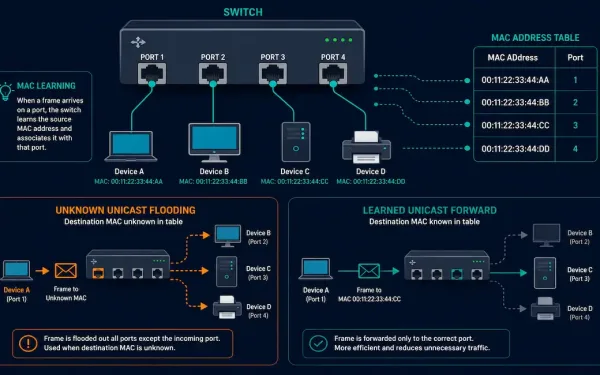
Switching Fundamentals: MAC Address Tables and Frame Forwarding Methods
An Ethernet switch is a Layer 2 device, which means it makes every forwarding decision based on MAC addresses, entirely unaware of what protocol is actually carried inside the frame’s payload, whether that’s an IPv4 packet, an IPv6 packet, or something else entirely. This guide covers exactly how a switch builds and uses its MAC...
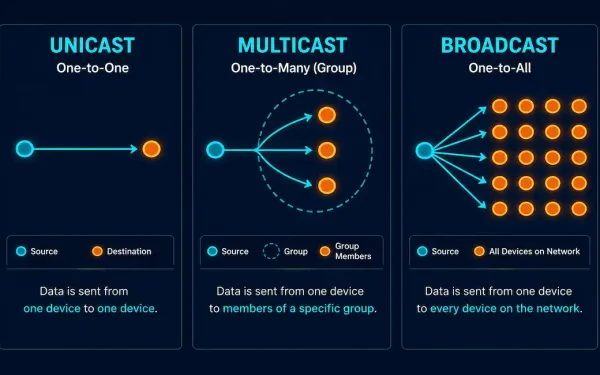
Unicast, Multicast, and Broadcast Addresses Explained
Every packet on a network needs a way to specify who should receive it. Networks handle this through three distinct address types: unicast for one-to-one delivery, multicast for one-to-a-group delivery, and broadcast for one-to-everyone delivery. This guide covers exactly how each one works at both the IP and MAC address level, and where you’ll actually...
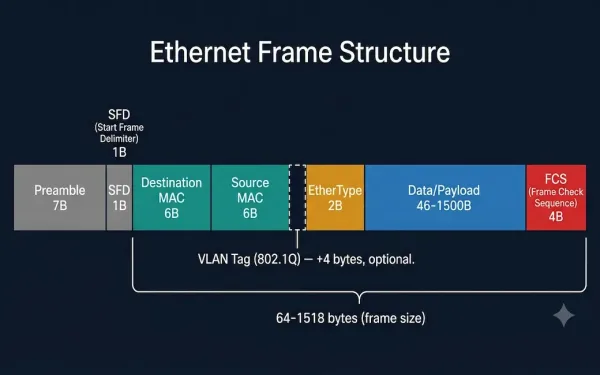
Ethernet Frame Structure: IEEE 802.3 and Ethernet II Fields Explained
The Ethernet frame structure is the backbone of wired networking, enabling reliable data transfer across everything from small office LANs to hyperscale data centers. This guide explores each component of an Ethernet frame, their exact byte sizes, their roles, and how VLAN tagging extends the basic structure for modern segmented networks. Overview of Ethernet Frame...
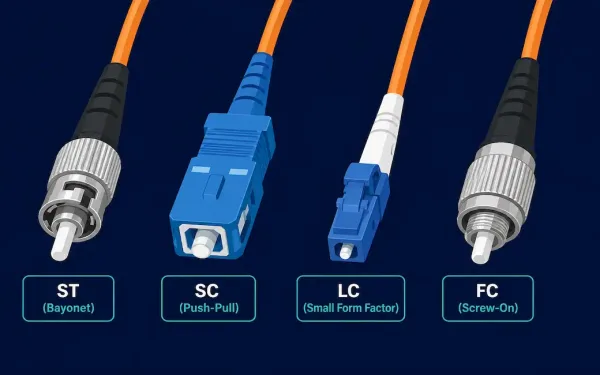
Fiber Optic Connectors Explained: ST, SC, LC, and FC Types
Fiber optic connectors terminate the ends of an optical fiber and let it plug into a port, patch panel, or another fiber run. Dozens of connector types exist, but the differences that actually matter for day-to-day work come down to three things: ferrule size, mating mechanism, and how much loss the connector introduces at the...
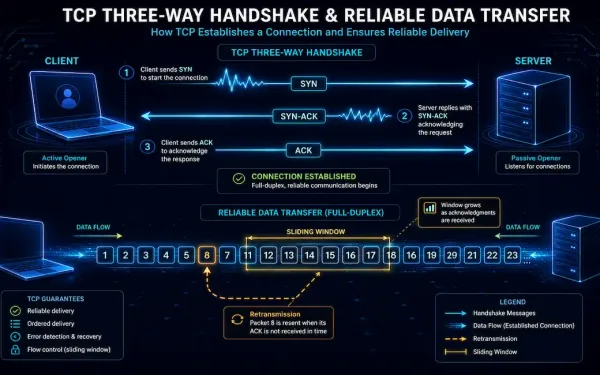
Transmission Control Protocol (TCP) Explained
Transmission Control Protocol, TCP, is a transport-layer protocol in the OSI model. It’s what actually creates a reliable connection between two remote computers, guaranteeing that data sent from one side arrives at the other, intact and in order. When the application layer has data to send, it hands that data down to the transport layer,...