
Networking
CCNA tutorials, Cisco guides, and enterprise networking insights for IT professionals.
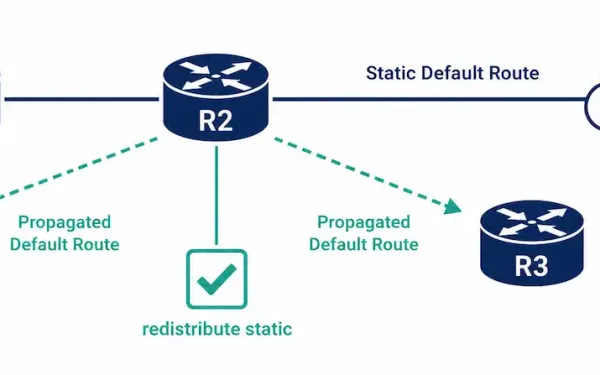
How to Propagate the Default Static Route Using EIGRP
A default route configured on one router doesn’t automatically become known to every other router in the network — static routes and dynamic routing protocols are separate systems by default, and bridging them requires a deliberate redistribution step. This is exactly the case with an EIGRP domain’s internet gateway: without redistribution, only the gateway router...
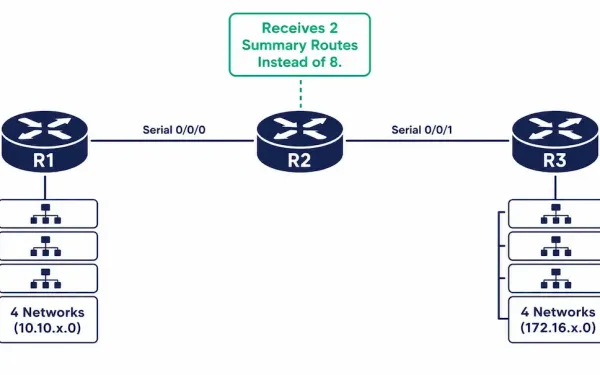
How to Configure EIGRP Manual Summary Routes
Route summarization lets a router advertise one compact route instead of several individual ones, cutting routing table size and update bandwidth without losing actual reachability. EIGRP supports this manually, independent of whether auto-summary is enabled, since EIGRP is a classless protocol that carries subnet mask information in every update it sends. This guide covers how...
NTS- Pakistan Studies Test-1
The National Testing Service (NTS) is a cornerstone of standardized testing in Pakistan, yet its influence and operational nuances remain widely misunderstood. Despite its ubiquity in academic and professional assessments, misconceptions about its processes, validity, and impact persist. A 2026 study by the Pakistan Institute of Education found that 68% of test-takers believe NTS results...
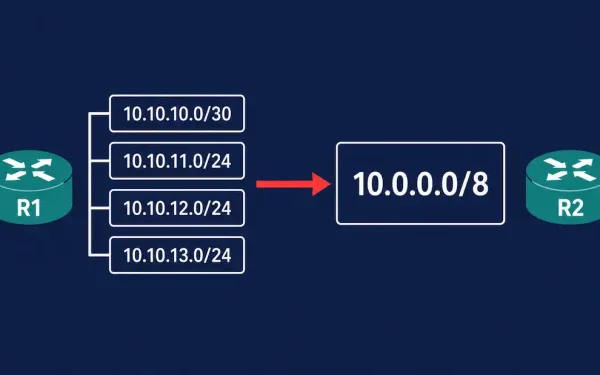
EIGRP Automatic Summarization: How It Works, How to Configure It, and Why It’s Disabled by Default
Route summarization is one of the most effective tuning tools available in EIGRP. Instead of advertising every individual subnet to a neighbor, a router can group several subnets together and advertise them as one summarized route. That single change cuts the number of entries in every downstream routing table and shrinks the size of routing...
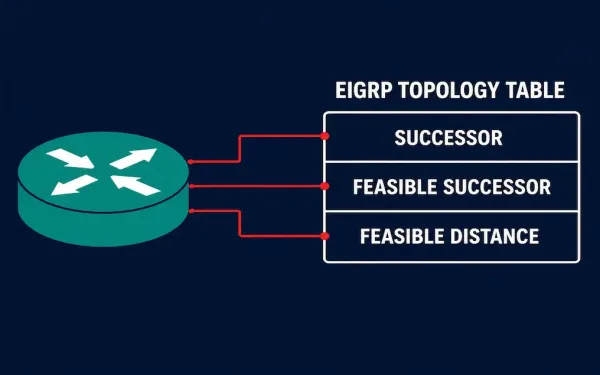
EIGRP Topology Table: The Complete Guide to Successors, Feasible Successors, and DUAL
The EIGRP topology table is the database that separates EIGRP from every distance-vector protocol that came before it. It holds every loop-free route an EIGRP router learns from its neighbors, not just the one it currently uses. That single design choice is why EIGRP can recover from a link failure in milliseconds instead of waiting...
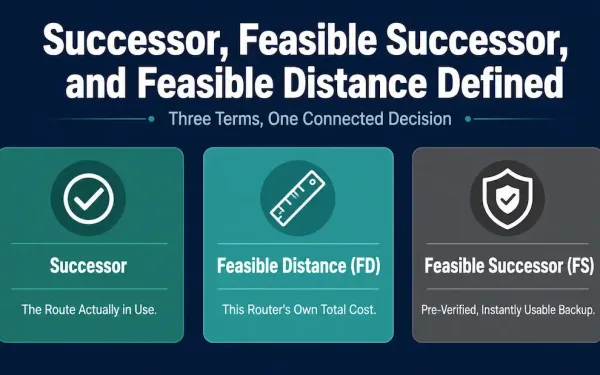
Successor, Feasible Successor, and Feasible Distance
DUAL relies on three closely related concepts to decide which route goes in the routing table and which routes stand ready as instant backups. This guide defines each one precisely, works through a real Feasibility Condition check using the same topology and numbers established in How to Calculate EIGRP Metric, and covers how OSPF’s fundamentally...
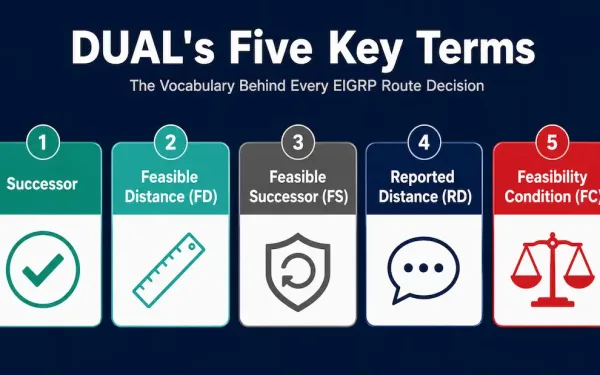
What Is DUAL? EIGRP’s Diffusing Update Algorithm
The Diffusing Update Algorithm (DUAL) is the algorithm EIGRP uses to guarantee loop-free routes and maintain backup paths throughout the routing domain, recalculating a route whenever a change could otherwise introduce a loop. This guide covers what DUAL actually does, corrects a common point of confusion about how EIGRP really prevents loops, and walks through...
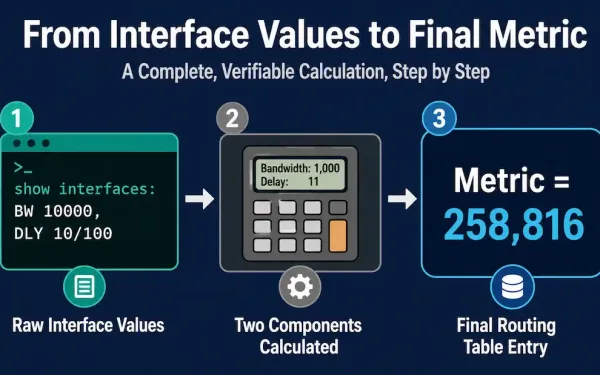
How to Calculate EIGRP Metric: A Worked Example
EIGRP automatically calculates the routing table metric to choose the best path, but understanding exactly how that number gets produced turns an abstract routing table entry into something you can verify by hand. This guide works through a complete, real calculation step by step, using a topology consistent with the rest of this site’s EIGRP...
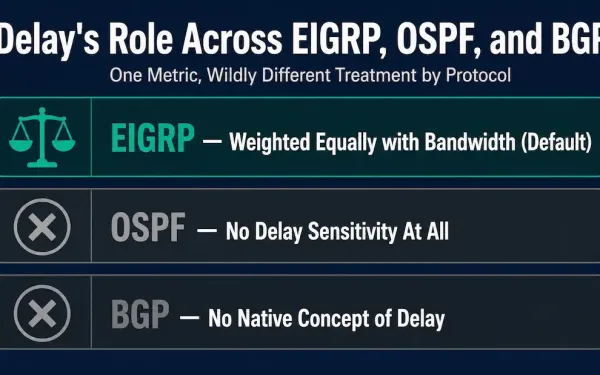
Delay Metric: How Routing Protocols Actually Use It
Delay measures the time it takes for a packet to traverse a path, and it plays a very different role depending on which routing protocol is doing the measuring. EIGRP weighs delay directly in its composite metric by default. OSPF’s cost calculation, by contrast, is purely bandwidth-based and doesn’t factor in delay at all. This...
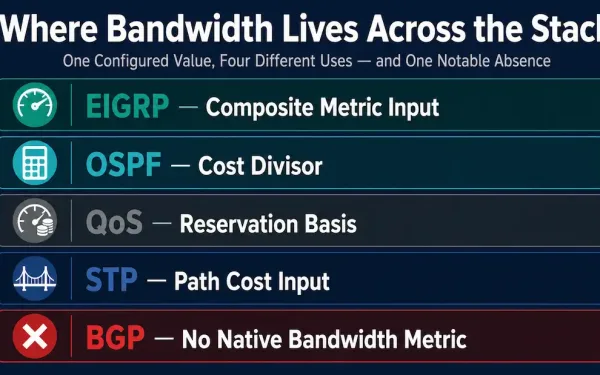
Bandwidth Metric: How Routing Protocols and QoS Use It
A network engineer stares at a traceroute that defies logic — traffic flows across a 10 Mbps satellite link while a 1 Gbps fiber path sits idle. The root cause isn’t a hardware fault. It’s a misconfigured bandwidth metric. Across every major routing protocol and QoS framework, the bandwidth metric quietly dictates which path packets...