Networking
CCNA tutorials, Cisco guides, and enterprise networking insights for IT professionals.
How to Configure OSPF MD5 Authentication
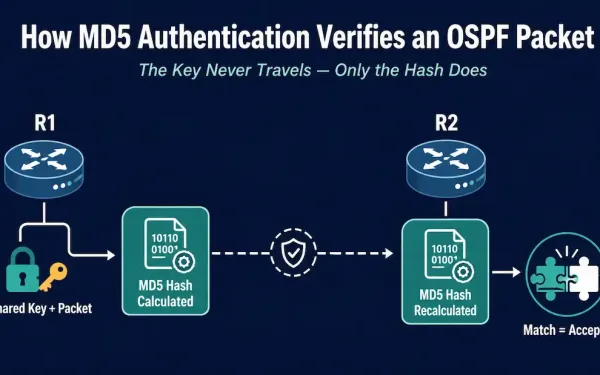
MD5 authentication is OSPF’s long-standing cryptographic option for verifying that routing updates come from a trusted neighbor rather than an attacker or a misconfigured device. This guide covers exactly how MD5 authentication works, the two ways to enable it (area-wide and per-interface), a full worked example including the adjacency drop you’ll see mid-migration, and how...
OSPF Authentication: Configuration, Migration, and Best Practices
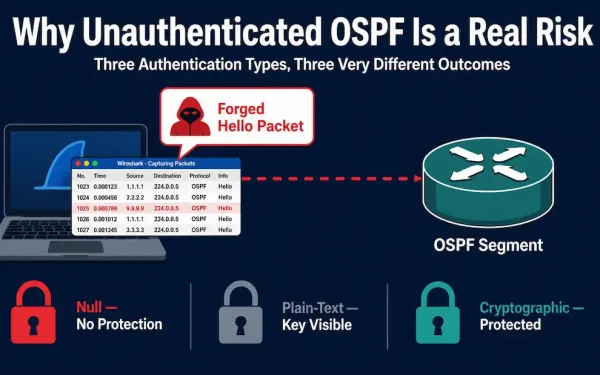
OSPF packets are not encrypted or authenticated by default. Any device on a shared broadcast segment can listen to, replay, or forge Hello and Link-State Advertisement (LSA) packets unless authentication is explicitly configured. This guide covers how OSPF authentication actually works — MD5, the modern HMAC-SHA replacement, vendor configuration differences, common failure modes, and how...
OSPF Hello and Dead Intervals
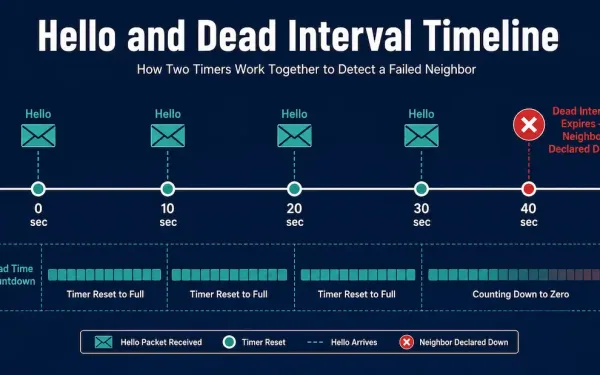
OSPF routers constantly track whether their neighbors are still alive using two timers built into every Hello packet: the Hello interval and the Dead interval. Understanding how these two timers interact — including a genuinely useful Cisco IOS behavior that surprises a lot of people — is essential for both the CCNA exam and real-world...
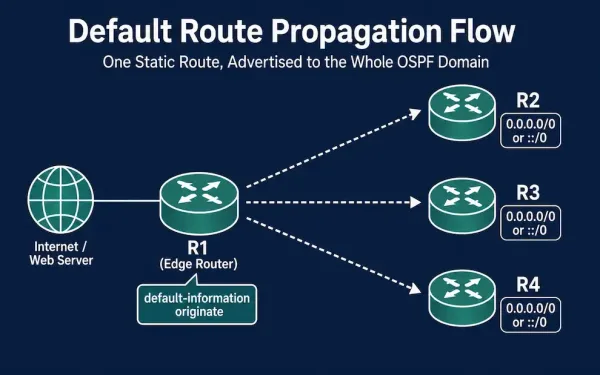
Propagating a Default Static Route in OSPF (OSPFv2 and OSPFv3)
When a network has a single exit point to the internet or another external service, it’s usually more efficient to advertise one default route through that exit point than to inject every specific external route into OSPF. This guide covers how to configure a default static route on an edge router and propagate it through...
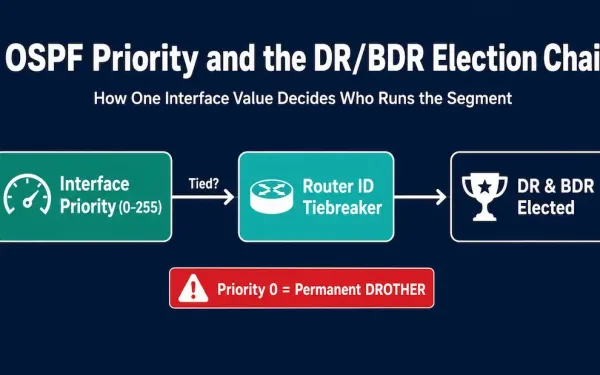
OSPF Priority: DR/BDR Election, Configuration, and Verification
Each broadcast and Non-Broadcast Multi-Access (NBMA) network has a designated router. This router is the central point for collecting and distributing LSAs (Link-State Advertisements), so it must have enough CPU and memory capability to handle the workload. The OSPF priority value is the primary mechanism for controlling which router wins the DR/BDR election on these...
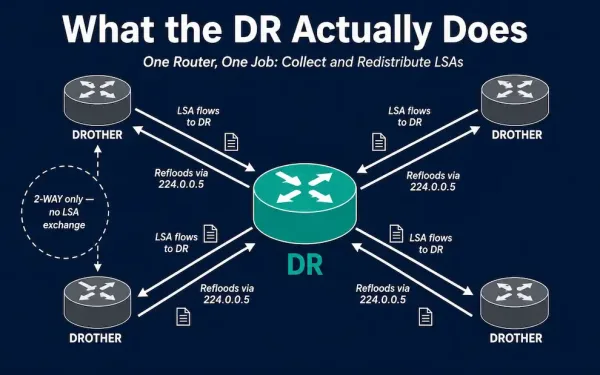
OSPF Designated Router: Role, Election, and a Worked Failure Scenario
The previous article in this series covered the scalability challenges multiaccess OSPF segments face — unnecessary adjacencies and duplicated LSA flooding. The Designated Router (DR) is OSPF’s solution to both problems. This article covers exactly what the Designated Router does, how it and the Backup Designated Router (BDR) are elected, and walks through a complete,...
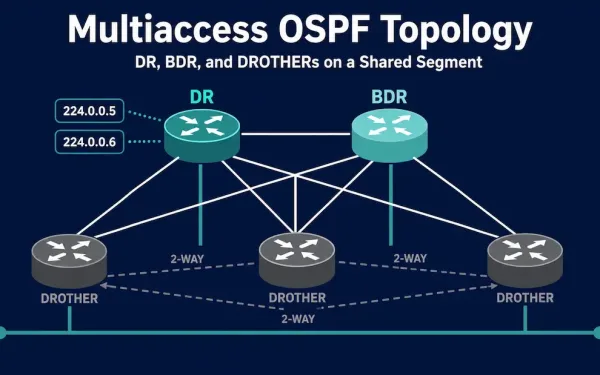
Challenges in Multiaccess OSPF Networks
OSPF operates differently on multiaccess network segments than it does on point-to-point links. When multiple OSPF routers share a single broadcast or non-broadcast segment — such as an Ethernet LAN or a Frame Relay network — adjacency management, LSA flooding, and Designated Router (DR) election introduce challenges that do not exist on simple point-to-point connections....
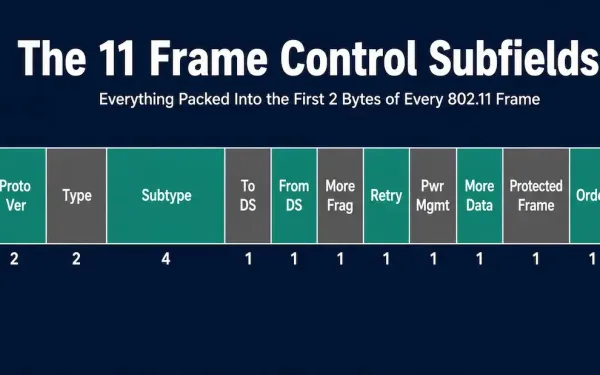
Frame Control Field Format: The 11 Subfields Explained
The Frame Control field is the first two bytes of every 802.11 frame, and it’s arguably the single most important part of the header — it’s what tells a receiving station what kind of frame it’s looking at before anything else gets parsed. This guide breaks down all eleven subfields packed into those 2 bytes...
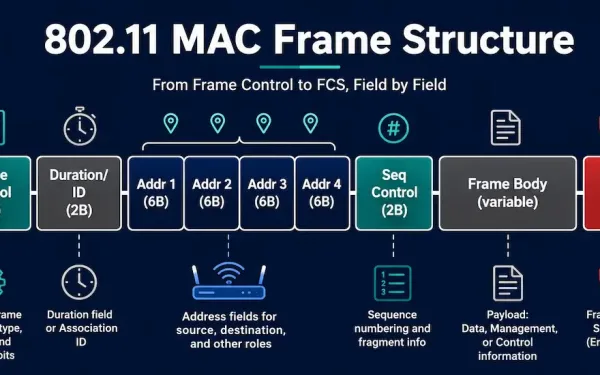
The 802.11 Wireless Frame: MAC Header Fields Explained
Every piece of data that travels over Wi-Fi is wrapped inside an 802.11 frame before it hits the air. Like any Layer 2 frame, an 802.11 frame consists of a header, a payload (frame body), and a Frame Check Sequence (FCS) for error detection. The 802.11 frame format is closely related to the Ethernet frame...
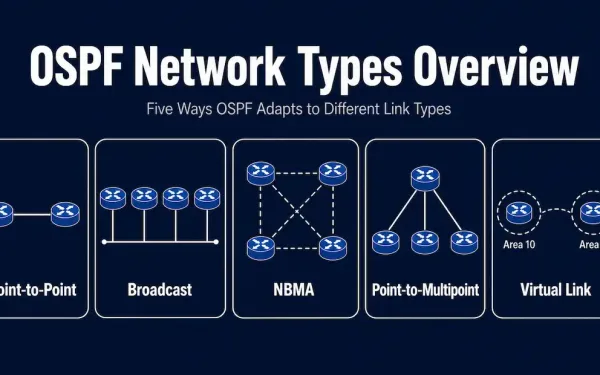
Types of OSPF Networks: Point-to-Point, Broadcast, NBMA, and More
OSPF is a dynamic link-state routing protocol that largely replaced RIP, an older distance-vector protocol, in most enterprise networks. OSPF converges faster and scales to far larger networks than RIP ever could, but part of what makes it powerful is that it doesn’t treat every network link the same way. OSPF classifies the network connected...