
- What the CIA triad means and why it is a foundation of information security.
- How confidentiality, integrity, and availability differ in real-world systems.
- Which controls commonly support each CIA objective.
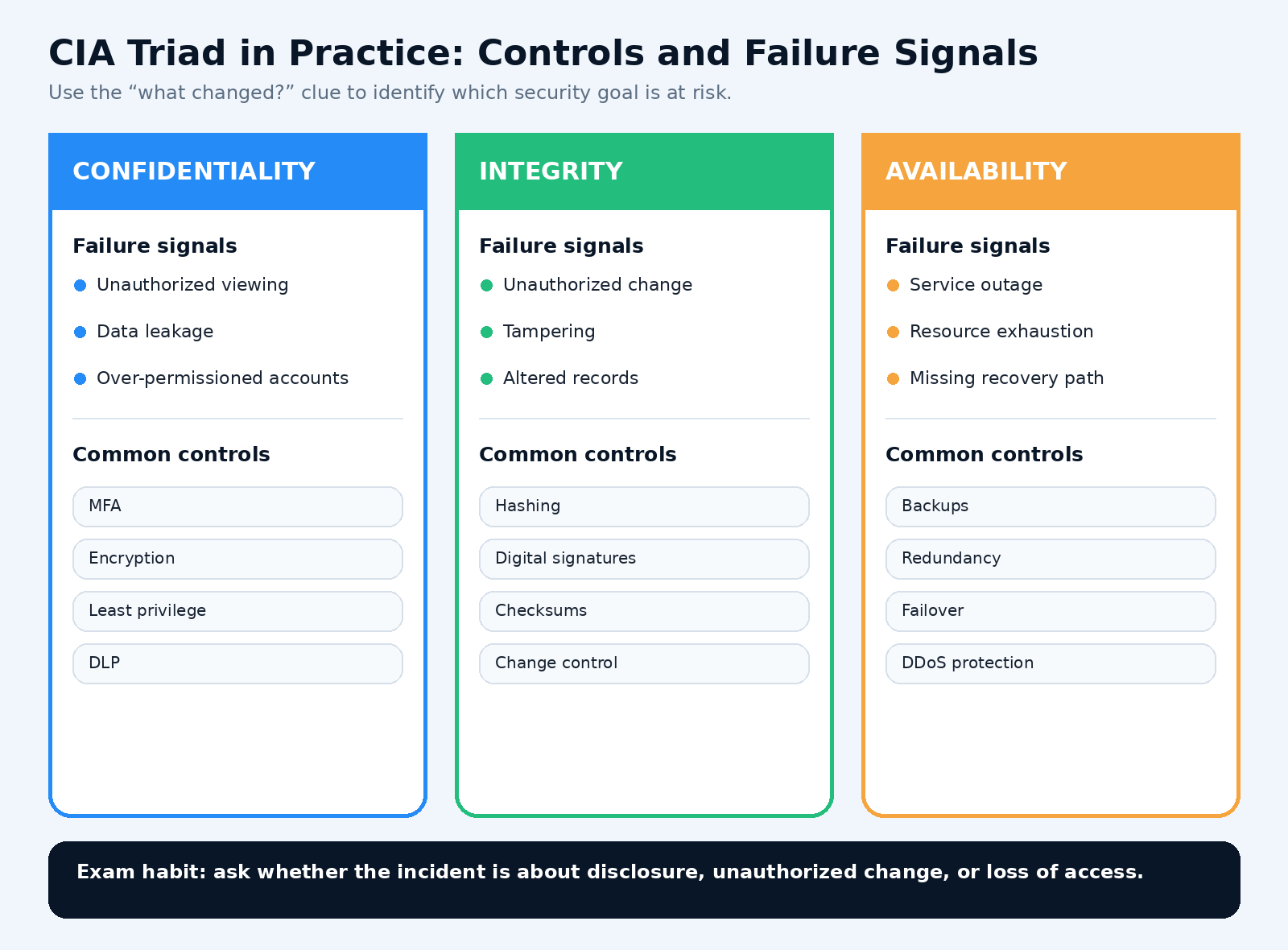
- How a single incident can affect more than one CIA objective.
- How to identify CIA concepts quickly in Security+ SY0-701 scenario questions.
What Is the CIA Triad?
The CIA triad is a foundational model for information security built around three objectives: confidentiality, integrity, and availability. NIST identifies these three properties as core security objectives and defines them in terms of preventing unauthorized disclosure, guarding against improper modification or destruction, and ensuring timely and reliable access.
The model is useful because it turns a broad security question into three practical questions:
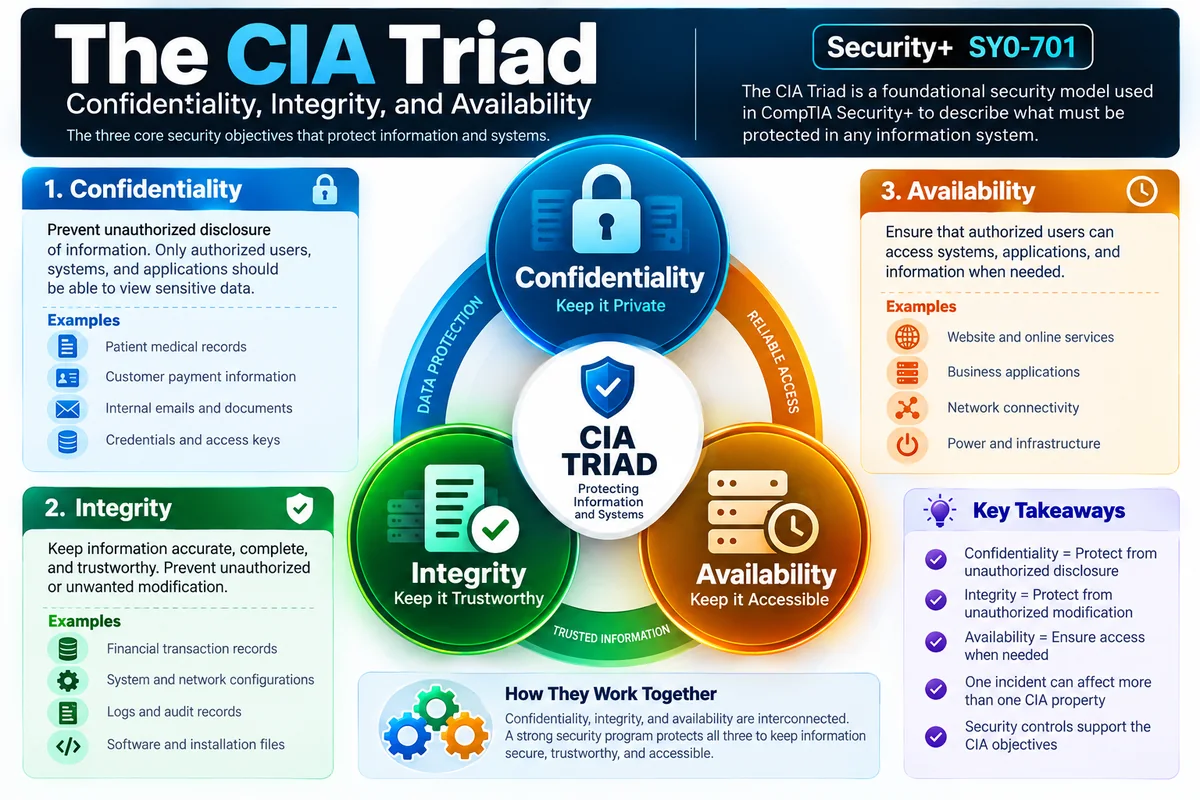
Confidentiality: Protecting Information From Unauthorized Disclosure
Confidentiality means preserving authorized restrictions on access and disclosure. In practical terms, sensitive information should be visible only to people, processes, or systems that are allowed to see it.
Confidentiality matters for many types of information: payroll records, customer data, credentials, intellectual property, health information, security configurations, and business plans. A confidentiality failure can happen even when the original data remains accurate and the system stays online.
Common Confidentiality Controls
| Control | How It Helps | Example |
|---|---|---|
| Access control | Limits who may read information | RBAC permissions on an HR folder |
| Encryption | Makes data unreadable without the required key | Full-disk encryption on a laptop |
| Data masking | Hides sensitive values that a user does not need to see | Showing only the last four digits of an account number |
| Least privilege | Reduces unnecessary access | Support staff can view tickets but not payroll |
| Secure transmission | Protects data while moving between systems | HTTPS or a VPN for remote access |
Integrity: Keeping Data Accurate and Trustworthy
Integrity means guarding against improper modification or destruction and maintaining confidence that information has not been changed in an unauthorized or unexpected way.
Integrity is about more than preventing attackers from editing a database. It also includes accidental changes, corrupted files, manipulated configurations, unauthorized code modifications, and other events that make information less trustworthy.
Common Integrity Controls
Helps detect whether data or files changed unexpectedly.
Can provide evidence of integrity and origin, and support non-repudiation when implemented and validated correctly.
Flags changes to protected files and configuration data.
Makes authorized changes traceable, reviewed, and easier to restore when needed.
A simple way to think about a hash is as a compact value derived from content. If the content changes, the expected hash comparison can fail. This makes hashing useful for integrity verification, but it does not by itself keep the data secret. That is why hashing and encryption solve different primary problems.
Availability: Keeping Systems and Data Accessible
Availability means ensuring timely and reliable access to and use of information and services.
Availability becomes visible whenever a system is down, overloaded, isolated, under maintenance, or otherwise unable to serve authorized users. A system can have excellent confidentiality and integrity while still failing its availability objective.
Common Availability Controls
| Control | Availability Benefit | Example |
|---|---|---|
| Redundancy | Removes single points of failure | Multiple application servers |
| Failover | Moves service to a healthy component | Automatic server failover |
| Backups | Provides recovery copies when data is lost or encrypted | Offline or immutable backup copies |
| Load balancing | Distributes demand across resources | Traffic shared across servers |
| Disaster recovery | Restores critical operations after major disruption | Recovery site and tested procedures |
How the CIA Triad Works Together
The CIA triad is most useful when you stop treating the three objectives as isolated categories. Real systems need all three. For example, a customer portal should keep personal information private, prevent unauthorized changes to account data, and remain usable when customers need it.

Why Security Controls Can Affect More Than One Objective
Security controls are not always one-to-one with CIA. Encryption can support confidentiality, but poor key management can create recovery problems. Redundancy supports availability, but replicated data introduces more locations that must be protected for confidentiality and integrity. Access control can support confidentiality and integrity by limiting who can view or modify resources.
The practical goal is to understand the primary security objective in the scenario while recognizing that a control may have secondary effects.
CIA Triad and Common Threat Scenarios
Unauthorized access
Packet interception
Misconfigured permissions
Data corruption
Malicious code changes
Configuration tampering
Ransomware lockouts
Hardware failure
Power or network outages
Real-World CIA Scenarios
Scenario 1 — Data exposure: An employee accidentally uploads a customer export to a public storage bucket. Primary impact: Confidentiality.
Scenario 2 — Tampering: An attacker modifies a DNS configuration so users are redirected to an unauthorized server. Primary impact: Integrity.
Scenario 3 — Outage: A DDoS attack exhausts bandwidth and legitimate users cannot reach the application. Primary impact: Availability.
Scenario 4 — Ransomware: Production files are encrypted and employees lose access. Primary impact: Availability, with possible Integrity and Confidentiality impacts depending on whether files were altered or data was also exfiltrated.
Security lesson: In scenario questions, identify the business or technical outcome first, then map that outcome to the CIA objective.

CIA Triad vs. Related Security Concepts
| Concept | Main Question | Relationship to CIA |
|---|---|---|
| Authentication | Who are you? | Can support Confidentiality and Integrity by limiting access. |
| Authorization | What can you do? | Can protect Confidentiality and Integrity through permission decisions. |
| Non-repudiation | Can an action or origin be credibly tied to a party? | Related to trust, authenticity, and Integrity but distinct from the three CIA objectives. |
| Accounting | What happened? | Provides records that help investigate CIA-related events. |
Common Security+ CIA Exam Traps
- Unauthorized viewing = Confidentiality. The problem is disclosure, not necessarily modification.
- Unauthorized modification = Integrity. Even if the system stays online, incorrect data is an integrity failure.
- Users cannot access the service = Availability. This is the classic outage clue.
- Encryption is not the same as hashing. Encryption is primarily used for confidentiality; hashes are commonly used for integrity verification.
- Incidents can hit multiple CIA objectives. Choose the objective that best matches the primary outcome described in the question.
Quick CIA Reference
| CIA | Protects | Common Controls | Fast Exam Clue |
|---|---|---|---|
| Confidentiality | Private information | Encryption, access control, masking | Leaked / exposed / unauthorized viewing |
| Integrity | Accuracy and trustworthiness | Hashing, signatures, change control | Altered / corrupted / tampered |
| Availability | Access to services and data | Redundancy, backups, failover | Down / unreachable / outage |
Practice Questions
10 scenario-based questions — click to reveal each answer and explanation.
Exam Quiz
Lesson 01.2 — CIA Triad Exam Simulation · 15 questions · 10 minutes
CIA Triad — Exam Simulation
15 MCQ questions focused on confidentiality, integrity, availability, threats, controls, and real-world scenarios
Mirrors the style and difficulty of Security+ SY0-701 knowledge checks
15 Questions
Lesson 01.2 scope only
10 Minutes
~40 sec per question
Instant Feedback
Explanation after each answer
Full Review
Score + answers at end
Lesson 01.2 — Summary
The CIA Triad: Confidentiality, Integrity, and Availability in Real-World Security
Domain 1.0: General Security Concepts · 12% of Security+ SY0-701
📌 Key Takeaways from Lesson 01.2
Think access control, encryption, masking, least privilege, and secure transmission.
Think hashing, digital signatures, file integrity monitoring, permissions, and change control.
Think redundancy, backups, failover, monitoring, and disaster recovery.
A single incident can affect more than one CIA objective.
| CIA Objective | Main Purpose | Typical Controls | Exam Clues |
|---|---|---|---|
| Confidentiality | Prevent disclosure | Encryption, access control, masking, least privilege | Leaked, exposed, unauthorized viewing |
| Integrity | Prevent improper change | Hashing, signatures, permissions, change control | Altered, corrupted, tampered, inaccurate |
| Availability | Maintain access | Redundancy, failover, backups, recovery, monitoring | Down, inaccessible, outage, denial of service |
⚡ Exam Tips — Lesson 01.2 Specific
- Memorize the core mapping: unauthorized disclosure → Confidentiality; unauthorized modification → Integrity; loss of access → Availability.
- Ransomware can affect multiple objectives, but “users cannot access the files” is a strong Availability clue.
- Hashing helps verify Integrity; encryption primarily protects Confidentiality.
- Backups and redundancy mainly support Availability, but backup data still needs confidentiality and integrity protections.
- The CIA triad is not a checklist where every control protects only one objective. Many controls support more than one security goal.
⚠️ Common Pitfalls — Lesson 01.2
📋 Complete Security+ SY0-701 Guide Series — 5 Domains · 57 Lessons
Further Reading and Related Guides
Continue learning on NetworkUstad:
- Security+ SY0-701 Guide Hub — browse the complete certification guide series.
- General Security Concepts — revisit the Domain 1.0 introduction and security control fundamentals.
External references:
- NIST: Confidentiality, Integrity, Availability — CIA terminology and definitions.
- NIST: Confidentiality — definition and security context.
- NIST: Integrity — definition and security context.
- NIST: Availability — definition and security context.