Security+ SY0-701 — Domain 1.0 — 12% of exam
Domain 01: General Security Concepts
Security controls, CIA triad, cryptography basics, and PKI fundamentals.
11
Total Lessons
11
Live Now
12% of exam
Exam Weight
Domain Progress
11 of 11 live
Lessons in This Domain
Click any live lesson to start reading. New lessons added weekly.
Live
Coming Soon
 1
✅ Live
General Security Concepts: Complete Security+ SY0-701 Domain 1 Study Guide
 2
✅ Live
The CIA Triad: Confidentiality, Integrity, and Availability in Real-World Security
 3
✅ Live
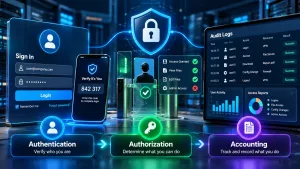
Authentication, Authorization, and Accounting (AAA): How Identity Works in Security
 4
✅ Live
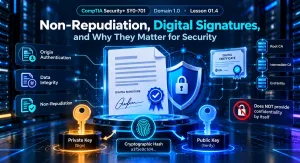
Non-Repudiation, Digital Signatures, and Why They Matter for Security
 5
✅ Live
Zero Trust Architecture: Never Trust, Always Verify
 6
✅ Live
Physical Security Controls: Locks, Cameras, Badges, and Access Restrictions
 7
✅ Live
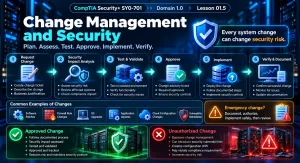
Change Management and Security: Why Every System Update is a Security Event
 8
✅ Live
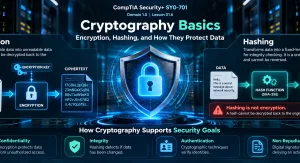
Cryptography Basics: Encryption, Hashing, and How They Protect Data
Symmetric vs Asymmetric Encryption — AES, RSA, and Hybrid Encryption
 10
✅ Live
Public Key Infrastructure (PKI): Certificates, CAs, and Trust Chains
 11
✅ Live
Security Frameworks Overview: NIST, ISO 27001, CIS Controls Compared
Domain 1.0 Summary & Common Exam Pitfalls
→
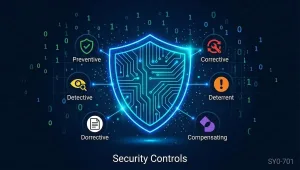
Security controls have four categories—Technical, Managerial, Operational, and Physical—and six types: Preventive, Deterrent, Detective, Corrective, Compensating, and Directive. Do not confuse a control's category with its type.
→
Remember the CIA Triad: unauthorized disclosure affects Confidentiality, unauthorized or improper modification affects Integrity, and loss of timely access affects Availability. A single incident may affect multiple objectives.
→
Authentication verifies identity, Authorization determines permitted actions, and Accounting records activity. Non-repudiation helps provide evidence linking an action or origin to a party; it is not a fourth CIA objective.
→
Zero Trust requires explicit verification and least-privilege access rather than automatic trust based on network location. Understand the roles of the control plane, data plane, policy engine, policy administrator, and policy enforcement point.
→
Physical security includes barriers, bollards, access control vestibules, fencing, surveillance, security guards, badges, lighting, and sensors. Deception technologies include honeypots, honeynets, honeyfiles, and honeytokens.
→
Secure change management includes approval, ownership, stakeholder involvement, impact analysis, testing, backout planning, maintenance windows, standard procedures, dependency assessment, documentation, and version control. Skipping testing or rollback planning can introduce security and availability risks.
→
Encryption primarily protects confidentiality, while hashing commonly supports integrity verification. Salting and key stretching address password-storage risks; digital signatures can help verify integrity and origin. Encryption and hashing are not interchangeable.
→
Distinguish symmetric encryption, asymmetric encryption, and key exchange. Symmetric encryption uses a shared secret key; asymmetric cryptography uses a public/private key pair. Understand how PKI, certificate authorities, certificate chains, root of trust, certificate signing requests, CRLs, OCSP, and key escrow fit into certificate and key management.
→
Recognize appropriate cryptographic tools and techniques, including full-disk and file-level encryption, TPMs, HSMs, key management systems, secure enclaves, steganography, tokenization, data masking, blockchain, and open public ledgers.
→
For scenario-based questions, identify the primary security problem before selecting a control or CIA objective. Consider the stated outcome, business impact, and control purpose instead of relying on a single keyword.
Ready to test yourself?
Practice domain-specific Security+ SY0-701 questions with timer, scoring, and explanations.