
Networking
CCNA tutorials, Cisco guides, and enterprise networking insights for IT professionals.
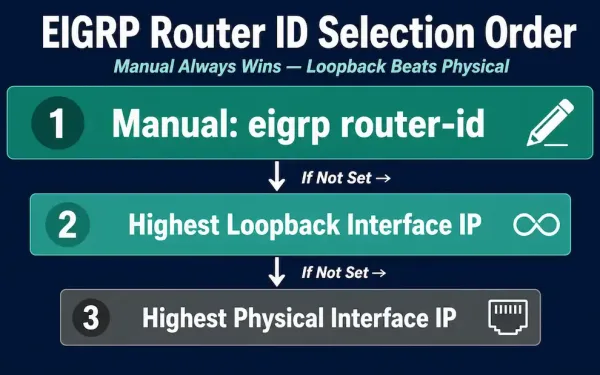
EIGRP Router ID: Selection Rules and Configuration
An EIGRP router ID is a 32-bit unique identifier assigned to each router in the EIGRP domain, represented in the same dotted-decimal format as an IPv4 address. This guide covers exactly how EIGRP selects a router ID automatically, how to configure one manually, a genuinely useful “sticky” behavior that catches people off guard when they...
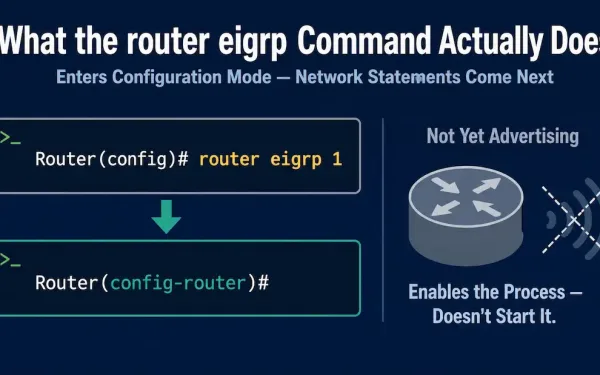
The “router eigrp” Command
The router command in global configuration mode is the starting point for configuring any dynamic routing protocol on Cisco IOS. This guide covers exactly what router eigrp does, its argument’s valid range, what it does and doesn’t accomplish on its own, the modern EIGRP Named Mode alternative worth knowing alongside it, and the small set...
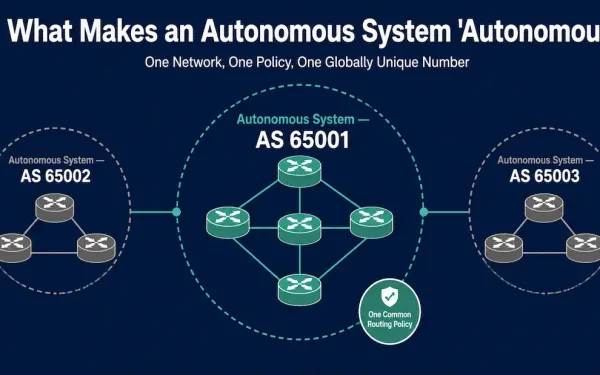
BGP’s ASN vs EIGRP’s “AS Number” — Same Name, Different Meaning
An Autonomous System Number (ASN) is a globally unique identifier assigned to an autonomous system — a group of networks under the administrative control of a single organization, presenting one common routing policy to the internet. The guidelines for creating, selecting, and registering an autonomous system are described in RFC 1930. This guide covers how...
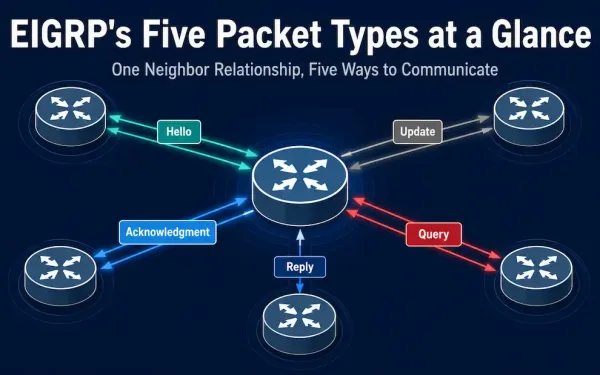
EIGRP Packet Types: Hello, Update, Acknowledgment, Query, and Reply Explained
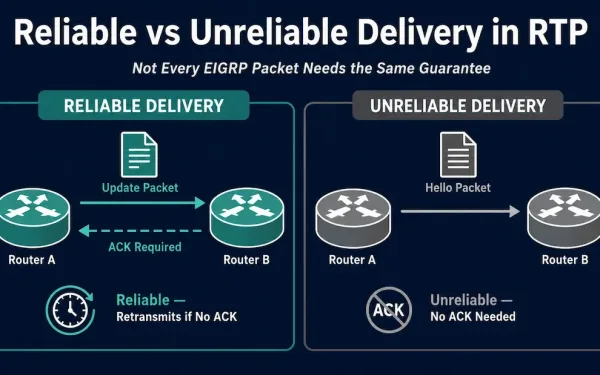
EIGRP uses five different types of packets to communicate with its neighbors: Hello, Update, Acknowledgment, Query, and Reply. Depending on the packet type, EIGRP sends them with reliable or unreliable delivery, and as unicast, multicast, or sometimes both. These packet types are sometimes also referred to as EIGRP packet formats or EIGRP messages. Here’s a...
What Is EIGRP’s Reliable Transport Protocol (RTP)?
EIGRP doesn’t use TCP or UDP to deliver its packets. Instead, it uses its own purpose-built delivery mechanism called Reliable Transport Protocol (RTP) — not to be confused with the unrelated Real-time Transport Protocol used in VoIP and streaming, which shares the same acronym but nothing else. EIGRP’s RTP is what guarantees Update, Query, and...
What Is a Protocol-Dependent Module (PDM) in EIGRP?
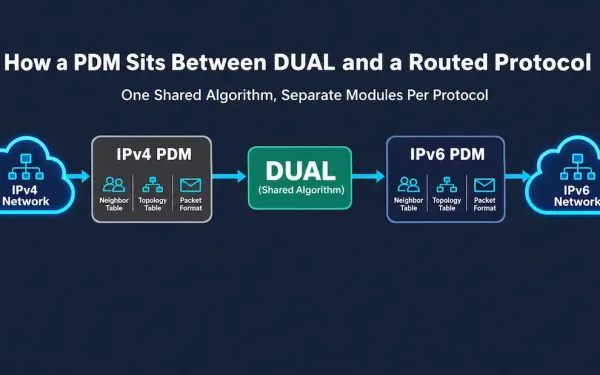
EIGRP can route more than one network-layer protocol at once, and the mechanism that makes this possible is the Protocol-Dependent Module (PDM). Each PDM handles everything specific to one particular routed protocol — building its own neighbor table, its own topology table, and interfacing with the shared DUAL algorithm — while DUAL itself remains protocol-agnostic....
Introduction to EIGRP
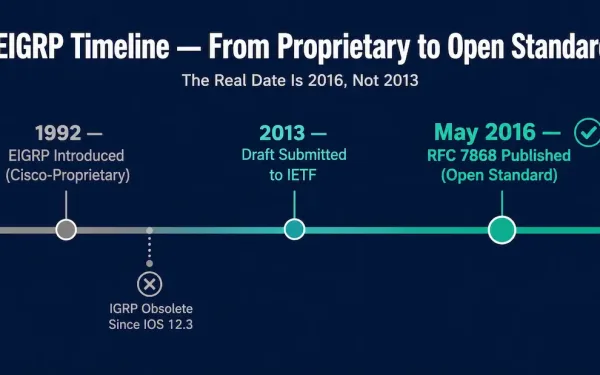
Enhanced Interior Gateway Routing Protocol (EIGRP) was introduced by Cisco in 1992 as an advanced distance-vector routing protocol, originally running only on Cisco devices. It remained Cisco-proprietary for over two decades before becoming an open, multi-vendor standard — a milestone worth getting the date right on, since it’s commonly misstated. From Proprietary Protocol to Open...
How to Verify Multiarea OSPF
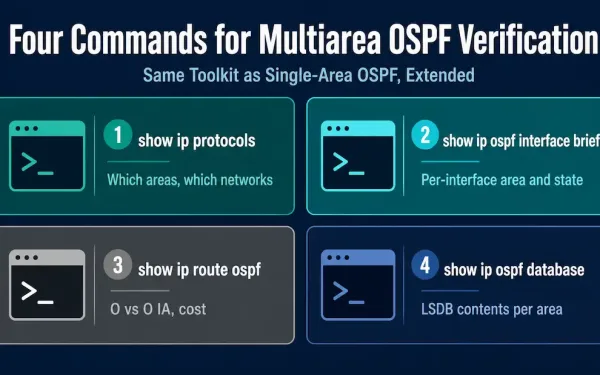
Most multiarea OSPF verification uses the exact same commands already familiar from single-area OSPF — show ip ospf neighbor, show ip ospf, and show ip ospf interface all work identically regardless of how many areas are involved. A handful of additional commands specifically surface multiarea information: which areas a router participates in, how routes crossed...
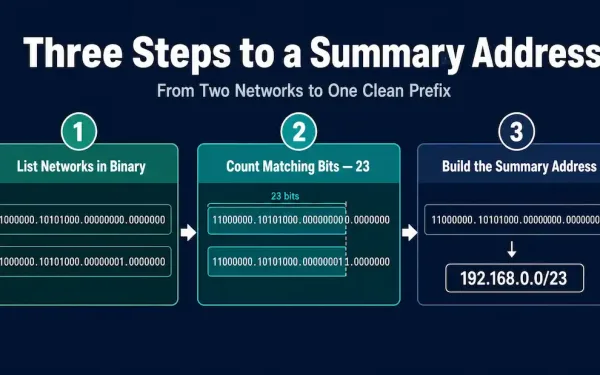
Interarea Route Summarization: Calculating the Summary Address by Hand
Interarea route summarization must be manually configured on an ABR — OSPF has no auto-summarization feature. Once configured, the ABR condenses multiple specific routes from one area into a single Type 3 Summary LSA before forwarding it into the backbone. This guide focuses specifically on the part most guides skip: how to actually calculate the...
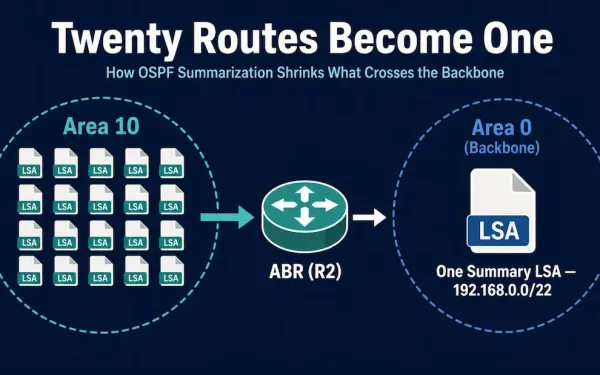
OSPF Route Summarization: Inter-Area and External, with Both Commands
Route summarization converts multiple specific routes into a single, condensed route, shrinking routing tables and reducing the volume of routing updates that need to flood through a network. This guide covers both types of OSPF summarization — inter-area (at an ABR) and external (at an ASBR) — including the specific command for each, since one...