
Networking
CCNA tutorials, Cisco guides, and enterprise networking insights for IT professionals.
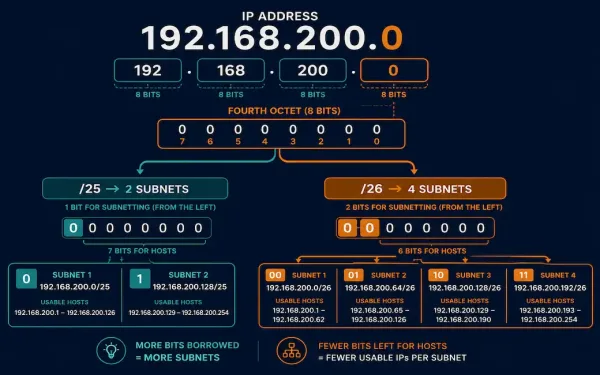
Classless Subnetting Examples: Two Fully Worked Problems
Classless subnetting, made possible by CIDR (Classless Inter-Domain Routing) since its introduction in 1993, lets an administrator borrow bits from any position in the host portion of an address, rather than being restricted to classful boundaries like /8, /16, or /24. This guide works through two complete subnetting problems on the same base network, step...
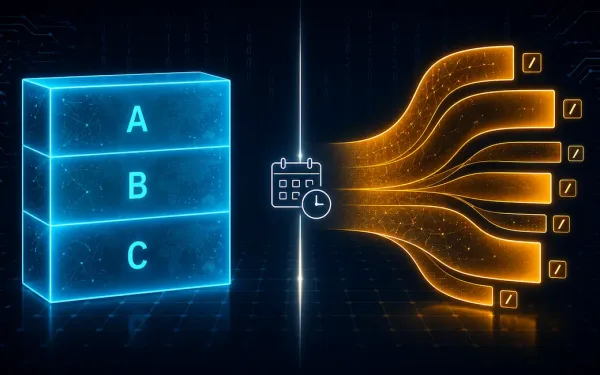
Classful vs. Classless Addressing: What’s the Difference?
Classful and classless addressing describe two different ways to structure an IPv4 address. Classful addressing came first, in the early internet of the 1980s. It used fixed Class A, B, and C ranges. That rigid structure eventually led to serious IPv4 address exhaustion. CIDR arrived in 1993 and introduced classless addressing instead, allowing flexible prefixes...
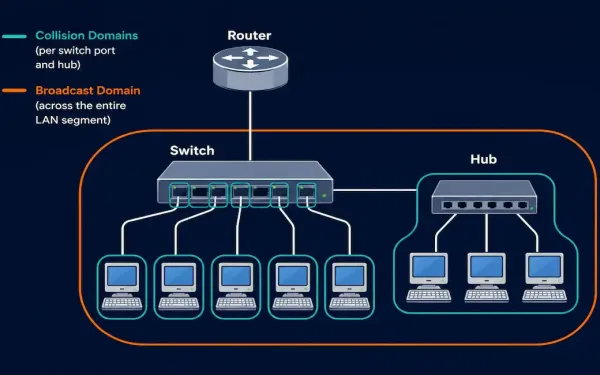
Collision Domains and Broadcast Domains Explained
Understanding where a collision domain ends and where a broadcast domain ends is one of the most fundamental spatial-reasoning skills in networking, and it’s tested constantly on the CCNA exam through topology diagrams. This guide covers both concepts precisely, works through a single consistent topology example for each, and covers the real problems that happen...
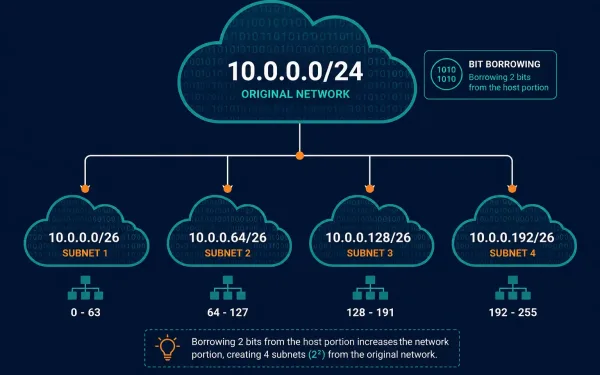
Introduction to Subnetting: How and Why to Divide a Network
Subnetting lets a network administrator divide a large network into smaller, more manageable sub-networks by borrowing bits from the host portion of an IP address. Rather than running one enormous flat network, subnetting adds a third level to the addressing hierarchy, network, subnetwork, and host, giving administrators far more control over how a network actually...
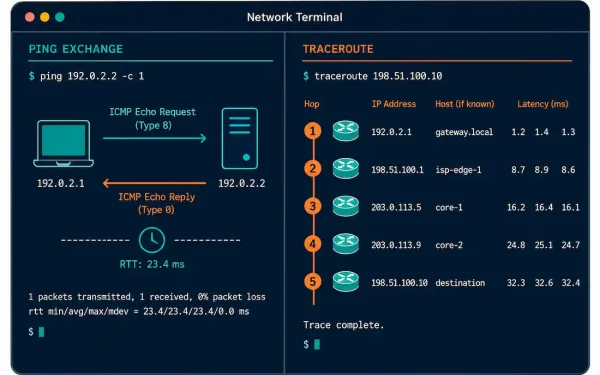
Ping and Traceroute: The Essential Network Troubleshooting Toolkit
Ping and traceroute are the first tools most network engineers reach for when something isn’t working. Both rely on ICMP, but they answer different questions: ping tells you whether a destination is reachable at all, while traceroute maps out exactly which hops a packet passes through along the way. This guide covers both in depth,...
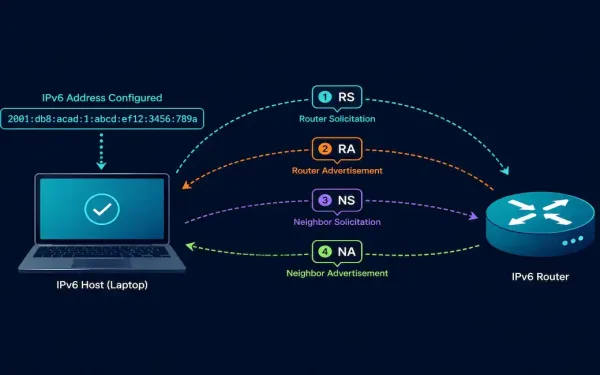
ICMPv6 Neighbor Discovery: RS, RA, NS, and NA Messages Explained
ICMPv6 does considerably more than its IPv4 counterpart. Beyond basic error reporting, it absorbs an entire protocol’s worth of functionality through the Neighbor Discovery Protocol (NDP), four distinct message types working together to replace ARP, handle address resolution, and drive SLAAC. This guide covers each of the four NDP message types, how they interact, and...
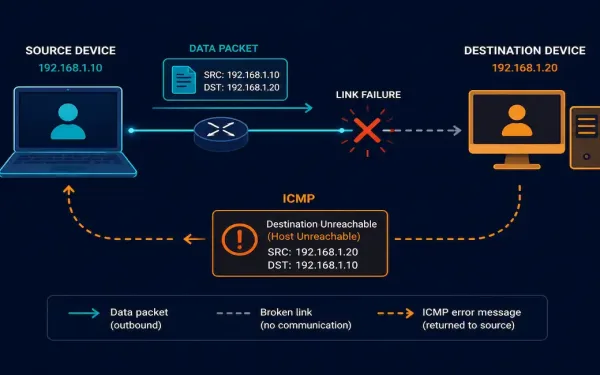
Internet Control Message Protocol (ICMP) Explained
IP is deliberately unreliable: it has no built-in mechanism to report when something goes wrong. That’s exactly the gap the Internet Control Message Protocol (ICMP) fills. It doesn’t make IP more reliable, it doesn’t retransmit or guarantee delivery, but it does report problems back to the source, which is what makes tools like ping and...
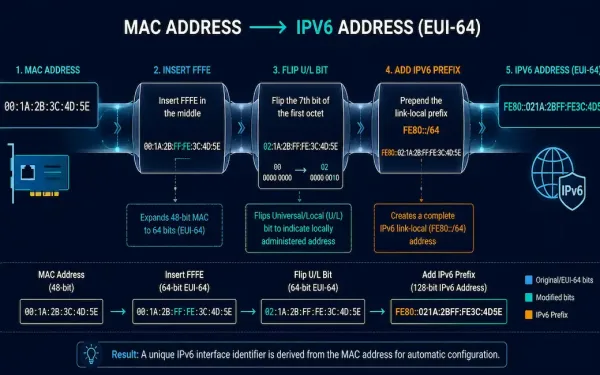
The EUI-64 Process: How IPv6 Interface IDs Are Generated
When a device configures an IPv6 address through Stateless Address Autoconfiguration (SLAAC), it gets the network prefix, typically a /64, from a Router Advertisement, but it has to generate its own 64-bit Interface ID independently. This guide covers exactly how that generation works: the EUI-64 process that derives an Interface ID from a MAC address,...
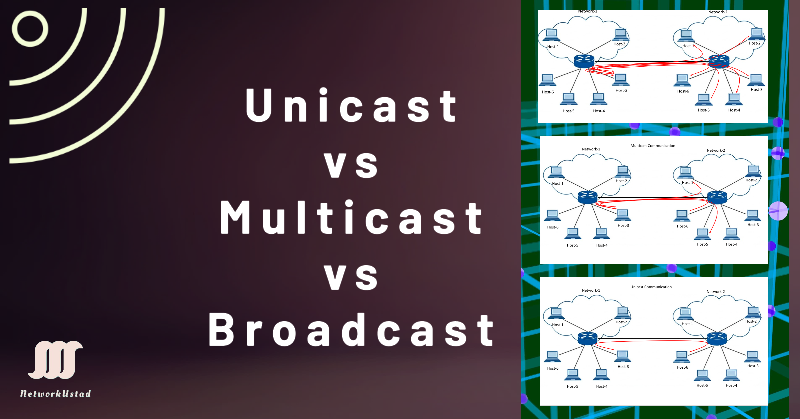
Unicast, Multicast, and Broadcast Communication Explained
Every packet that moves across a network is delivered using one of three fundamental communication methods: unicast, multicast, or broadcast. Each defines how many devices receive a given transmission — one, a selected group, or all of them — and choosing the right one is central to how efficiently a network runs. As video streaming,...
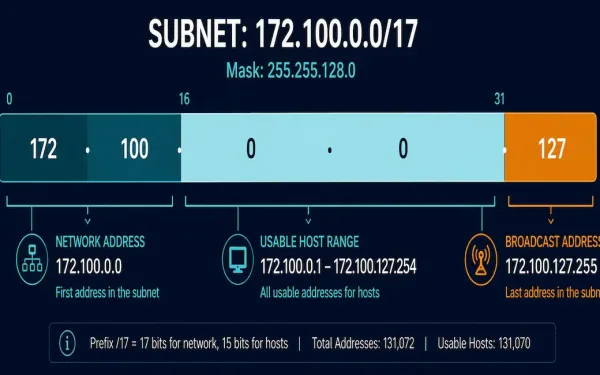
Network Prefix, Network Address, Broadcast Address, and Host Address Explained
Every IPv4 subnet has a handful of specific addresses with fixed roles: one identifies the network itself, one is reserved for broadcasting to every device on it, and the rest are available for hosts. This guide covers exactly how to calculate each one, using prefix notation and binary math, with one consistent worked example carried...