Domain 6.4 | Automation and Programmability — 10% of exam
Learning Objectives
By the end of this lesson, you will be able to:
- Describe traditional campus device management and its dependency on individual device access and tribal knowledge.
- Describe how Cisco DNA Center applies the controller-based concepts from objectives 6.2 and 6.3 specifically to campus network management.
- Explain network assurance and distinguish it from basic automated configuration push.
- Contrast proactive, analytics-driven troubleshooting with traditional, reactive troubleshooting.
Key Terms Glossary
| Term | Definition |
|---|---|
| Traditional campus management | Individually accessing each device’s CLI to check status, push changes, and troubleshoot issues. |
| Tribal knowledge | Undocumented, individually-held knowledge about a device’s specific configuration history and quirks. |
| Cisco DNA Center | Cisco’s controller-based platform for centralized campus network management, policy, automation, and assurance. |
| Assurance | Ongoing health monitoring, analytics, and proactive issue identification across an entire managed network from one interface. |
| Proactive troubleshooting | Identifying and addressing a developing problem before it causes a noticeable outage or user impact. |
| Reactive troubleshooting | Diagnosing and fixing a problem only after it has already caused a visible issue. |
Traditional Campus Management: Effective, But Slow to Scale
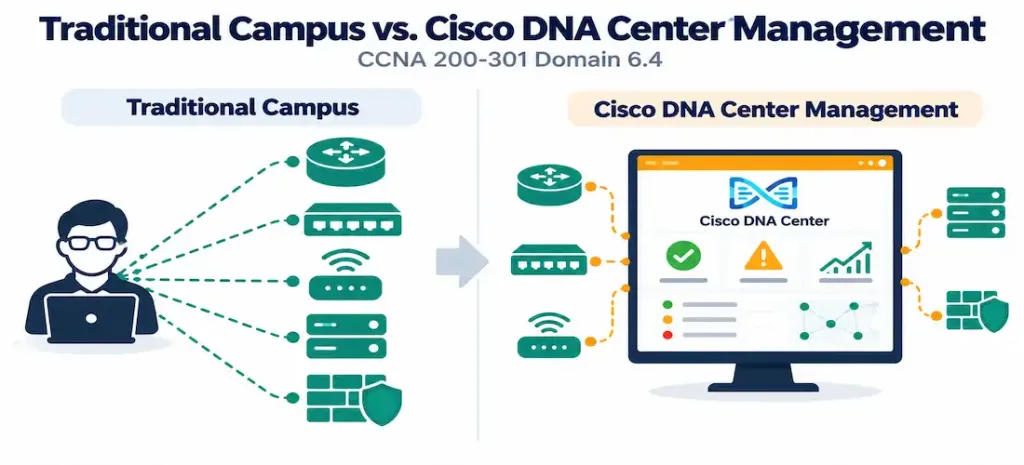
Traditional campus network management means an engineer individually accesses each device’s CLI to check its status, push configuration changes, and troubleshoot problems as they arise. This approach is genuinely effective at getting real work done — every configuration objective covered throughout this entire course demonstrates that CLI-based management is fully capable of correctly configuring and operating real network devices. The limitation isn’t correctness; it’s scale and dependency.
As a campus network grows, this model becomes slow to scale for exactly the reasons covered in objective 6.1 — more devices means more individual CLI sessions, more repetitive manual work, and more opportunity for inconsistency. But traditional campus management carries an additional, more specific dependency worth naming directly: tribal knowledge. Over time, individual engineers accumulate undocumented understanding of a specific device’s configuration history, its particular quirks, why a certain non-obvious setting was configured a certain way three years ago, and which changes have caused problems before.
This knowledge typically lives in people’s memory rather than in any centralized, accessible system. When that specific engineer is unavailable — on vacation, having left the organization, or simply not immediately reachable during an urgent incident — troubleshooting a device they historically managed becomes measurably harder for anyone else, even a highly competent colleague, since the undocumented context that would normally speed up diagnosis simply isn’t available to them.
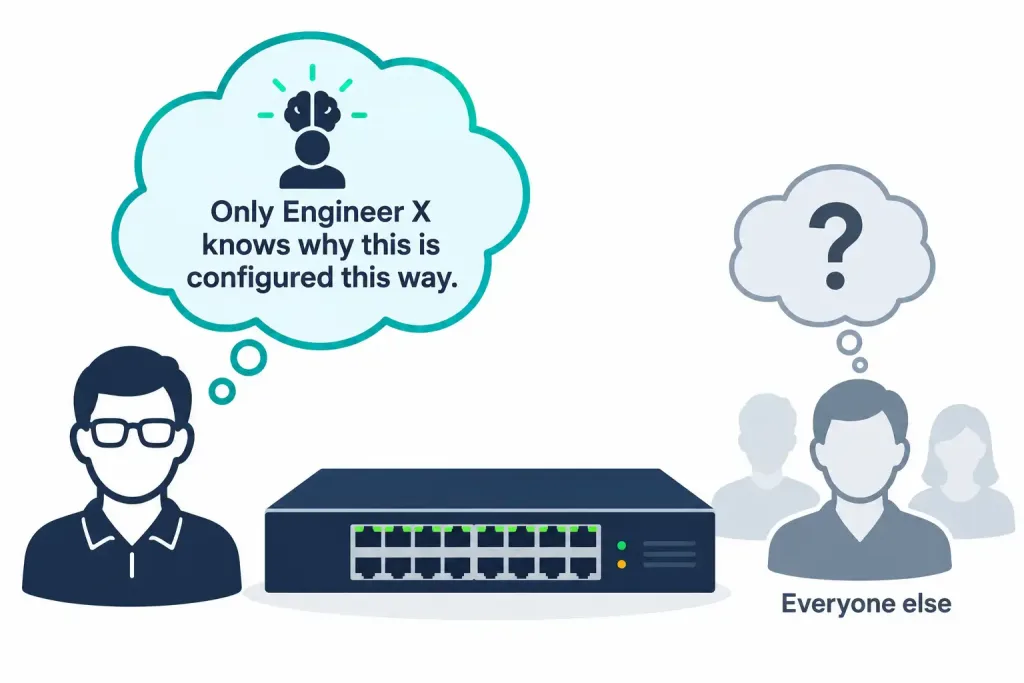
A Concrete Illustration of the Tribal Knowledge Problem
Consider a realistic scenario: a specific switch has a static route configured that appears unnecessary at first glance, since the same destination seems reachable through normal dynamic routing already covered elsewhere in the network. The engineer who originally configured it knew — but never documented — that this static route was actually a deliberate workaround for a specific timing issue during network boot-up, ensuring a management path stayed available during the brief window before the dynamic routing protocol fully converged.
Years later, a different engineer reviewing the configuration, unaware of this history, might reasonably conclude the static route is redundant and remove it during a cleanup effort, only to reintroduce the exact boot-up timing problem the original engineer had quietly solved. Nothing about this failure indicates incompetence on anyone’s part — it’s a direct, predictable consequence of critical context living only in one person’s memory rather than anywhere a successor could discover it before making a seemingly reasonable change.
Cisco DNA Center: The Controller-Based Alternative, Applied to Campus Networks
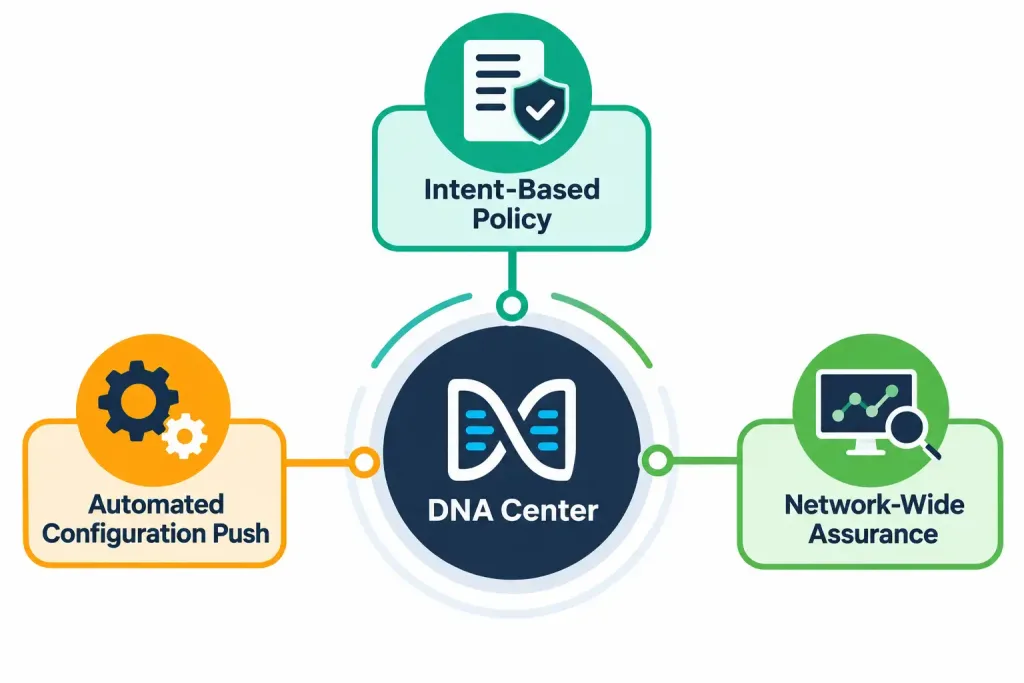
Cisco DNA Center represents the controller-based alternative described in objectives 6.2 and 6.3, applied specifically to campus networks. Rather than treating each campus device as an independent, individually managed entity, DNA Center provides three integrated capabilities working together:
Centralized, intent-based policy definition — exactly the intent-based management concept from objective 6.2, applied concretely to campus infrastructure. An administrator defines policy at the level of business intent, and DNA Center translates and pushes the corresponding technical configuration across the managed campus device fleet.
Automated, consistent configuration push — the same underlying benefit covered in objective 6.1, now delivered specifically through DNA Center’s platform: a configuration change defined once propagates consistently to every relevant device, rather than requiring individual, repeated manual work.
Network-wide assurance — this is the capability genuinely new to this specific objective, and it deserves focused attention below, since it goes meaningfully beyond “push configuration consistently” into ongoing, ambient monitoring and analysis.
Assurance: Beyond Configuration, Into Ongoing Health
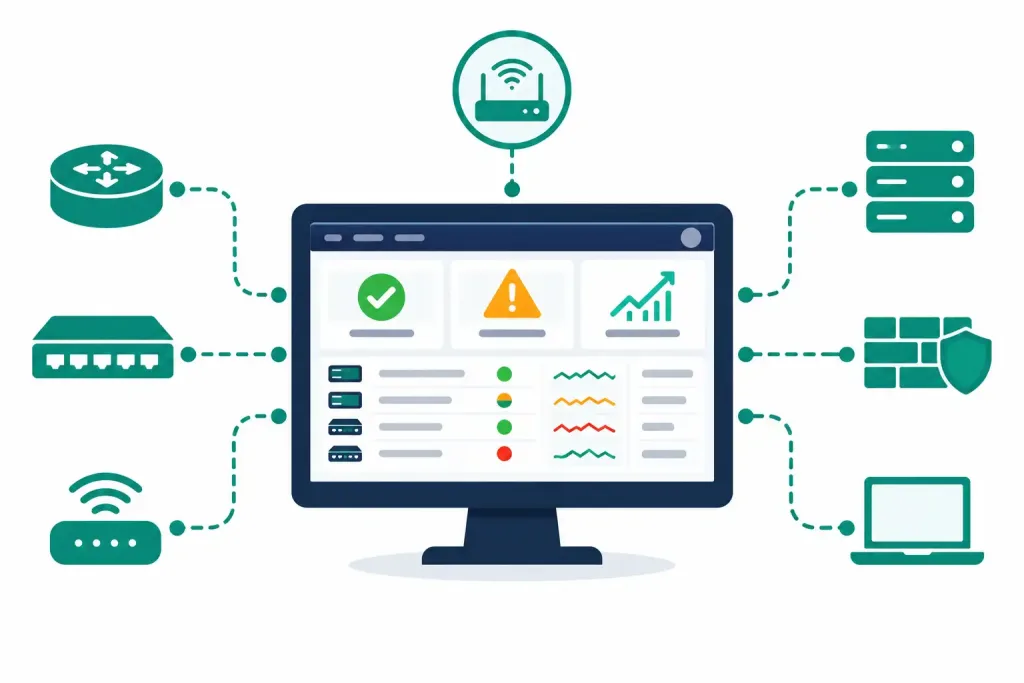
Assurance means ongoing health monitoring, analytics, and proactive issue identification across the entire managed environment, from a single interface — rather than needing to individually check the health of each device separately, the way traditional campus management requires.
This is a meaningfully different capability from simply pushing configuration consistently. A network could have perfectly consistent, correctly deployed configuration across every device and still develop real operational problems over time — a link’s error rate slowly climbing, a device’s CPU utilization trending upward toward a concerning threshold, a wireless client experiencing intermittent, hard-to-reproduce connectivity issues. None of these problems stem from incorrect configuration; they’re operational health trends that require ongoing observation and analysis to catch, ideally before they cause a visible, user-impacting outage.
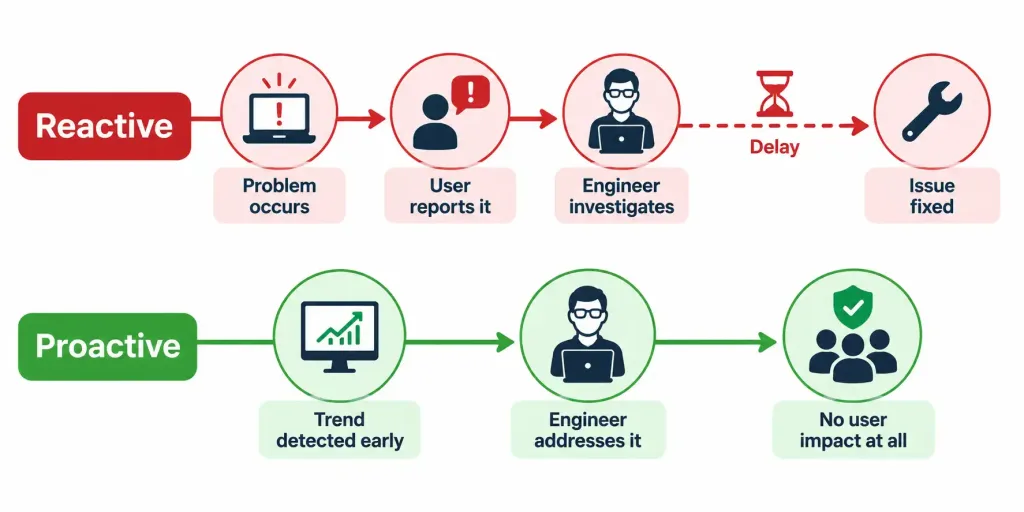
Proactive vs. Reactive Troubleshooting
This distinction is worth stating explicitly, since it’s the practical payoff assurance actually provides. Reactive troubleshooting — the traditional model — means diagnosing and fixing a problem only after it’s already caused a visible issue: a user calls to report their wireless connection keeps dropping, and an engineer then begins investigating what’s wrong. Proactive troubleshooting, enabled by assurance’s ongoing analytics, means identifying a developing problem — a specific access point’s client count trending unusually high relative to its capacity, for instance — and addressing it before any user ever notices degraded performance at all.
This connects directly to telemetry-gathering concepts covered earlier in this course. Assurance platforms don’t invent monitoring data from nothing — they build on and aggregate the same kinds of underlying telemetry mechanisms covered in objective 4.4’s SNMP discussion and objective 4.5’s syslog coverage — polling data, traps, and log messages — but assurance goes further by correlating that raw telemetry across the entire network, applying analytics to it, and surfacing meaningful, prioritized insights rather than leaving an administrator to manually review individual SNMP graphs or syslog streams device by device to notice the same underlying trend themselves.
A Concrete Assurance Feature Worth Knowing: Path Trace
One specific, illustrative DNA Center capability worth recognizing by name is Path Trace — a tool that visually maps and analyzes the actual, current path traffic takes between two specific endpoints across the managed fabric, surfacing per-hop details like latency, interface utilization, and any applied policy (such as an ACL) affecting that specific traffic flow.
Under traditional management, answering “why is traffic between these two specific devices slow or being unexpectedly blocked” typically requires an engineer to manually trace the path hop by hop, individually checking each device’s routing table, interface statistics, and any applied ACLs along the way — exactly the kind of device-by-device manual investigation objective 6.1 identified as slow and repetitive. Path Trace automates this entire investigative process, presenting the complete path and every relevant detail from a single query, directly illustrating how assurance capabilities translate into concretely faster, less tedious troubleshooting rather than remaining a purely abstract benefit.
AI and Machine Learning in Modern Assurance Platforms
Worth recognizing at a conceptual level, since this reflects the CCNA blueprint’s own August 2024 refresh specifically adding awareness of this area: modern assurance platforms, including DNA Center, increasingly incorporate machine learning and AI-driven analysis to identify patterns across the aggregated telemetry that would be genuinely difficult for a human to manually notice across a large network — subtle correlations between seemingly unrelated events, baseline “normal” behavior patterns learned over time that make genuine anomalies easier to flag automatically.
Prioritized recommendations for which of many detected issues most warrants immediate attention. This isn’t a wholesale replacement for engineering judgment, but it represents a genuine evolution beyond simple threshold-based alerting (a technique that long predates this specific technology) toward analysis that adapts to a specific network’s own observed normal behavior rather than relying purely on fixed, generic thresholds.
Comparison Table
| Characteristic | Traditional Campus Management | DNA Center–Enabled Management |
|---|---|---|
| Device access | Individual CLI sessions, device by device | Centralized platform managing the fleet |
| Policy application | Manually configured per device | Intent-based, translated and pushed centrally |
| Configuration consistency | Depends on administrator discipline | Enforced and maintained centrally |
| Institutional knowledge | Often tribal, held by specific individuals | Increasingly captured in the platform’s own history and analytics |
| Health monitoring | Reactive — checked when a problem is reported | Proactive — ongoing analytics across the whole network |
| Troubleshooting starting point | Begins after a user reports an issue | Can begin before any user-visible impact occurs |
Recognizing Which Model a Scenario Describes
As with objective 6.2, part of this objective’s practical skill is correctly classifying a described scenario rather than only reciting definitions. Language describing an engineer “logging in individually,” relying on “what someone remembers” about a device, or troubleshooting only “after a user reports” an issue all point toward traditional campus management. Language describing a “single dashboard” showing the whole network’s health, policy “defined once and pushed everywhere,” or a platform that “flags a developing issue before impact” all point toward DNA Center–enabled, assurance-driven management specifically.
A scenario describing intent-based policy alone, without any mention of ongoing health analytics, is describing the automation and controller concepts from objectives 6.1 and 6.2 rather than assurance specifically — assurance is a distinct, additional layer on top of that foundation, not a synonym for controller-based management as a whole.
This distinction matters for a subtler reason too: an organization could theoretically adopt centralized, intent-based configuration management without ever deploying meaningful assurance capabilities, or vice versa in a more limited sense. Recognizing assurance as a genuinely separate, identifiable capability — rather than assuming any controller-based platform automatically includes it in equal depth — is exactly the kind of precise distinction this comparative objective is testing.
Common Misconceptions
- “DNA Center only automates configuration push, nothing more.” Assurance — ongoing health monitoring, analytics, and proactive issue identification — is a distinct, additional capability beyond configuration automation, not simply a byproduct of pushing configuration consistently.
- “Correctly configured devices can’t develop operational problems.” Configuration correctness and ongoing operational health are separate concerns — a perfectly configured network can still develop real problems over time (rising error rates, capacity trends) that assurance specifically exists to catch.
- “Assurance platforms invent monitoring data independently of existing protocols like SNMP and syslog.” Assurance builds on and aggregates the same underlying telemetry mechanisms covered earlier in this course, adding correlation and analytics on top of that existing data rather than replacing the underlying data-gathering entirely.
- “Proactive troubleshooting means problems never occur at all.” It means identifying developing problems before they cause visible user impact — it reduces and often prevents outages, but it doesn’t guarantee the complete impossibility of any issue ever occurring.
- “Tribal knowledge is purely a discipline or documentation problem individual engineers should simply solve by writing things down.” While better documentation genuinely helps, tribal knowledge is also a structural consequence of the traditional management model itself — a centralized platform captures and surfaces institutional context more systematically than relying entirely on individual habit and discipline to document everything perfectly, every time.
Frequently Asked Questions
Does adopting DNA Center eliminate the need for engineers to understand individual device CLI configuration?
No — the underlying technical knowledge covered throughout this entire course remains essential for designing sound policy, understanding what DNA Center is actually doing when it translates intent into configuration, and troubleshooting situations the platform itself can’t fully resolve automatically.
Is assurance only useful for very large campus networks?
The proactive-versus-reactive troubleshooting benefit scales with network size and complexity, since a larger network has more devices and more telemetry to correlate manually — but the underlying value of catching a developing problem before it causes an outage applies conceptually at any scale, even if the practical cost-benefit of deploying a full assurance platform favors larger environments.
Can DNA Center manage non-Cisco devices?
DNA Center is primarily designed and optimized for Cisco’s own device ecosystem, with more limited support for other vendors’ equipment compared to some open-standard, multi-vendor controller platforms — this is a genuine practical consideration for organizations with a mixed-vendor environment.
How does DNA Center’s approach relate to the overlay/underlay/fabric concepts from objective 6.3?
Directly — DNA Center is the controller platform commonly used to manage a Cisco SD-Access fabric deployment, meaning the overlay, underlay, and fabric concepts from objective 6.3 describe the underlying architecture DNA Center actually manages when deployed in a full SD-Access context, rather than being unrelated ideas.
Does DNA Center’s AI-driven analysis replace the need for human review of flagged issues?
No — it surfaces and prioritizes potential issues based on learned patterns and correlated telemetry, but a human still needs to review, validate, and decide how to act on what’s flagged, exactly the same principle covered in objective 6.1 regarding automation not eliminating the need for human oversight of the underlying logic and judgment involved.
How does a platform “learn” what normal behavior looks like for a specific network?
Assurance platforms incorporating machine learning typically establish a baseline by observing a network’s actual telemetry over a period of time — normal ranges for interface utilization, typical client counts at different times of day, usual latency between specific points — and then flag meaningful deviations from that learned baseline rather than relying solely on generic, one-size-fits-all thresholds that might be too sensitive for one network’s normal traffic pattern and not sensitive enough for another’s. This is precisely what allows the same platform to reasonably monitor networks of very different sizes and traffic profiles without needing every threshold manually tuned by an administrator for each specific environment.
Network Management and Cisco DNA Center Quiz
Traditional Management, Tribal Knowledge, Assurance, and SD-Access
Summary
Traditional campus management relies on individually accessing each device's CLI, which is fully capable of correct configuration but scales poorly and depends heavily on undocumented tribal knowledge held by specific individuals who may eventually become unavailable.
Cisco DNA Center applies the controller-based concepts from objectives 6.2 and 6.3 specifically to campus networks, providing centralized intent-based policy, automated configuration push, and network-wide assurance as three genuinely distinct, integrated capabilities.
Assurance — ongoing health monitoring, analytics, and proactive issue identification — is a distinct capability beyond configuration automation, addressing operational health trends that can develop even in a correctly, consistently configured network, and shouldn't be assumed automatic just because a controller-based platform is in use.
Proactive troubleshooting, enabled by assurance's ongoing analytics, identifies and addresses developing problems before user-visible impact occurs, in contrast to traditional management's reactive, report-then-diagnose model that starts investigating only after someone notices something is wrong.
Modern assurance platforms increasingly incorporate machine learning and AI-driven analysis to correlate telemetry and prioritize issues, building on the same underlying SNMP and syslog mechanisms covered earlier in this course rather than replacing them — though human review and judgment remain essential regardless.
Concrete assurance features like Path Trace illustrate how these capabilities translate abstract benefits into genuinely faster, less tedious troubleshooting work in practice.