Domain 6.2 | Automation and Programmability — 10% of exam
Learning Objectives
By the end of this lesson, you will be able to:
- Describe the traditional, device-by-device network management model and its inherent consistency limitation.
- Describe the controller-based model, including the concept of a single source of truth.
- Explain intent-based networking and how it differs from device-by-device technical configuration.
- Identify the trade-offs a controller-based architecture introduces, including the controller itself becoming critical infrastructure.
Key Terms Glossary
| Term | Definition |
|---|---|
| Traditional network management | A model where each device is configured and managed individually and independently. |
| Controller-based network | A model where a central controller manages configuration and policy across every device it oversees. |
| Single source of truth | The principle that one authoritative system (the controller) defines the intended state for the entire managed network. |
| Intent-based networking | Managing a network based on desired business outcomes (“this group should have this access”) rather than device-by-device technical commands. |
| Cisco DNA Center | Cisco’s flagship controller platform for campus network management, covered in depth in objective 6.4. |
Traditional Networks: Independent, Device-by-Device Management
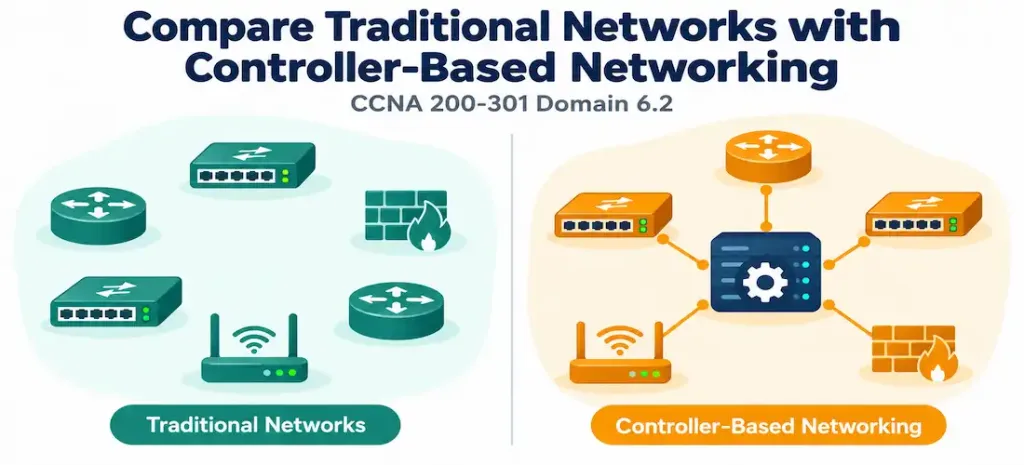
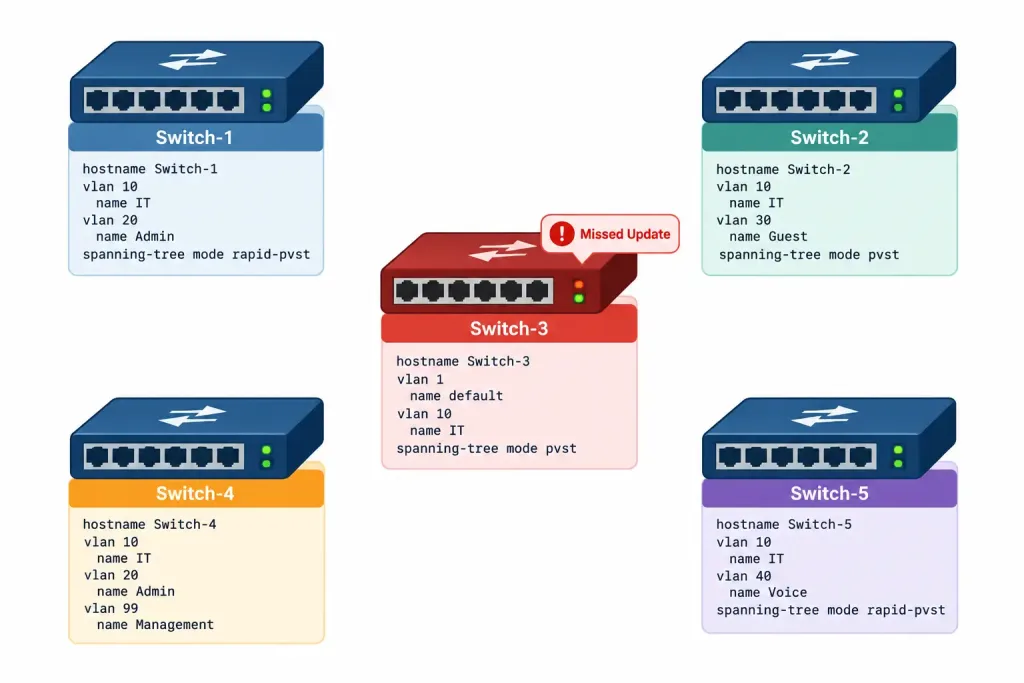
Every configuration task covered throughout this entire course up to this point has followed the traditional network management model: an administrator connects to one specific device, makes a change, verifies it, and moves on to the next device if the same change needs to be replicated elsewhere. Each device is configured and managed individually and independently — there’s no inherent mechanism keeping configuration consistent across the fleet, and no device inherently knows or cares what configuration exists on any other device.
This is precisely the structural gap objective 6.1 identified as configuration drift’s root cause: if an administrator updates a security policy on one switch but forgets a second switch, the network is now in a genuinely inconsistent state, and critically, there’s no automatic detection of this discrepancy under this model. Nothing is watching for it; nothing flags it. The inconsistency simply exists, quietly, until something — a security incident, a troubleshooting session, an audit, or a customer complaint about inconsistent access — happens to surface it.
Controller-Based Networks: A Single Source of Truth
Controller-based networking takes a fundamentally different architectural approach. Rather than each device managing its own configuration independently, a central controller — Cisco DNA Center being the flagship example in the CCNA context, covered in dedicated depth in objective 6.4 — becomes the single source of truth for configuration and policy across every device it manages. The controller pushes configuration outward and continuously maintains consistency across the fleet from one central place, rather than configuration living independently and potentially divergently on each individual device.
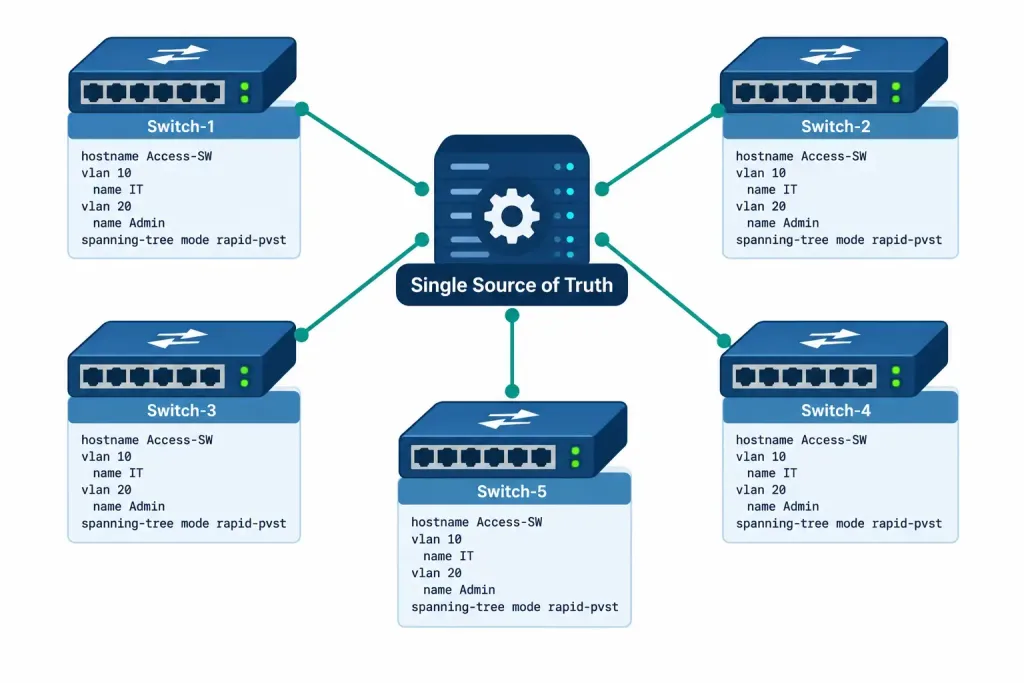
This architectural shift provides several concrete benefits directly built on top of automation’s general advantages from objective 6.1:
- Centralized visibility — an administrator can see the state of the entire managed network from one interface, rather than needing to individually query dozens or hundreds of separate devices to build the same picture.
- Simplified large-scale changes — a policy update pushed once from the controller propagates consistently to every device it applies to, rather than requiring individual, repeated manual configuration.
- Intent-based management — perhaps the most conceptually significant shift, covered in its own section below.
Intent-Based Networking: A Different Level of Abstraction
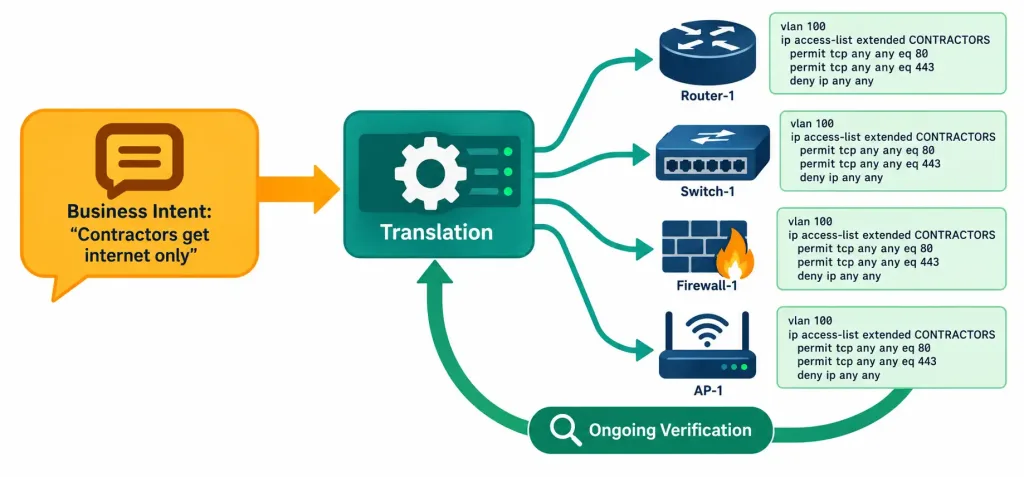
Traditional device configuration operates at a fundamentally technical level: an administrator writes specific commands — access-list 110 permit tcp..., vlan 20, switchport access vlan 20 — that directly correspond to low-level device behavior. Intent-based networking operates at a higher level of abstraction entirely: an administrator (or, more precisely, whoever is defining network policy) expresses a business intent — “this group of users should have this level of access” — and the controller translates that intent into the actual low-level technical configuration needed across every relevant device to achieve it.
This is a genuinely different way of thinking about network management, not merely a more convenient interface bolted onto the same underlying task. Under traditional management, achieving “the finance department’s devices should only reach finance servers, not engineering resources” requires an administrator to personally work out which specific VLANs, which specific ACLs, and which specific devices need which specific commands to accomplish that goal — and then manually or semi-manually apply all of it correctly.
Under intent-based management, that same goal is expressed once, at the level it’s naturally thought about, and the controller handles translating it into the technically correct configuration across however many devices are actually involved, including devices an administrator might not have even considered when framing the original intent.
Critically, intent-based systems don’t just apply the translated configuration once and stop — they typically maintain ongoing verification that the network’s actual state continues to match the expressed intent, closing the loop rather than treating “apply the configuration” as the final step. If a device’s state drifts from what the intent requires — whether from an unexpected failure, an unauthorized manual change, or any other cause — a properly functioning intent-based system can detect that gap and correct it, rather than the drift silently persisting the way it would under the traditional model until someone happens to notice.
A Worked Example of Intent Translation
Consider a concrete illustration of what “translation” actually means in practice. An administrator defines an intent: “Contractors should have internet access but no access to internal corporate resources.” Behind the scenes, the controller might need to: create or identify a dedicated VLAN for contractor devices, configure that VLAN consistently across every access switch where a contractor might plausibly connect, push an access control policy restricting that VLAN’s traffic to internet-bound destinations only, and configure whatever wireless SSID or 802.1X policy determines that contractor devices land on that VLAN in the first place rather than the standard corporate one.
Under traditional management, an administrator would need to personally identify every one of these pieces, implement each correctly, and remember to replicate all of it consistently on every relevant device — a process this course has covered piece by piece across earlier domains (VLANs, ACLs, wireless authentication) but which intent-based management assembles and maintains automatically from the single, higher-level statement of what should happen.
Comparison Table
| Characteristic | Traditional Networks | Controller-Based Networks |
|---|---|---|
| Configuration management | Individual, per-device | Centralized, single source of truth |
| Consistency mechanism | None — depends entirely on administrator discipline | Enforced centrally and continuously |
| Visibility | Device-by-device, manually aggregated | Centralized, network-wide from one interface |
| Change scale | Linear effort per device | Push once, applies consistently everywhere relevant |
| Level of abstraction | Technical, device-specific commands | Business intent, translated automatically |
| Drift detection | None inherent to the model | Ongoing verification against defined intent |
The Trade-off: The Controller Becomes Critical Infrastructure
It would be incomplete to present controller-based networking as a strictly superior replacement for traditional management with no trade-offs at all. Centralizing configuration authority in a controller means that controller itself becomes a genuinely critical piece of infrastructure — if it becomes unreachable, unavailable, or misconfigured, the consequences are potentially far more widespread than a single device’s individual failure would ever be under the traditional model, where each device’s configuration exists independently and would continue operating on its own even if some central management system disappeared entirely.
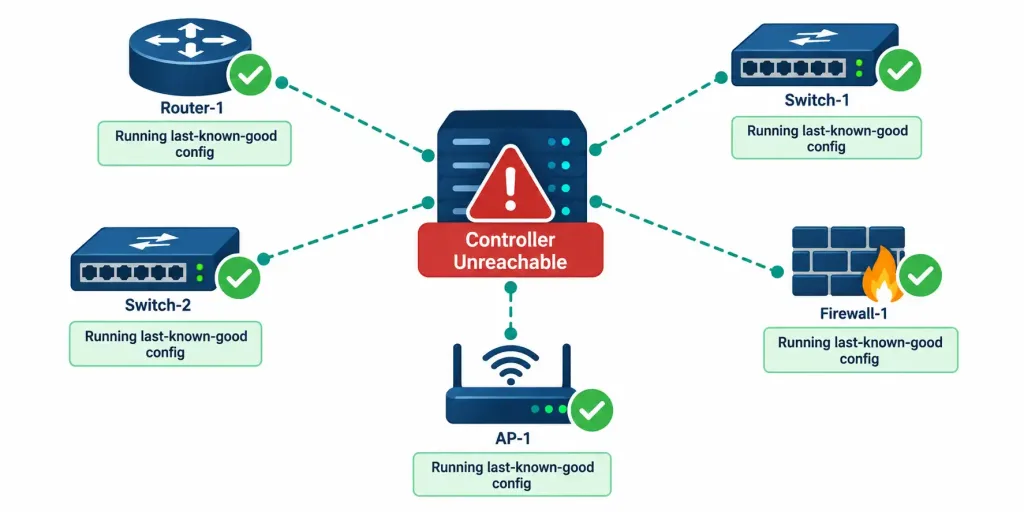
This is precisely why real controller-based deployments take the controller’s own availability seriously — redundant controller nodes, careful change management specifically for controller-level policy updates (since a single mistaken policy pushed centrally could propagate incorrectly to every managed device simultaneously, echoing the exact “flawed automation at scale” risk discussed in objective 6.1), and clear procedures for what happens to already-configured devices if the controller becomes temporarily unreachable. A well-designed system generally allows devices to continue operating on their last-known-good configuration even during a controller outage, rather than failing immediately — but this is a genuine design consideration a controller-based architecture introduces, not something the traditional model needs to account for at all.
This same set of trade-offs is worth keeping in mind heading into later objectives in this domain, which introduce specific architectural terms — overlay, underlay, and fabric — describing exactly how a controller-based system like Cisco’s SD-Access actually structures the relationship between the logical network administrators design intent against, and the physical infrastructure that ultimately carries the traffic. Those terms build directly on the controller concept introduced here, rather than representing an unrelated set of new ideas.
Recognizing Which Model a Scenario Describes
Since this objective is explicitly comparative, a meaningful part of the practical skill being tested is correctly identifying which model a described scenario represents, rather than reciting the definitions in isolation. A few recognition cues are worth internalizing. Language describing an administrator “logging into each device individually,” managing configuration “device by device,” or a network having “no way to detect” a missed update all point toward the traditional model.
Language describing a “central platform,” “single pane of glass,” policy defined “once and pushed everywhere,” or a system that “continuously verifies” configuration against a defined baseline all point toward the controller-based model. Business-outcome phrasing — “this department should have this access,” “guests should only reach the internet,” “contractors need internet but nothing internal” — rather than technical command-level phrasing is the specific signal for intent-based management specifically, a further refinement within the controller-based category rather than a separate third option entirely.
This pattern-recognition skill matters because exam scenarios, and more importantly real job responsibilities, rarely announce “this is a controller-based network” directly — they describe a situation and expect the reader to correctly classify what’s actually being described based on these underlying characteristics, rather than relying on the scenario to explicitly name the model being tested.
Common Misconceptions
- “Controller-based networking eliminates individual device configuration entirely.” Devices still hold and run their actual configuration locally — the controller centralizes how that configuration is defined, pushed, and kept consistent, but the devices themselves still ultimately execute real configuration, just as they always have.
- “Intent-based networking means administrators no longer need to understand underlying technical concepts like VLANs and ACLs.” Someone still needs to understand what’s technically happening for the system to be designed, troubleshot, and trusted correctly — intent-based management changes the primary interface for expressing desired outcomes, not the underlying technical reality every objective in this course has covered.
- “A controller-based network has no meaningful downsides compared to traditional management.” Centralizing configuration authority introduces a new category of risk — the controller itself becoming a critical single point requiring its own redundancy and careful change control — that traditional, fully independent device management never needed to consider.
- “Traditional and controller-based networking are entirely separate, incompatible approaches an organization must fully choose between.” Many real deployments are hybrid, with some parts of a network under controller management and other parts (often older equipment, or portions outside the controller’s supported scope) still managed traditionally during a transition period or indefinitely.
- “Centralized visibility just means being able to log into any device remotely instead of walking to it physically.” It specifically means seeing the state of the entire managed network from one interface without needing to individually query each device at all — a qualitatively different capability than simply having remote CLI access to devices one at a time.
- “Adopting a controller platform locks an organization into a single vendor forever, with no flexibility.” While a specific controller platform is often optimized for (or exclusively supports) a particular vendor’s equipment, the underlying architectural concept — centralizing policy, maintaining a single source of truth, verifying against defined intent — is a general principle implemented by multiple vendors’ platforms, not a single company’s proprietary idea that locks an organization out of ever changing direction.
Frequently Asked Questions
Does a controller-based network still use protocols covered elsewhere in this course, like SNMP or syslog?
Often yes, at least in transitional or hybrid environments — the centralized visibility concept in controller-based networking is a natural extension of the centralized monitoring philosophy already introduced with SNMP and syslog — a controller platform commonly builds on or alongside these existing protocols for gathering telemetry, rather than replacing the underlying data-gathering mechanisms entirely with something unrelated.
Can a single controller manage devices from multiple vendors?
This varies by controller platform and its supported southbound protocols — some controllers are explicitly designed for multi-vendor environments using open standards, while others (like Cisco DNA Center) are primarily optimized for a single vendor’s device ecosystem, with more limited or no support for other vendors’ equipment.
Is controller-based networking only relevant for very large campus networks?
While the benefits scale dramatically with network size, the underlying architectural concept — centralized policy, single source of truth, intent-based management — applies conceptually at smaller scales too, though the practical cost and complexity of deploying a full controller platform often makes it a better fit for larger environments where the benefits clearly outweigh that overhead, rather than a small office with only a handful of devices to manage in the first place.
What happens to a device’s current configuration if the controller becomes unreachable?
This depends on the specific platform’s design, but well-architected controller-based systems generally allow devices to continue operating on their last-known-good, already-applied configuration during a controller outage, rather than losing functionality immediately — the controller’s unavailability affects the ability to make new changes or gather centralized visibility, not necessarily the device’s continued operation using configuration it already received.
How does this objective relate to the automation benefits covered in objective 6.1?
Directly — controller-based networking is essentially automation’s consistency and centralized-management benefits applied at an architectural level, extending the same underlying principles (reducing manual repetition, ensuring consistency, providing auditability) from individual automated tasks to an entire network’s ongoing management model.
Are Cisco DNA Center and similar controllers only used for wired campus networks?
No — while Cisco DNA Center specifically focuses on campus network management (covered in more depth in objective 6.4), the broader controller-based architectural concept applies across other domains too, including wireless LAN controllers managing fleets of access points, and software-defined WAN (SD-WAN) controllers managing branch-to-headquarters connectivity — the underlying single-source-of-truth and centralized-policy principle is consistent across these different application areas, even though the specific platform, vendor, and managed device types differ considerably from one deployment context to another.
Controller-Based Networking Quiz
Test your understanding of traditional management, controllers, intent-based networking, and centralized policy.
Summary
- Traditional network management configures each device individually and independently, with no inherent mechanism to detect or prevent configuration inconsistency across the fleet over time.
- Controller-based networking centralizes configuration and policy in a single source of truth, providing centralized visibility, simplified large-scale changes, and intent-based management across the entire managed device fleet.
- Intent-based networking expresses desired business outcomes rather than device-specific technical commands, with the controller translating that intent into actual configuration and continuously verifying the network stays aligned with it, correcting drift automatically when it’s detected.
- Controller-based architecture introduces a genuine trade-off: the controller itself becomes critical infrastructure, requiring redundancy and careful change management, since a flawed centrally-pushed policy can affect every managed device simultaneously and near-instantly.
- Traditional and controller-based approaches aren’t mutually exclusive — many real-world deployments are hybrid, and controller-based networking builds directly on the same automation principles (consistency, reduced manual effort, auditability) introduced in objective 6.1.
- The controller-based architectural pattern extends beyond a single vendor’s platform or a single application area — wireless LAN controllers and SD-WAN controllers apply the same single-source-of-truth principle to their respective managed device types.