administrative distance
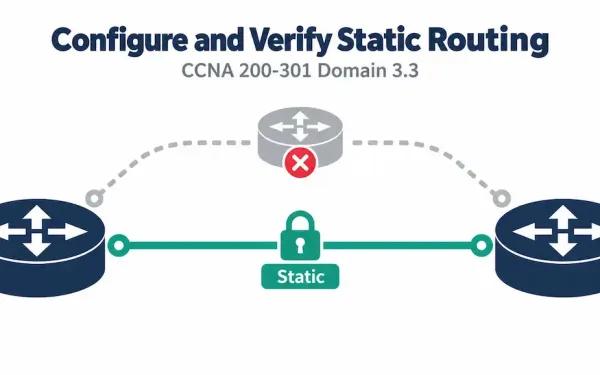
Configure and Verify IPv4 and IPv6 Static Routing
Domain 3.3 | IP Connectivity — 25% of exam Learning Objectives By the end of this lesson, you will be able to: Key Terms Glossary Term Definition Static route A manually configured routing table entry pointing to a specific destination network via a next-hop address or exit interface. Next-hop IP address The IP address of...

Determining How a Router Makes a Forwarding Decision by Default
Domain 3.2 | IP Connectivity — 25% of exam Learning Objectives By the end of this lesson, you will be able to: Key Terms Glossary Term Definition Forwarding decision The process by which a router selects one route from its routing table to forward a specific packet toward its destination. Longest prefix match (LPM) The...
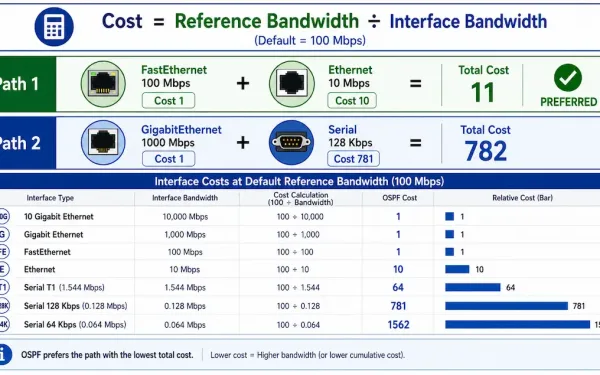
OSPF Metric and Reference Bandwidth: Complete Cost Calculation Guide
OSPF (Open Shortest Path First) relies on “cost” as its metric to select the best path in a network. For CCNA and CCNP students, understanding OSPF cost calculation is essential for exam topics covering route selection and path optimization. The default reference bandwidth is 100 Mbps (10^8 bps), and lower costs indicate preferred paths. This...
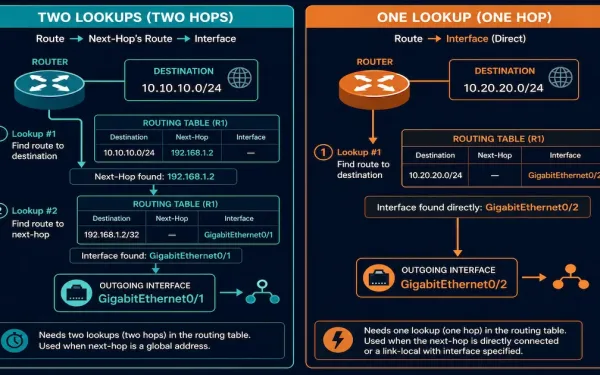
Static IPv6 Routes: Next-Hop Address vs. Directly Connected (Exit Interface)
A static IPv6 route can be built two different ways: pointing only at a next-hop IPv6 address, or pointing at an exit interface directly. These aren’t just two syntax options — they produce genuinely different lookup behavior in the router, and understanding that difference is core CCNA and CCNP material. This guide covers both forms,...
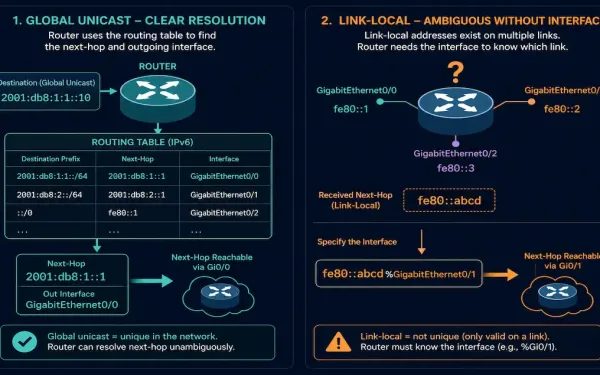
The IPv6 Route Next-Hop Option: Global vs. Link-Local, Explained
Configuring a static IPv6 route looks almost identical to configuring a static IPv4 route — but IPv6 has one real syntax wrinkle that trips up a lot of people moving from IPv4: whether the next hop needs an interface specified alongside it depends entirely on whether that next hop is a global unicast address or...
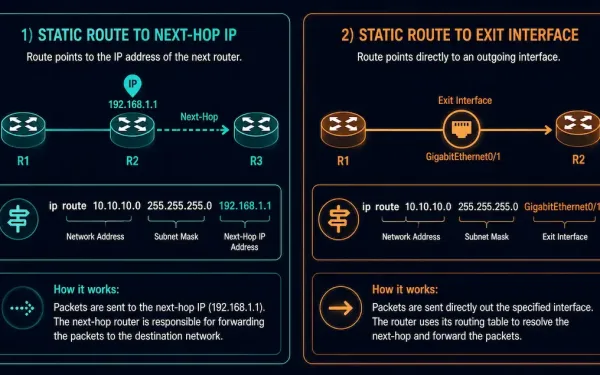
Directly Connected Static Routes: Configuration and When to Use Them
A static route can point to a destination in one of two ways: by specifying the next-hop IP address, or by specifying the exit interface directly. This second form — using the exit interface — is what’s called a directly connected static route, and understanding when and why to use it is a useful piece...
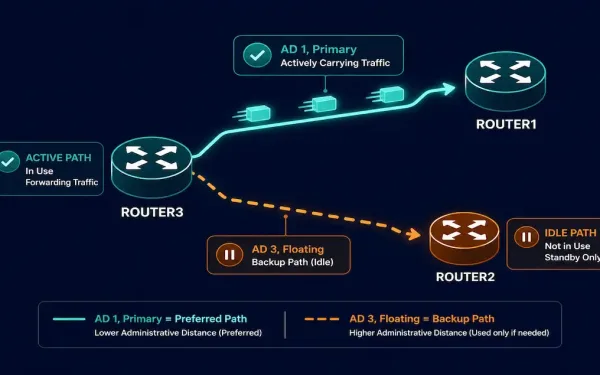
Floating Static Routes: Configuration, Verification, and Troubleshooting
Static routes are manually configured paths in a router’s routing table, giving precise control over traffic flow. Unlike dynamic routing protocols such as EIGRP or OSPF, static routes suit small networks and backup scenarios particularly well. A floating static route takes that idea further: it’s a backup path configured with a higher administrative distance (AD)...
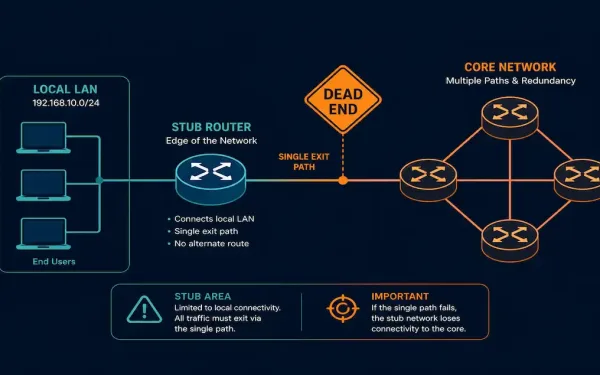
What Is a Stub Network? Routing, Configuration, and Real-World Use
Understanding stub networks and stub routers is fundamental to designing efficient networks, and a direct requirement for the CCNA exam. Stub networks show up in branch office designs, service provider edge connections, and anywhere a network segment has only one path in and out. This guide covers what a stub network is, why static and...
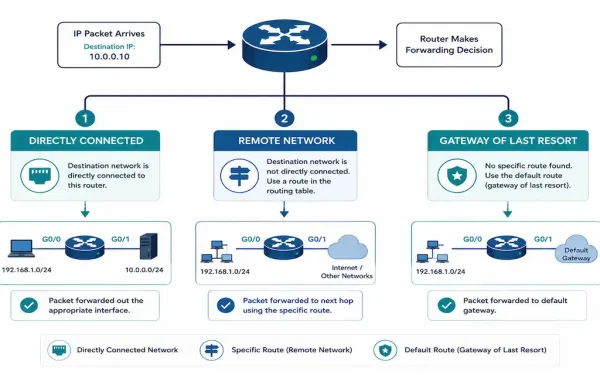
Router Path Selection: How Routers Determine the Best Path
Every time a router receives a packet, it runs through the same basic decision sequence: is the destination directly connected, is it a remote network reachable through a known route, or is there no known route at all? Understanding this sequence — and exactly how a router picks between multiple valid paths when more than...