Muhammad Khattak
Routing and switching specialist, CCNA certified, with extensive experience in network configuration and troubleshooting. Covers OSPF, EIGRP, VLAN management, and advanced routing concepts.
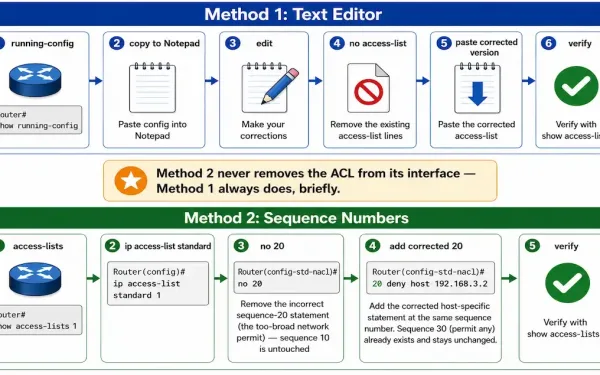
How to Edit Standard ACLs
Network administrators sometimes need to edit a standard ACL after it’s already been configured — an address was mistyped, a rule needs tightening, or a statement that made sense at the time no longer fits the network. As covered in the standard ACL configuration guide, each new entry you add to an ACL appears at...
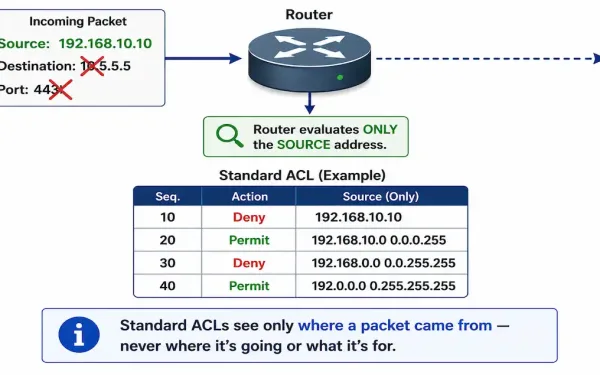
How to Configure Standard ACLs
Standard ACLs permit or deny traffic based on source addresses only. They match a packet’s source IP address against a list of address ranges and a corresponding permit-or-deny statement — nothing else. The port and destination of the packet are never evaluated, which is the single most important thing to understand about standard ACLs before...
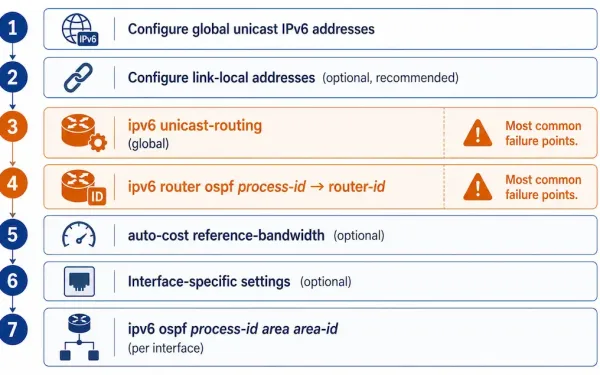
How to Configure OSPFv3: Complete Guide
Figure 1 shows the reference topology for this guide: Router1 through Router4, connected via a mix of GigabitEthernet, FastEthernet, and Serial interfaces. This walkthrough configures OSPFv3 on Router1 step by step; assume Router2, Router3, and Router4 already have their global IPv6 and link-local addresses configured. This topology is IPv6-only, no dual-stack, to keep the focus...
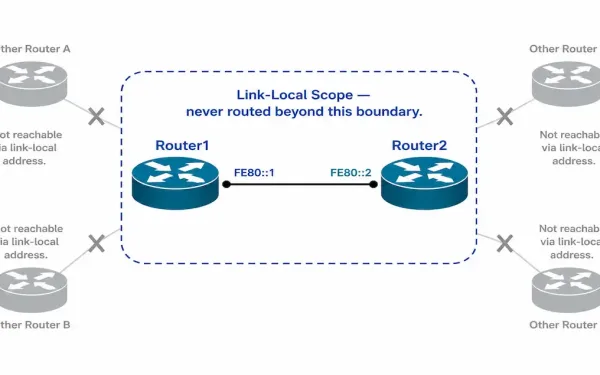
What is a Link-Local IPv6 Address
Routers configured with dynamic routing protocols such as OSPF or EIGRP must send and receive routing protocol messages with their directly connected neighbors, exchanging those messages between neighbors on the same subnet. In IPv4, those messages are sourced from the router’s configured IPv4 interface address — the same address used for everything else on that...
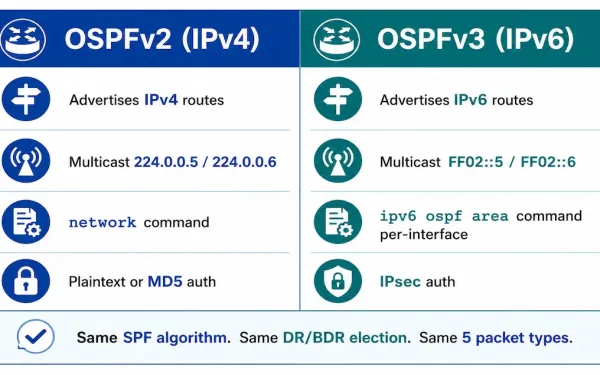
OSPFv2 vs OSPFv3: Key Differences and Similarities
OSPFv3 is a routing protocol for IPv6, just as OSPFv2 is for IPv4. While both share core principles, there are vital differences in their operation. OSPFv3 serves as the IPv6 equivalent to OSPFv2 for exchanging prefixes, making it essential for modern networks handling dual-stack environments. In IPv6, the network address is referred to as the...
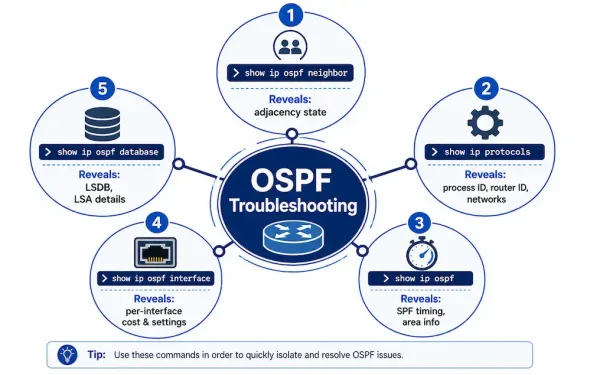
OSPF Troubleshooting and Verification Guide
OSPF (Open Shortest Path First) is a cornerstone of enterprise routing, widely tested in CCNA and CCNP exams. Its complexity stems from link-state operations, making OSPF troubleshooting and verification crucial for network stability and certification success. This guide explores real-world scenarios, like multi-area OSPF in large networks, to equip students with practical skills. Regular verification...
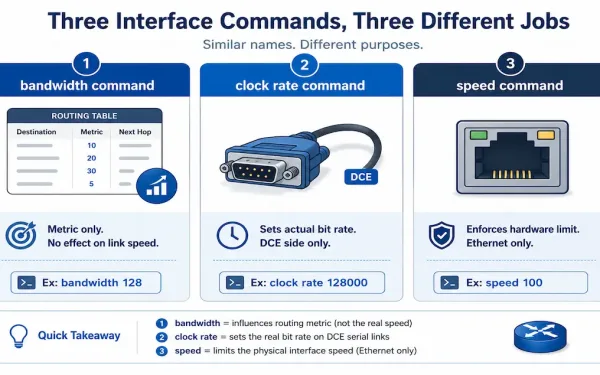
Understanding Cisco Interface Bandwidth: Configuration, Verification, and Routing Impacts
In Cisco networking, the interface bandwidth value plays a crucial role in routing decisions without affecting the actual link speed. For CCNA students, this is key to understanding basic router configurations and why routing protocols might choose suboptimal paths. CCNP learners will appreciate its ties to advanced topics like OSPF cost calculations and QoS policies....
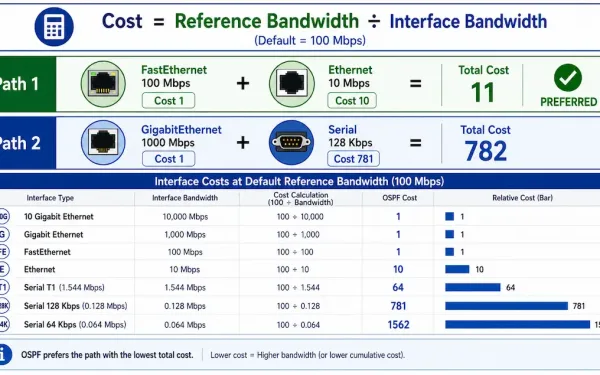
OSPF Metric and Reference Bandwidth: Complete Cost Calculation Guide
OSPF (Open Shortest Path First) relies on “cost” as its metric to select the best path in a network. For CCNA and CCNP students, understanding OSPF cost calculation is essential for exam topics covering route selection and path optimization. The default reference bandwidth is 100 Mbps (10^8 bps), and lower costs indicate preferred paths. This...
OSPF Passive Interfaces: Configuration and Best Practices
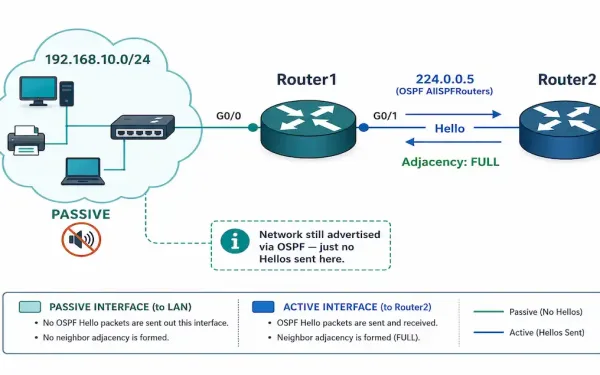
In OSPF (Open Shortest Path First), a passive interface is an interface on which the router stops sending OSPF Hello packets, while still advertising that interface’s connected network in OSPF. Because no Hellos are sent, no OSPF neighbor adjacency can form on that link — but the subnet remains reachable and advertised to the rest...
Configure Single-Area OSPFv2: A Comprehensive Guide
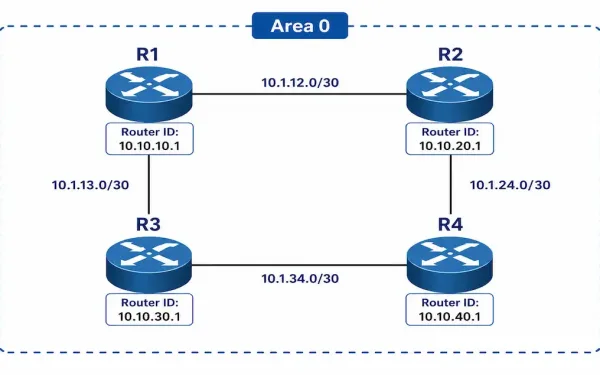
OSPFv2 is a link-state routing protocol for IPv4, first drafted in 1991 (RFC 1247) and standardized in 1998 (RFC 2328). It’s the scalable, classless alternative to the distance-vector Routing Information Protocol (RIP). OSPF uses Dijkstra’s algorithm to compute shortest paths, which is what makes it a solid fit for larger networks where RIP’s hop-count limit...