Muhammad Khattak
Routing and switching specialist, CCNA certified, with extensive experience in network configuration and troubleshooting. Covers OSPF, EIGRP, VLAN management, and advanced routing concepts.
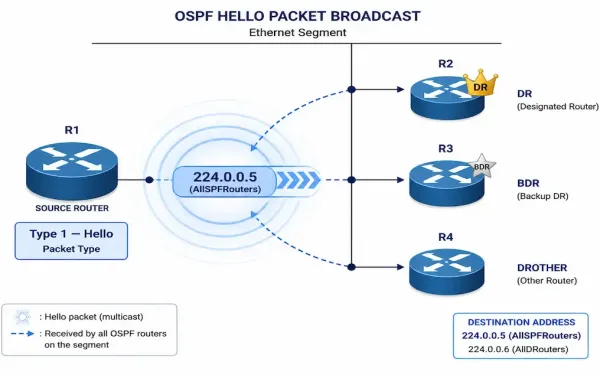
OSPF Hello Packets: Structure, Timers, and Troubleshooting
OSPF Hello packets are Type 1 packets. Routers send them out every OSPF-enabled interface, including virtual links. Their job is simple: find neighbors, and keep those neighbor relationships alive. It’s a small packet with a big job. Nearly every OSPF problem you’ll ever troubleshoot starts here. Routers send Hello packets as multicast, to 224.0.0.5 (AllSPFRouters)....
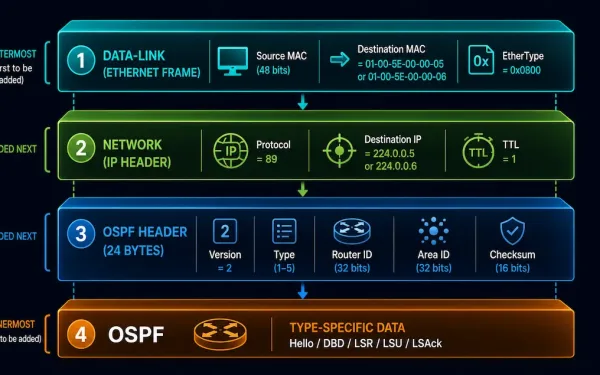
OSPF Encapsulation: How an OSPF Message Is Wrapped for Delivery
Open Shortest Path First (OSPF) operates at the network layer, but it doesn’t travel across a network on its own — every OSPF message gets wrapped in a stack of headers before it ever leaves a router’s interface. Understanding exactly how that wrapping works, layer by layer, is essential for reading a packet capture correctly...
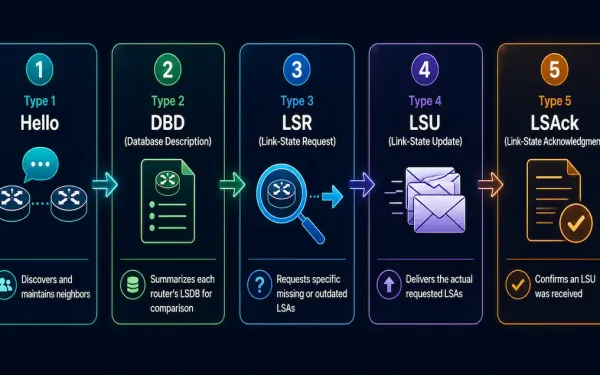
OSPF Packets Types: Hello, DBD, LSR, LSU, and LSAck Explained
Open Shortest Path First (OSPF) is a link-state routing protocol widely used in enterprise networks, and a key topic for CCNA and CCNP certifications. OSPF relies on five distinct packet types to establish neighbor adjacencies, exchange routing information, and maintain a consistent Link-State Database (LSDB) across every router in an area. Understanding these packets —...
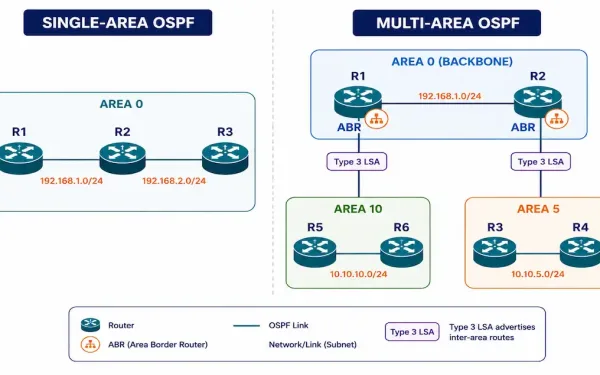
Single-Area OSPF vs. Multi-Area OSPF
Open Shortest Path First (OSPF) is a link-state routing protocol widely used in enterprise IP networks for its efficiency and scalability. Unlike distance-vector protocols like RIP, OSPF uses a hierarchical design, segmenting networks into areas to optimize routing. Each area consists of routers sharing identical Link-State Databases (LSDBs), containing topology information. For CCNA and CCNP...
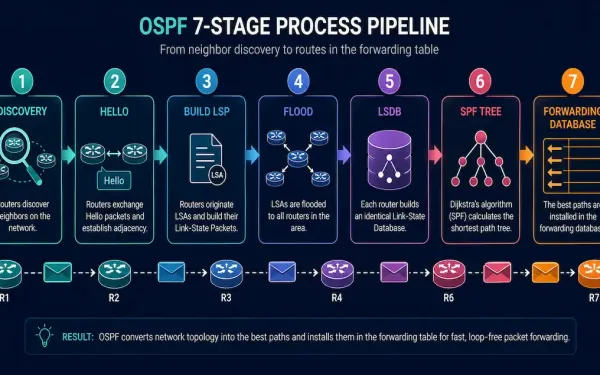
Link-State Routing Protocols Explained: Discovery, Flooding, and the SPF Tree
Link-state routing protocols are also known as shortest-path-first protocols. Every router running one maintains a complete picture of the entire network topology, built by having each router originate information about itself, its directly connected links, and the state of those links — then flooding that information to every other router in the area. OSPF is...
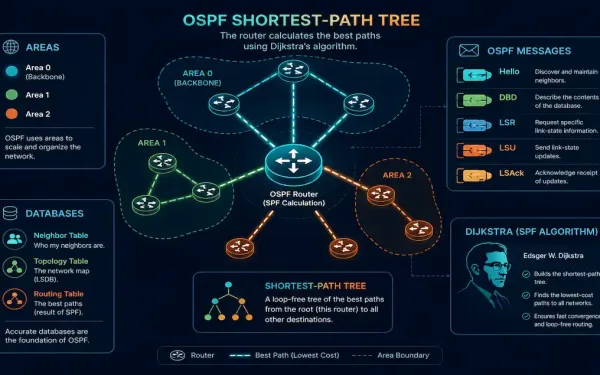
Introduction to Open Shortest Path First (OSPF)
Open Shortest Path First is a link-state routing protocol built to replace RIP, the distance-vector protocol that worked reasonably well in early, small networks but never scaled. RIP’s hop-count metric ignores bandwidth entirely and its full periodic table broadcasts don’t hold up as networks grow — problems OSPF was specifically designed to solve. Open Shortest...
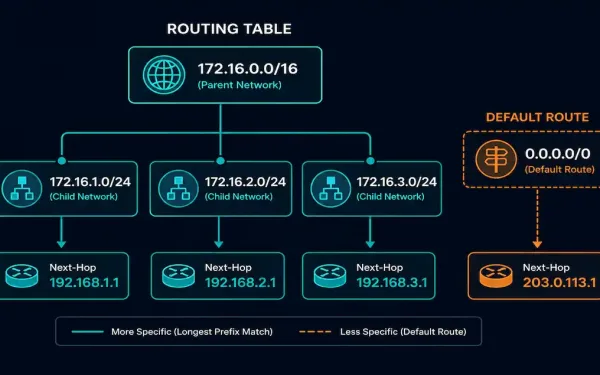
Best Route, Routing Table Terms, and the Lookup Process
When a router receives a packet, it doesn’t just glance at the destination address and pick whichever route looks close enough — it runs a specific, hierarchical process to find the single best match. Understanding that hierarchy, and the terminology Cisco uses to describe it, is essential CCNA and CCNP material that goes a level...
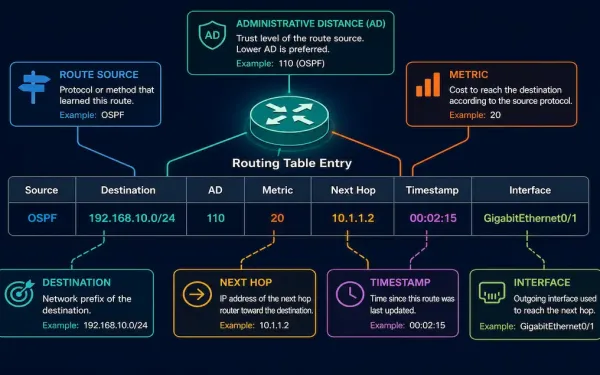
Routing Table Entries and How the Lookup Process Actually Works
A router’s core job is directing traffic across multiple networks, and it does that using a routing table — a list of known networks and the directions to reach them. Each entry in that table is called a route entry, or simply a route. Understanding what information a route entry actually contains, and how a...
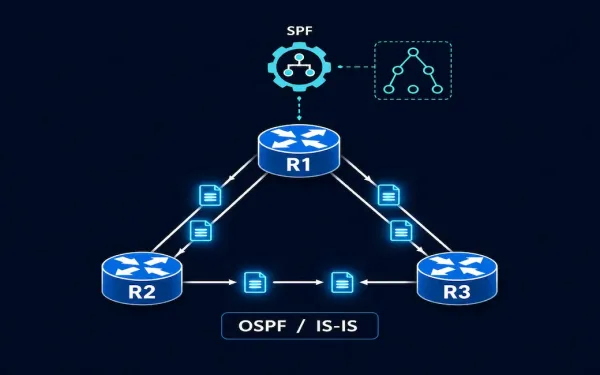
Link-State Routing Protocols Explained: How OSPF and SPF Work
Link-state routing protocols are also known as shortest-path first protocols. They maintain a complete picture of all the routers running a link-state routing protocol in the entire network. All routers running a link-state routing protocol originate information about themselves and their directly connected routers, links, and the state of those links as multicast messages. The...
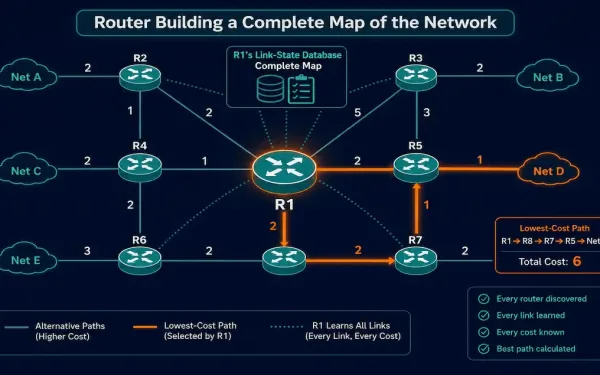
The Shortest Path First (SPF) Protocol: Link-State Routing with Dijkstra’s Algorithm
Efficient routing matters most in complex topologies with many possible paths between two points. The Shortest Path First protocol — better known as link-state routing — uses Edsger Dijkstra’s shortest-path algorithm to work out the genuinely optimal path for forwarding packets, rather than relying on a simpler metric like hop count. Open Shortest Path First...