Muhammad Khattak
Routing and switching specialist, CCNA certified, with extensive experience in network configuration and troubleshooting. Covers OSPF, EIGRP, VLAN management, and advanced routing concepts.
PVST+: Per-VLAN Spanning Tree Explained
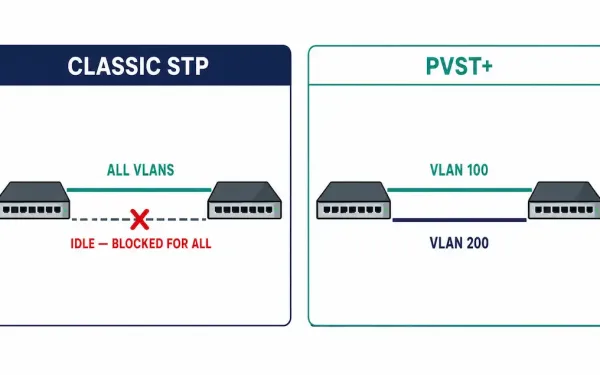
Classic STP runs one spanning tree for the entire switched network, no matter how many VLANs exist. That means every VLAN shares the same root bridge and the same blocked links — one uplink ends up carrying nothing while every other uplink carries everything, regardless of which VLANs actually need which paths. PVST+ (Per-VLAN Spanning...
Spanning Tree Bridge ID Configuration: Root Primary and Root Secondary Explained
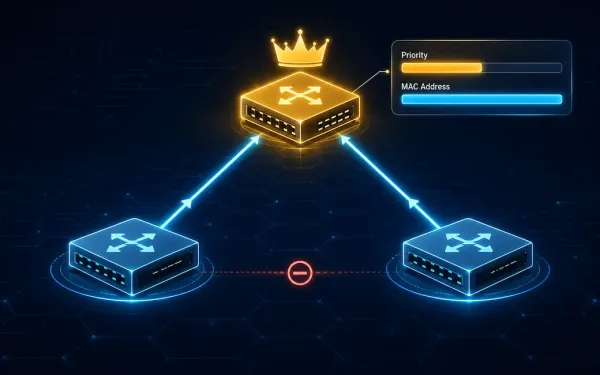
When configuring a specific switch as the root bridge, its bridge ID priority value must be lower than the bridge priority values of all other switches on the network — in Spanning Tree Protocol (STP), a lower priority value always wins the root bridge election. There are two different methods for configuring the bridge priority...
What is RSTP and Rapid PVST+: Exclusive Details
RSTP- IEEE 802.1w is the advanced version of STP, providing faster convergence than CST but holding with the same single root bridge in the topology. Most parameters in RSTP are the same as STP, so users who understand STP can effortlessly configure the RSTP. Rapid PVST+ is Cisco’s proprietary implementation of RSTP that operates on...
What is PVST+ – Revolutionize VLAN Load Balancing and Banish Network Loops Forever (Updated 2025)
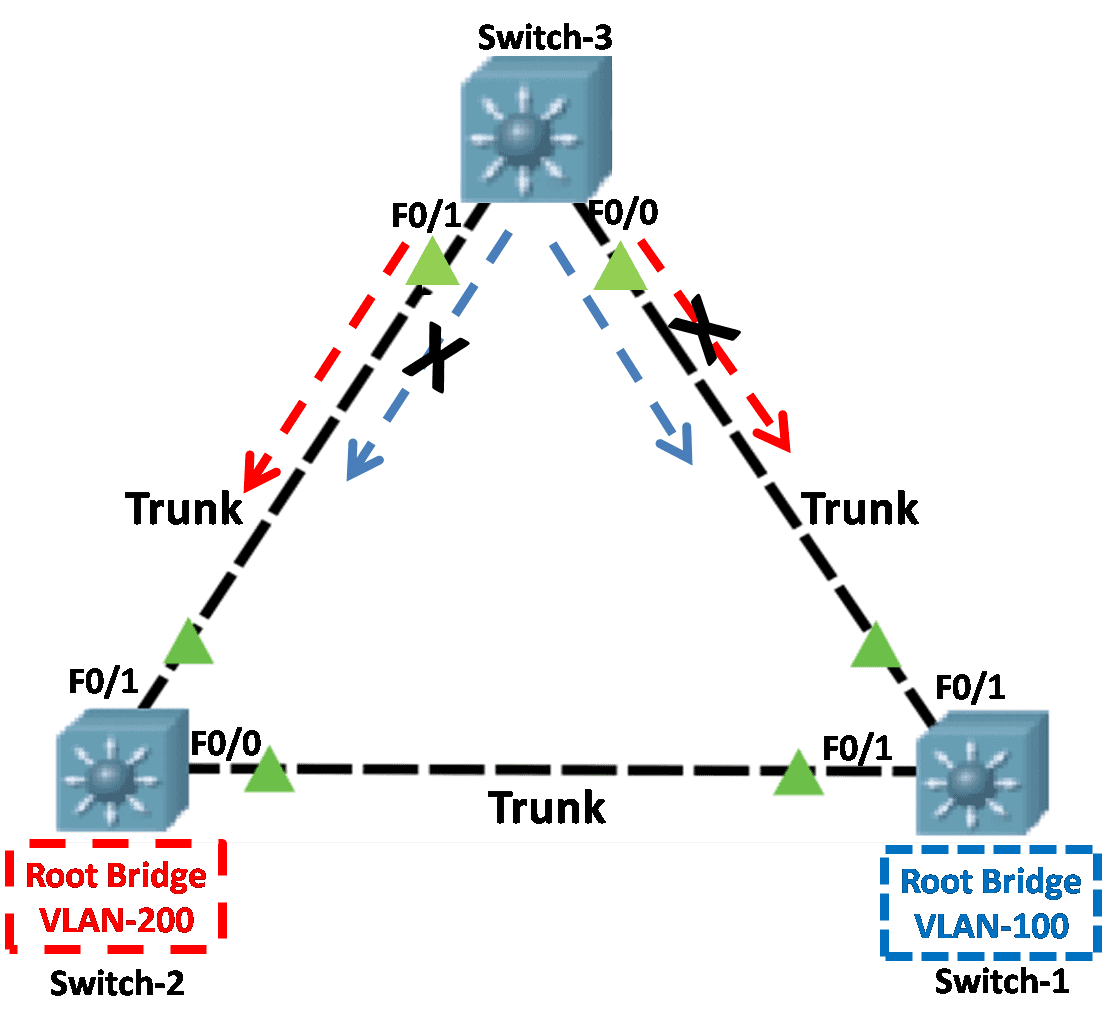
The original IEEE 802.1D standard spanning tree protocol assumes only one spanning-tree instance for the entire switched network, regardless of the number of VLANs. A network running cannot ensure load balancing because one uplink must block all VLANs, but the CPU is free because there is only one instance of a spanning tree working. The...
Types of Spanning Tree Protocols: STP, PVST+, RSTP, Rapid PVST+, and MSTP Compared
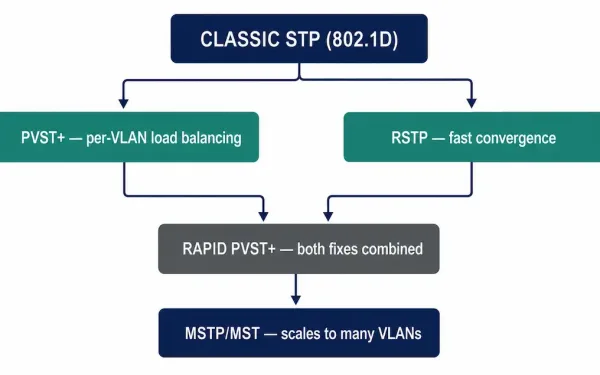
Spanning Tree Protocol prevents Layer 2 loops, but “STP” isn’t one single implementation — it’s a family of standards and Cisco extensions that evolved over three decades to fix the original protocol’s two biggest weaknesses: slow convergence and one-size-fits-all topology. This article ties together the whole family covered so far in this series — what...
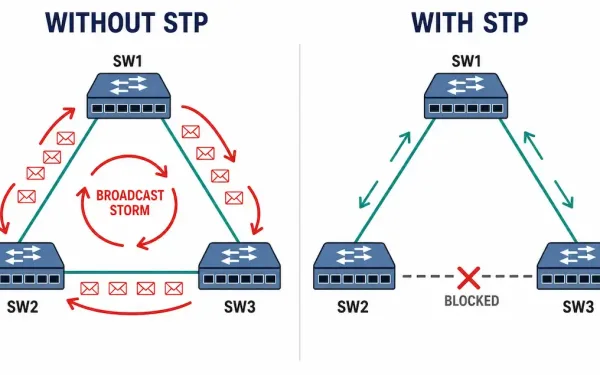
Spanning Tree Protocol (STP): The Complete Guide to Loop-Free Switched Networks
Redundant links keep a switched network alive when a cable or switch fails. But redundancy has a cost. Without a control mechanism, those extra paths create Layer 2 loops. Loops cause broadcast storms, duplicate frames, and MAC address table instability. Spanning Tree Protocol (STP) is that control mechanism. It lets you build physical redundancy without...
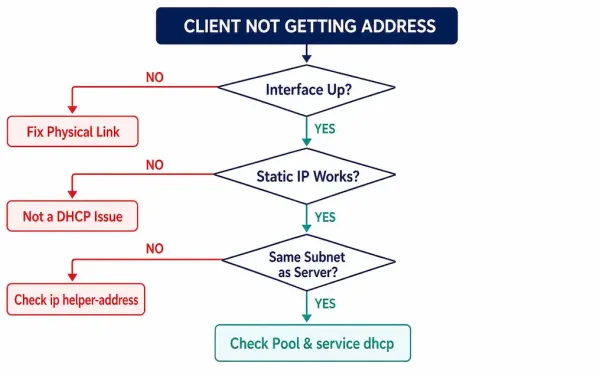
How to Troubleshoot DHCPv4 Problems
DHCP failures rarely announce their cause directly — a client just sits without an address, or ends up with the wrong one, and the actual reason could be anywhere from a bad cable to a missing relay command to a full address pool sitting quietly exhausted. What separates a fast fix from an hour of...
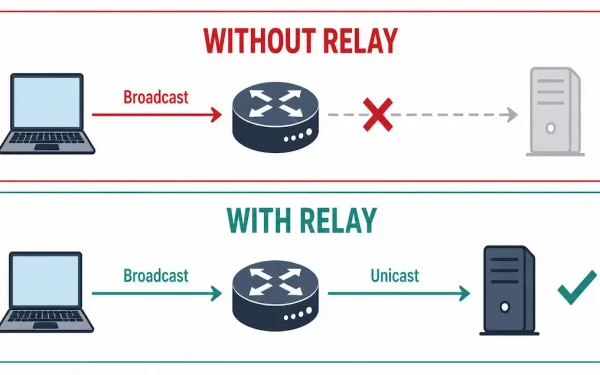
What Is DHCPv4 Relay?
Routers don’t forward broadcast traffic between subnets — that’s the whole point of a router, keeping broadcast domains contained. Most of the time that’s exactly what you want. But DHCP’s initial DISCOVER message is a broadcast, sent by a client that has no IP address yet and therefore no way to address anything directly. If...
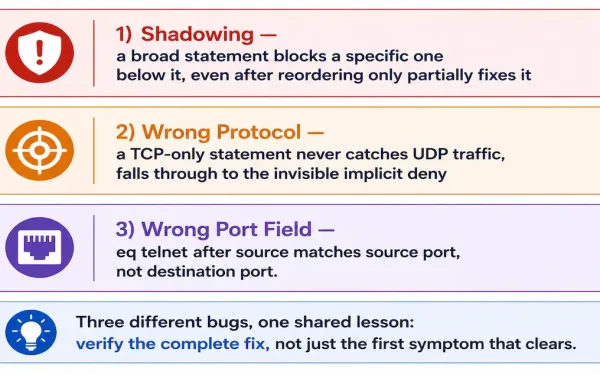
How to Troubleshoot ACL Errors
Access Control Lists are fundamental to network security and traffic management in Cisco environments, but misconfigurations can block legitimate traffic or allow unauthorized access just as easily as a correctly written ACL prevents both. This guide walks through three real categories of ACL bugs, using show access-lists to diagnose each one, and gives the genuinely...
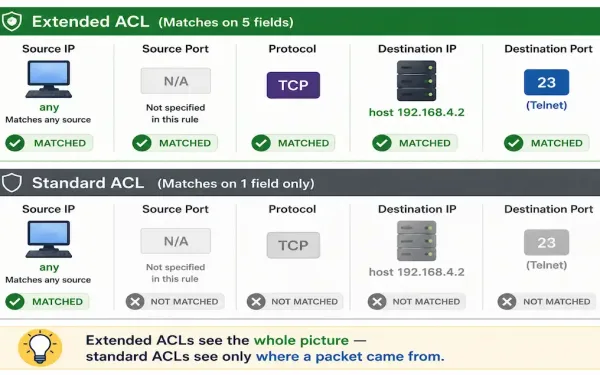
How to Configure Extended ACLs
Extended ACLs are used more than standard ACLs because of their far greater precision. Where a standard ACL can only match source address, extended ACLs check source address, destination address, protocol, and port number together — enabling filtering standard ACLs simply can’t express. An extended ACL can, for example, allow FTP traffic from a network...