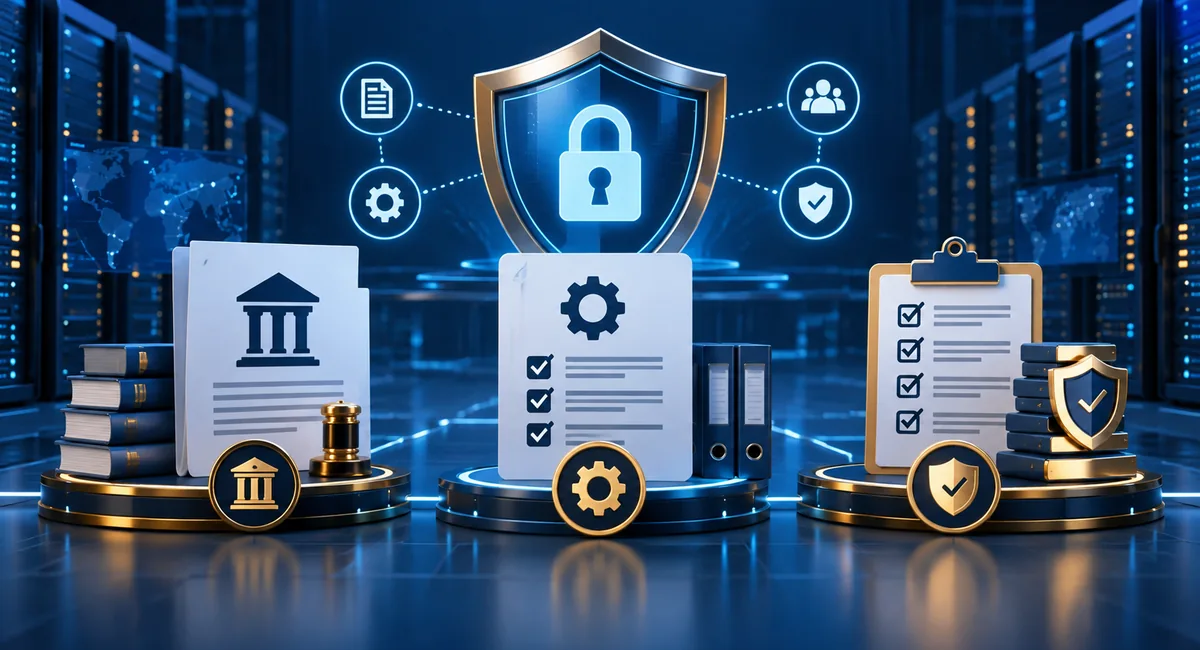
- What cybersecurity frameworks, management-system standards, and prioritized control sets are designed to do.
- How NIST Cybersecurity Framework (CSF) 2.0 organizes cybersecurity risk outcomes.
- How ISO/IEC 27001:2022 defines requirements for an Information Security Management System (ISMS).
- How CIS Critical Security Controls v8.1 prioritizes practical safeguards against common attacks.
- How these approaches differ in purpose, structure, implementation, and certification.
- How organizations can combine frameworks without treating them as interchangeable.
- How to identify the most appropriate approach in Security+ SY0-701 scenarios.
What Are Cybersecurity Frameworks and Standards?
Organizations use security frameworks, standards, and control sets to organize security activities, reduce risk, define expectations, and communicate progress. They can support decisions about governance, asset protection, risk treatment, incident response, audits, and continuous improvement.
These terms are related, but they do not mean exactly the same thing. The NIST Cybersecurity Framework (CSF) organizes cybersecurity outcomes and provides a flexible structure for managing risk. ISO/IEC 27001 specifies requirements for an Information Security Management System (ISMS). The CIS Critical Security Controls provide prioritized, practical safeguards that organizations can implement to improve their defenses.
NIST CSF, ISO/IEC 27001, and CIS Controls can support the same security program, but they serve different purposes. Choose them according to the organization's risk, obligations, desired outcomes, maturity, and resources—not because one is universally best.
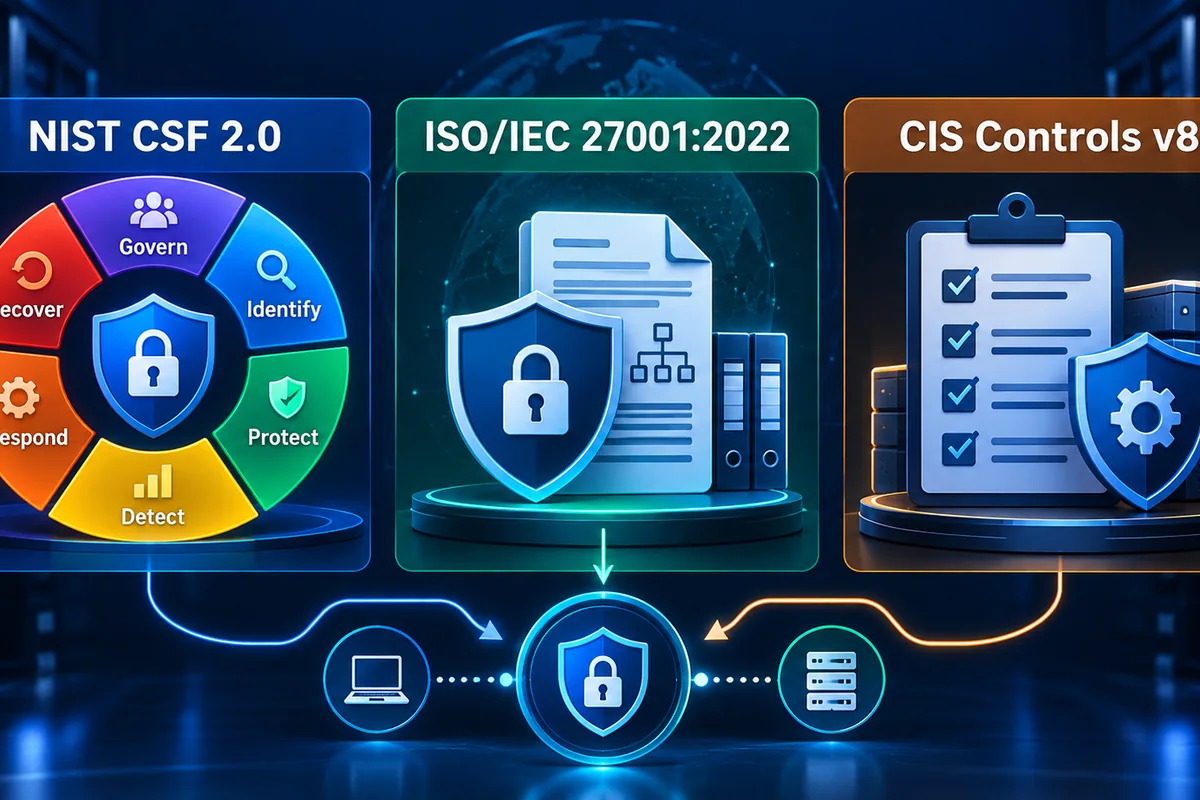
NIST Cybersecurity Framework (CSF) 2.0
The NIST Cybersecurity Framework 2.0 helps organizations understand, assess, prioritize, and communicate cybersecurity risk. It groups cybersecurity outcomes into a flexible structure that organizations can adapt to their mission, risk tolerance, size, sector, and current security capabilities. It describes desired outcomes rather than prescribing one mandatory way to achieve them.
CSF 2.0 is organized around six concurrent and continuous Functions: Govern, Identify, Protect, Detect, Respond, and Recover. The Govern Function makes cybersecurity governance and its relationship to enterprise risk management more explicit. NIST's CSF resources explain the Framework's Functions and components.

The Six NIST CSF 2.0 Functions
Govern
Establish cybersecurity risk-management strategy, expectations, policies, roles, oversight, and supply-chain risk considerations.
Identify
Understand the organization's assets, business context, vulnerabilities, threats, and cybersecurity risks.
Protect
Implement safeguards such as identity management, access control, awareness, data security, and platform protection.
Detect
Find and analyze potential cybersecurity attacks, compromises, and anomalies in a timely way.
Respond
Take appropriate actions when a cybersecurity incident is detected, including analysis, communication, mitigation, and response coordination.
Recover
Restore affected systems, services, and operations while supporting resilience and improvement.
Profiles and Implementation Tiers
CSF Profiles describe cybersecurity outcomes selected for an organization or use case. A Current Profile describes outcomes being achieved today; a Target Profile describes outcomes the organization aims to achieve. Comparing them helps identify gaps and prioritize improvements.
CSF Implementation Tiers characterize the rigor of cybersecurity risk governance and management practices, from Partial through Adaptive. They help describe how risk decisions are made and integrated; they are not, by themselves, a pass/fail certification score.
If a scenario asks for a flexible, outcome-based approach to understand and prioritize cybersecurity risk, consider NIST CSF. If it asks for a formal ISMS requirements standard that can be used as a basis for certification, consider ISO/IEC 27001.
ISO/IEC 27001:2022
ISO/IEC 27001:2022 is an international standard specifying requirements for establishing, implementing, maintaining, and continually improving an Information Security Management System (ISMS). It gives an organization a systematic way to manage information-security risks and decide how those risks will be treated.
An ISMS includes more than technical tools. It connects leadership, risk assessment, policies, assigned responsibilities, operational processes, evidence, internal audits, management review, and improvement. The organization defines the scope and uses risk assessment and treatment to determine which controls are appropriate.
Risk Treatment and Annex A
ISO/IEC 27001 requires an organization to evaluate and treat information-security risks and document relevant decisions. Annex A provides a reference set of information-security controls to consider during risk treatment. Control selection should be justified by the organization's risk assessment and requirements; every control does not automatically apply in the same way to every organization.
The 2022 edition groups Annex A controls into four themes: organizational, people, physical, and technological. The standard also requires documented information and ongoing evaluation of the ISMS. An organization seeking certification is assessed against the standard's requirements within the certification scope. Certification is not a guarantee that incidents can never occur.
Plan and Operate
Define scope, responsibilities, risk assessment, risk treatment, policies, and operational processes for information security.
Evaluate and Improve
Monitor performance, retain appropriate evidence, audit the ISMS, review results, address nonconformities, and continually improve.
ISO/IEC 27001 specifies the requirements for an ISMS. ISO/IEC 27002 provides guidance on information-security controls and their implementation. Do not confuse the two in an exam question.
CIS Critical Security Controls v8.1
The CIS Critical Security Controls v8.1 are a prioritized set of cybersecurity safeguards designed to help organizations defend against prevalent attacks. They translate security improvement into practical actions covering assets, configuration, accounts, data, monitoring, vulnerability management, incident response, and other areas.
CIS Controls v8.1 realigns its mappings to NIST CSF 2.0 and includes clearer identification of governance recommendations. The Controls are useful when a team needs actionable priorities rather than only a high-level statement of desired outcomes.

Implementation Groups (IG1, IG2, and IG3)
CIS Implementation Groups help organizations prioritize the Controls and Safeguards most appropriate to their risk profile and resources. They support progressive implementation rather than acting as interchangeable certification levels.
Essential Cyber Hygiene
A starting point for organizations that need foundational safeguards against common risks and have limited resources dedicated to cybersecurity.
Broader Risk Coverage
Builds on IG1 for organizations with more operational complexity, specialist roles, sensitive information, or additional requirements.
Advanced Protection Needs
Builds on the earlier groups for environments with demanding risks, sensitive assets, and greater need for specialized expertise.
If a question asks for a prioritized, actionable set of safeguards to improve cyber defense, CIS Controls are a strong match. Select an Implementation Group based on risk, resources, and operational complexity—not organization size alone.
NIST CSF vs. ISO/IEC 27001 vs. CIS Controls
These approaches can be mapped to one another and used together, but they differ in primary purpose and structure. This comparison is a study aid, not a claim that one approach fully replaces another.
| Comparison | NIST CSF 2.0 | ISO/IEC 27001:2022 | CIS Controls v8.1 |
|---|---|---|---|
| Primary purpose | Organize and communicate cybersecurity risk outcomes. | Define requirements for an Information Security Management System. | Prioritize practical safeguards against prevalent attacks. |
| Structure | Six Functions, Categories, Subcategories, Profiles, and Tiers. | ISMS requirements, risk assessment and treatment, and a reference control set in Annex A. | Controls and Safeguards, with Implementation Groups to help prioritize adoption. |
| Typical question | What cybersecurity outcomes should we achieve, and how do we assess gaps? | How do we establish, operate, evaluate, and improve a risk-based ISMS? | Which prioritized safeguards should we implement to improve defense? |
| Certification | Not a certification standard by itself. | Organizations can seek certification against the standard's requirements. | Not itself an ISO-style ISMS certification standard. |
| Best fit | Risk discussions, current/target posture, and flexible improvement planning. | Formal management-system requirements, assurance, and stakeholder needs. | Concrete technical and operational safeguards prioritized by risk and capacity. |
How the Three Approaches Work Together
An organization does not necessarily need to select only one. NIST CSF can help leadership define target outcomes and assess gaps. ISO/IEC 27001 can provide requirements for the organization's ISMS. CIS Controls can help technical teams select and implement prioritized safeguards that address identified risks.
Use business context, asset information, and a CSF Profile to identify current gaps and desired outcomes.
Define scope, assess and treat information-security risks, assign responsibilities, and establish processes under ISO/IEC 27001 where appropriate.
Select applicable controls and practical CIS Safeguards to address priority risks and support required outcomes.
Track evidence, review effectiveness, audit as appropriate, update priorities, and repeat the improvement cycle.
Real-World Scenario: A Growing Service Provider
Scenario
A growing service provider stores customer information and uses cloud services. Leadership wants a clearer view of cyber risk, a major customer asks for evidence of a formal security management program, and the operations team needs concrete priorities for hardening endpoints and accounts.
The organization could use NIST CSF 2.0 to communicate current and target cybersecurity outcomes, evaluate gaps, and prioritize risk discussions. It could implement an ISMS aligned with ISO/IEC 27001:2022 if formal management-system requirements and potential certification fit its business needs. Its technical team could then use CIS Controls and the appropriate Implementation Group to prioritize safeguards such as asset inventory, secure configuration, account management, vulnerability management, logging, and incident response.
Security lesson: A framework helps organize outcomes, an ISMS standard defines management-system requirements, and prioritized safeguards guide implementation. Align them through mapping and evidence instead of treating them as identical documents.
Choosing the Right Approach
Choose NIST CSF When…
- You need an adaptable cybersecurity risk-management structure.
- You want to assess current and target outcomes.
- You need a common language for leadership and technical teams.
Choose ISO/IEC 27001 When…
- You need formal requirements for an ISMS.
- You need systematic risk treatment, internal review, and continual improvement.
- Customers, partners, or business objectives make certification valuable.
Use CIS Controls When…
- You need prioritized, practical security actions.
- Your team wants a clear path to strengthen cyber defenses.
- You need safeguards selected according to risk and implementation capacity.
Use Them Together When…
- You need outcomes, governance, and actionable safeguards.
- You need to communicate risk and demonstrate implementation evidence.
- Different stakeholders need complementary views of the same security program.
Common Misconceptions
Security+ SY0-701 Exam Strategy
Read the requested outcome carefully. Risk outcomes and current/target posture point toward NIST CSF; formal ISMS requirements and certification point toward ISO/IEC 27001; prioritized practical safeguards point toward CIS Controls.
Learn each approach's purpose, structure, and typical use case. The best answer is the one that matches the specific business requirement in the scenario.
Practice Questions
10 scenario-based questions. Expand each card to reveal the answer and explanation.
Exam Quiz
Security Frameworks Overview · Supplemental Guide · 15 questions · 10 minutes
Security Frameworks — Exam Simulation
Test your understanding of NIST CSF 2.0, ISO/IEC 27001, CIS Controls, Profiles, Implementation Groups, and framework selection.
15 Questions
Framework comparisons
10 Minutes
Timed simulation
Instant Feedback
Explanation per answer
Answer Review
Score and corrections
Security Frameworks Overview — Summary
NIST CSF 2.0, ISO/IEC 27001:2022, and CIS Controls v8.1 · Supplemental guide for Domain 1.0 — General Security Concepts · Exam domain weight: 12%
Key Takeaways
| Approach | Purpose | Exam Clue |
|---|---|---|
| NIST CSF 2.0 | Organizes cybersecurity risk outcomes | Profiles, Tiers, six Functions |
| ISO/IEC 27001:2022 | Requirements for an ISMS | Formal management system and certification |
| ISO/IEC 27002 | Guidance on information-security controls | Control guidance, not the ISMS requirements standard |
| CIS Controls v8.1 | Prioritized cyber defense Safeguards | Practical actions and Implementation Groups |
| CSF Profile | Describe selected current or target outcomes | Gap analysis and improvement planning |
| CIS IG1 / IG2 / IG3 | Help prioritize safeguard adoption | Risk, resources, and operational complexity |
Exam Tips — Security Frameworks
- NIST CSF 2.0 has six Functions: Govern, Identify, Protect, Detect, Respond, and Recover.
- ISO/IEC 27001 specifies requirements for an ISMS and can support certification.
- ISO/IEC 27002 provides guidance on information-security controls.
- CIS Controls are prioritized, actionable Safeguards; Implementation Groups help structure adoption.
- A Current Profile compared with a Target Profile helps identify improvement gaps in NIST CSF.
- Framework mapping supports alignment but does not make different approaches identical.
Common Pitfalls
Security+ SY0-701 — Exam Domains
Security Frameworks is a supplemental, unnumbered guide; it is not Lesson 01.11.