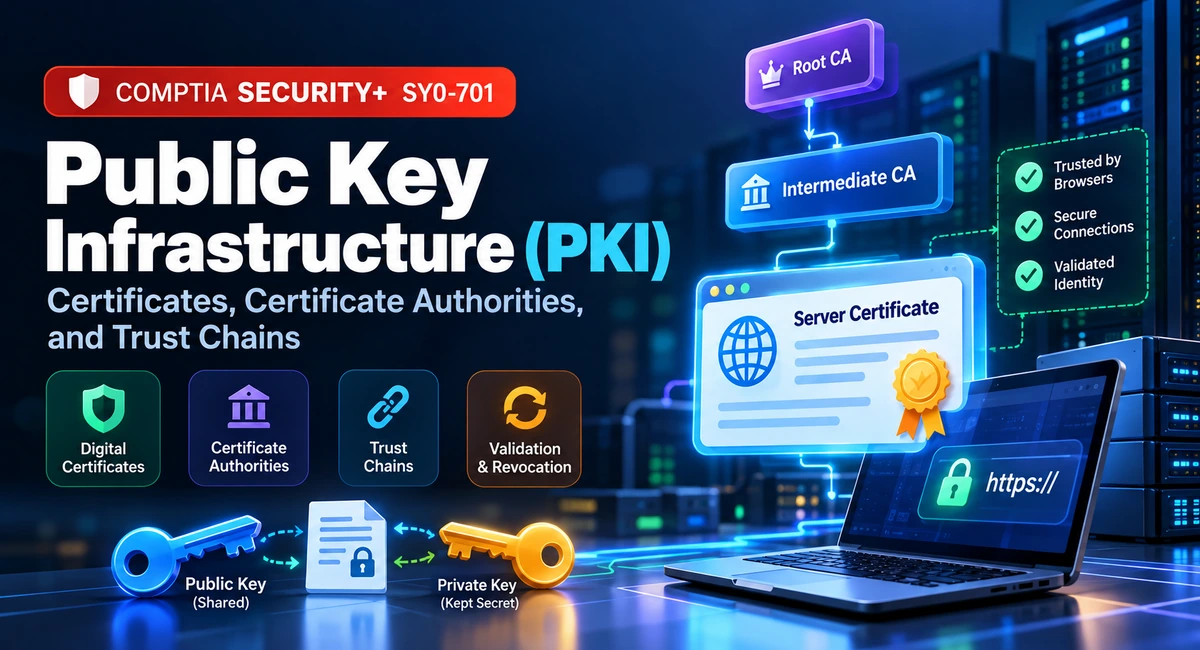
- What Public Key Infrastructure (PKI) is and why organizations use it.
- How public-key certificates connect identity information with a public key.
- What certificate authorities do and why root and intermediate CAs exist.
- How certificate chains and trust anchors support certificate validation.
- How certificate signing requests (CSRs), issuance, renewal, expiration and revocation work.
- How certificate revocation lists (CRLs) differ from OCSP.
- How self-signed, third-party CA-issued, wildcard and SAN certificates differ.
- How key escrow can support controlled recovery and what risks it creates.
- How PKI supports TLS, HTTPS, authentication and digital signatures.
- How to identify common PKI concepts in Security+ scenario questions.
What Is Public Key Infrastructure (PKI)?
Public Key Infrastructure (PKI) is a framework of technologies, policies, processes and trusted entities used to create, manage, validate, distribute and revoke digital certificates and public keys.
PKI helps organizations establish trust when communicating over networks that cannot automatically be trusted. It is especially important for secure web connections, enterprise authentication, VPNs, email security, digital signatures and other systems that rely on public-key cryptography.
Why Is PKI Needed?
Public-key cryptography allows parties to use a public/private key pair, but cryptography alone does not answer an important question: Who actually owns this public key?
A digital certificate helps solve this identity problem by binding information about an entity to its public key. A trusted certificate authority can provide a mechanism for other systems to validate that binding.
Unknown Public Key
How can a client know that a public key belongs to the claimed server or identity?
Digital Certificate
A certificate binds identity information to a public key.
Certificate Authority
A trusted CA issues certificates according to defined validation and policy requirements.

What Is a Digital Certificate?
A digital certificate is an electronic credential that associates identity information with a public key. It contains information that allows relying systems to evaluate who the certificate represents and whether it can be trusted.
Certificates commonly use the X.509 standard. An X.509 certificate can contain the subject, issuer, public key, validity period, serial number, extensions and the issuer’s digital signature.
| Certificate Element | Purpose |
|---|---|
| Subject | Identifies the entity represented by the certificate. |
| Issuer | Identifies the CA that issued and signed the certificate. |
| Public key | Contains the public key associated with the identity. |
| Validity period | Defines when the certificate becomes valid and when it expires. |
| Serial number | Identifies the certificate within the issuing CA’s scope. |
| Digital signature | Allows the relying party to verify the issuer’s signature over the certificate data. |
| Subject Alternative Name (SAN) | Can list DNS names, IP addresses or other identities covered by the certificate. |
What Is a Certificate Authority (CA)?
A Certificate Authority (CA) is a trusted entity that issues and manages digital certificates. The CA evaluates certificate requests under its policies, signs approved certificates and may publish or support certificate status information.
In a PKI environment, the CA is part of the chain of trust. A certificate is not automatically trustworthy merely because a CA signed it; the client must also validate the chain, identity, validity, usage, revocation status and applicable policy.
- Validate certificate requests according to policy.
- Issue and sign certificates.
- Maintain certificate records.
- Support renewal and replacement.
- Revoke certificates when required.
- Publish or support certificate status information.
- That the subject’s private key is protected automatically.
- That every issued certificate remains trusted forever.
- That certificate issuance eliminates configuration risk.
- That a certificate is valid for every hostname or intended use.
Root CA vs. Intermediate CA
PKI often uses a hierarchy of certificate authorities instead of having one CA issue every certificate directly.
Root CA
The root CA is the highest authority in a CA hierarchy. Its certificate is commonly self-signed and may serve as a trust anchor when it is already trusted by the relying system.
Intermediate CA
An intermediate CA sits below the root CA. It can issue certificates to subordinate CAs or end entities according to its constraints and policies.

What Is a Certificate Chain?
A certificate chain, also called a chain of trust, is the sequence of certificates that connects an end-entity certificate to a trusted root CA or another accepted trust anchor.
During validation, the relying system checks certificate signatures and issuer relationships throughout the chain. It ultimately relies on a root certificate or other trust-anchor information that it already accepts.
Trust Anchor and Root of Trust
A trust anchor is trusted information—commonly a root CA certificate—that provides the starting point for certificate-chain validation. Operating systems, browsers and applications may maintain trusted root certificates in a trust store.
The phrase root of trust describes a foundational trusted component or information on which a security verification process relies. In PKI scenarios, look for the trusted root certificate or public key. In hardware and platform security, a root of trust may instead begin with a protected hardware or firmware component.
Self-Signed vs. Third-Party CA-Issued Certificates
Certificates differ in who signs them and how relying systems establish trust. A signature alone does not guarantee that a certificate is safe or suitable for every use.
Signed by Its Own Issuing Entity
A self-signed certificate is signed using the key associated with the entity that issues it. It can be useful for testing or controlled internal environments, but it is not automatically trusted by browsers or other systems. Trust must be established through a suitable out-of-band process or explicit configuration.
Signed by a Certificate Authority
A third-party CA validates a certificate request according to its policies and signs the resulting certificate. Publicly trusted certificates can chain to roots already trusted by clients, provided the required validation checks pass.
Wildcard Certificates and Subject Alternative Names
A wildcard certificate uses a wildcard in a domain name to cover matching subdomains at the applicable label level. For example, *.example.com can cover shop.example.com and mail.example.com, subject to certificate and client matching rules.
A wildcard does not automatically cover unrelated domains, every deeper nested subdomain or the base name example.com unless that name is also included. The Subject Alternative Name (SAN) extension can list additional identities, including DNS hostnames or IP addresses.
| Feature | Best Clue | Important Limitation |
|---|---|---|
| Wildcard | One pattern covers matching subdomains, such as *.example.com. | Coverage depends on matching rules; compromise may affect multiple covered hosts. |
| SAN | Lists specific DNS names or IP addresses on one certificate. | Each required identity must be included and validated correctly. |
Certificate Signing Request (CSR)
A Certificate Signing Request (CSR) is submitted to a CA when an entity needs a certificate. It commonly contains the requester’s public key, requested identity information and a signature made with the corresponding private key to demonstrate control of that key.
The private key itself must never be sent in the CSR. It remains under the requester’s control and must be stored using appropriate protection.
Create a public/private key pair using an approved process.
Package the public key and requested identity information into a signed request.
The CA, and a registration function if used, check identity and authorization under policy.
If approved, the CA signs and returns the certificate while the private key remains protected.
Key Escrow and Controlled Recovery
Key escrow means placing a controlled copy of a selected cryptographic key with an authorized escrow agent or system so that recovery can occur under defined conditions. Organizations may use escrow for certain encryption keys when losing the original key would make business data inaccessible or when an approved operational process requires recovery.
Potential Benefit
Authorized recovery may restore access to encrypted information after a key is lost or unavailable, when the escrow process is designed for that purpose.
Security Risk
An escrowed key becomes another high-value target. Strong access controls, encryption, auditing, separation of duties and recovery authorization are essential.
Key escrow is not a reason to make every private key recoverable. Signing keys and other identity-sensitive keys may have different recovery requirements. Follow the organization’s cryptographic policy and the key’s intended use. See the Cryptography Basics lesson for related key-management concepts.
PKI Certificate Lifecycle
Certificates have a lifecycle. Understanding each stage is important for operational security and Security+ scenario questions.
A public/private key pair is created.
The requester submits the information needed to obtain a certificate.
The CA validates the request according to its policy.
The CA signs and issues the certificate.
The certificate is installed and used by the intended system.
A new certificate is obtained before the current one expires.
The certificate is invalidated before normal expiration when necessary.
The certificate reaches the end of its validity period.
Certificate Revocation
A certificate can become untrusted before its expiration date. This may occur if the private key is compromised, the certificate was issued incorrectly, the subject is no longer authorized or another policy-defined revocation condition is met.
Revocation is different from expiration. Expiration occurs at the end of the certificate’s validity period. Revocation is an administrative or policy-driven action that invalidates the certificate before that normal end date.

Certificate Revocation List (CRL)
A Certificate Revocation List (CRL) is a published list of certificates revoked by a CA. A client can retrieve the relevant CRL and check whether a certificate’s serial number appears on it.
List-Based Status
The client retrieves a published list and checks whether the certificate appears on it.
Online Status Query
The client can query an OCSP responder for the status of a specific certificate.
Online Certificate Status Protocol (OCSP)
OCSP allows a client to query an OCSP responder about the status of a particular certificate rather than downloading an entire revocation list. It can reduce the amount of status information that a client needs to retrieve compared with traditional CRL-based checking.
How Certificate Validation Works
A relying system does not simply check whether a certificate exists. Certificate validation can involve several checks:
- Is the certificate within its validity period?
- Is its issuer trusted under the client’s trust configuration?
- Does the certificate chain terminate at an accepted trust anchor?
- Are the certificate signatures valid?
- Does the certificate match the intended identity or hostname when applicable?
- Has the certificate been revoked, and what is the configured status-checking behavior?
- Are the key usage, extended key usage and other constraints appropriate?
- Do the algorithms and key parameters meet the applicable policy?
Certificate Algorithms and Key Length
Certificate validation also depends on the algorithms and key parameters used for the public key and certificate signature. A certificate that has not expired can still be unacceptable if it relies on a deprecated algorithm, a weak key or parameters that violate security policy.
Algorithm
Identifies the cryptographic method used for the public key or certificate signature. Do not confuse the certificate’s signature algorithm with the symmetric algorithm used later to protect application traffic.
Key Length
Represents the size of key material for algorithms where size is expressed this way. Security depends on the algorithm and its parameters together, not on a number alone.
PKI and TLS
PKI is closely associated with TLS and HTTPS. When a browser connects securely to a web server, the server can present a digital certificate containing its public key and identity information.
The client validates the certificate and its trust chain. Modern TLS then uses secure key-establishment mechanisms to establish session keys that protect application data.
Establish Trust
Provides certificates, CAs, trust chains and validation mechanisms.
Secure Session
Establishes protected communication between endpoints.
Secure Web Traffic
HTTP traffic protected through TLS.
PKI in Real-World Security
Example: Secure Banking Website
A user visits a banking website using HTTPS. The server presents a certificate. The browser checks the certificate’s identity information, validity period, signature, trust chain and other applicable status or policy information.
Once the secure TLS session is established, application traffic can be protected using session keys negotiated during the TLS handshake.
Security lesson: PKI helps the client establish confidence in the server’s identity and public key. TLS then uses this trust as part of the secure session-establishment process.
Other Common Uses of PKI
PKI Security Risks
PKI vs. Related Concepts
| Concept | Main Purpose | Security+ Clue |
|---|---|---|
| Public key | Can be distributed to others. | Used for verification, encryption or key establishment depending on the system. |
| Private key | Secret key controlled by its owner. | Must be protected from unauthorized disclosure. |
| Digital certificate | Associates identity information with a public key. | Identity + public key + issuer + validity information. |
| CA | Issues and manages certificates. | Trusted authority within the certificate hierarchy. |
| Root CA | Provides a common trust anchor. | Top of a typical CA hierarchy. |
| Intermediate CA | Delegated issuing authority. | Between the root and lower-level certificates. |
| CSR | Requests a certificate from a CA. | Contains a public key and request information, never the private key. |
| CRL | Publishes revoked certificates. | Revocation list. |
| OCSP | Provides online certificate status responses. | Online status query. |
| Trust chain | Links a certificate to an accepted trust anchor. | Chain of trust. |
Security+ SY0-701 Exam Strategy for PKI
Practice Questions
15 scenario-based questions. Open a question to reveal its answer and explanation.
Exam Quiz
Lesson 01.10 — PKI, Certificates, CAs and Trust Chains · 20 questions · 10 minutes
PKI — Exam Simulation
Test your understanding of certificates, CSRs, certificate authorities, trust chains, certificate validation, wildcard and self-signed certificates, key escrow, CRLs, OCSP and certificate lifecycle management.
20 Questions
Lesson 01.10 scope
10 Minutes
Timed exam practice
Instant Feedback
Explanation after each answer
Full Review
Correct, wrong and unanswered counts
Lesson 01.10 — Summary
Public Key Infrastructure: Certificates, Certificate Authorities, Trust Chains and Revocation · Domain 1.0 — General Security Concepts · 12% of Security+ SY0-701
Key Takeaways from Lesson 01.10
| PKI Concept | Main Purpose | Exam Clue |
|---|---|---|
| Digital certificate | Binds identity to a public key | Identity + public key |
| Certificate Authority | Issues and signs certificates | Trusted issuer |
| Root CA | Common trust anchor in a CA hierarchy | Top of trust chain |
| Intermediate CA | Delegated issuing authority | Between root and end entity |
| CSR | Requests a certificate | Public key and request information, not private key |
| CRL | Publishes revoked certificates | Revocation list |
| OCSP | Returns certificate status information online | Single-certificate status query |
| Trust chain | Links a certificate to an accepted trust anchor | Chain of trust |
| Wildcard certificate | Covers matching names within its scope | Hostname matching rules |
| Key escrow | Provides controlled recovery of selected keys | Recovery benefit and added risk |
Exam Tips — Lesson 01.10
- A certificate associates identity information with a public key.
- A root CA can act as the trust anchor at the top of a CA hierarchy.
- An intermediate CA operates below the root and can issue certificates within its authority.
- CRL = list; OCSP = online status query.
- Expiration occurs at the end of the certificate validity period; revocation can occur earlier.
- A CSR contains a public key and request information, never the private key.
- Self-signed certificates are not automatically trusted. Wildcards cover only matching names within their scope.
- Key escrow supports controlled recovery of selected keys but creates an additional high-value target.
- Certificate validation can include identity, signature, algorithms, key parameters, validity, chain, revocation and usage checks.
Common Pitfalls
CompTIA Security+ SY0-701 — Exam Domains
Security Frameworks is a supplemental guide and is not assigned a numbered lesson in this sequence.