
Networking
CCNA tutorials, Cisco guides, and enterprise networking insights for IT professionals.
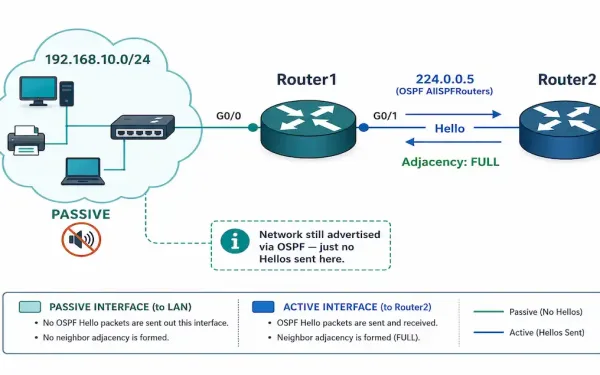
OSPF Passive Interfaces: Configuration and Best Practices
In OSPF (Open Shortest Path First), a passive interface is an interface on which the router stops sending OSPF Hello packets, while still advertising that interface’s connected network in OSPF. Because no Hellos are sent, no OSPF neighbor adjacency can form on that link — but the subnet remains reachable and advertised to the rest...
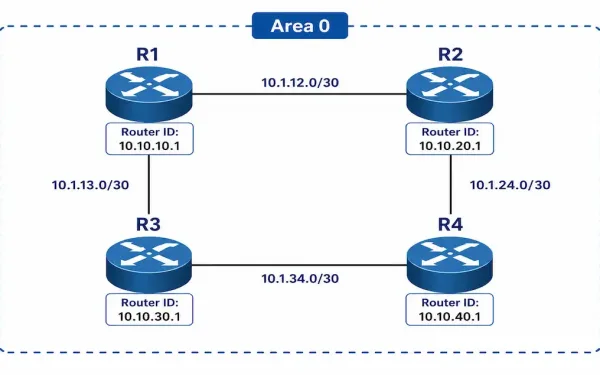
Configure Single-Area OSPFv2: A Comprehensive Guide
OSPFv2 is a link-state routing protocol for IPv4, first drafted in 1991 (RFC 1247) and standardized in 1998 (RFC 2328). It’s the scalable, classless alternative to the distance-vector Routing Information Protocol (RIP). OSPF uses Dijkstra’s algorithm to compute shortest paths, which is what makes it a solid fit for larger networks where RIP’s hop-count limit...
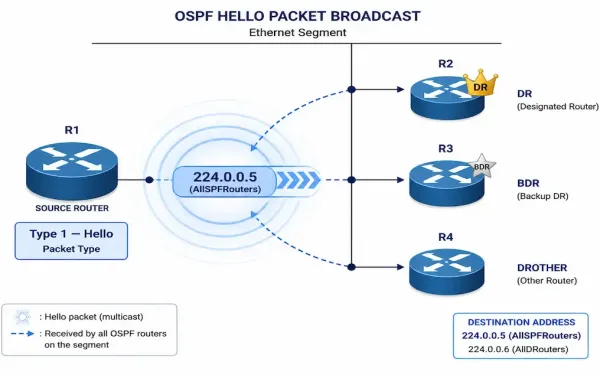
OSPF Hello Packets: Structure, Timers, and Troubleshooting
OSPF Hello packets are Type 1 packets. Routers send them out every OSPF-enabled interface, including virtual links. Their job is simple: find neighbors, and keep those neighbor relationships alive. It’s a small packet with a big job. Nearly every OSPF problem you’ll ever troubleshoot starts here. Routers send Hello packets as multicast, to 224.0.0.5 (AllSPFRouters)....
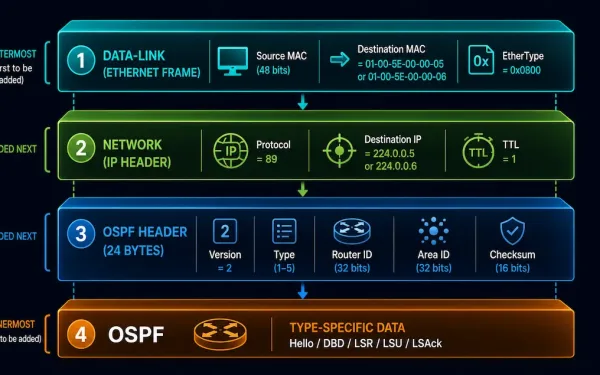
OSPF Encapsulation: How an OSPF Message Is Wrapped for Delivery
Open Shortest Path First (OSPF) operates at the network layer, but it doesn’t travel across a network on its own — every OSPF message gets wrapped in a stack of headers before it ever leaves a router’s interface. Understanding exactly how that wrapping works, layer by layer, is essential for reading a packet capture correctly...
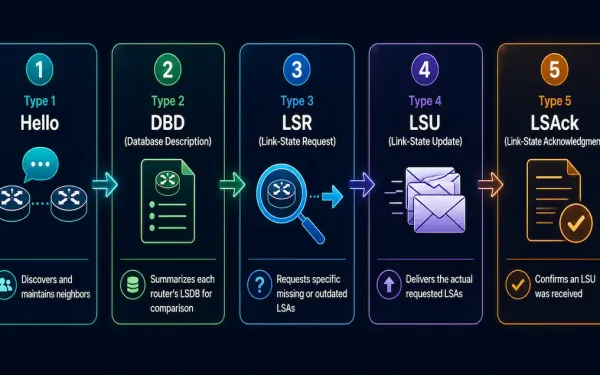
OSPF Packets Types: Hello, DBD, LSR, LSU, and LSAck Explained
Open Shortest Path First (OSPF) is a link-state routing protocol widely used in enterprise networks, and a key topic for CCNA and CCNP certifications. OSPF relies on five distinct packet types to establish neighbor adjacencies, exchange routing information, and maintain a consistent Link-State Database (LSDB) across every router in an area. Understanding these packets —...
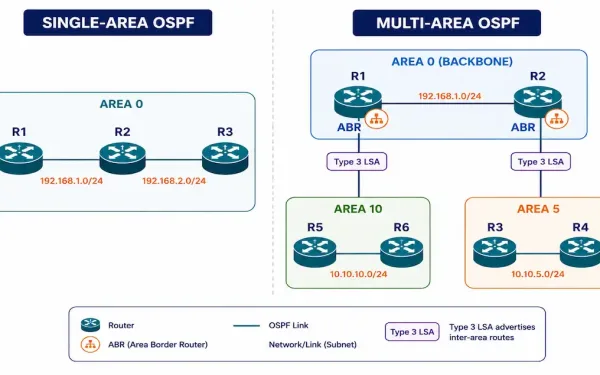
Single-Area OSPF vs. Multi-Area OSPF
Open Shortest Path First (OSPF) is a link-state routing protocol widely used in enterprise IP networks for its efficiency and scalability. Unlike distance-vector protocols like RIP, OSPF uses a hierarchical design, segmenting networks into areas to optimize routing. Each area consists of routers sharing identical Link-State Databases (LSDBs), containing topology information. For CCNA and CCNP...
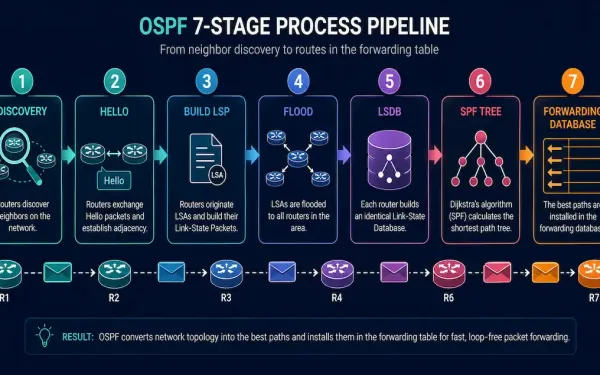
Link-State Routing Protocols Explained: Discovery, Flooding, and the SPF Tree
Link-state routing protocols are also known as shortest-path-first protocols. Every router running one maintains a complete picture of the entire network topology, built by having each router originate information about itself, its directly connected links, and the state of those links — then flooding that information to every other router in the area. OSPF is...
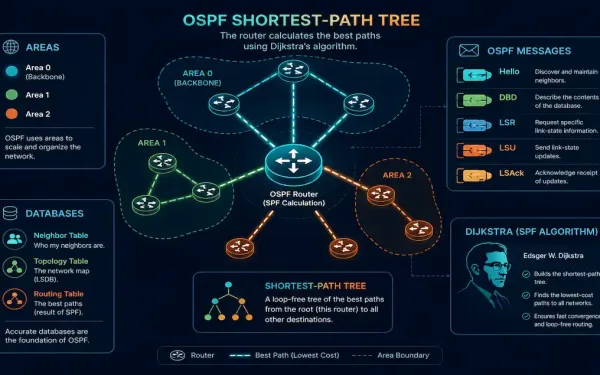
Introduction to Open Shortest Path First (OSPF)
Open Shortest Path First is a link-state routing protocol built to replace RIP, the distance-vector protocol that worked reasonably well in early, small networks but never scaled. RIP’s hop-count metric ignores bandwidth entirely and its full periodic table broadcasts don’t hold up as networks grow — problems OSPF was specifically designed to solve. Open Shortest...
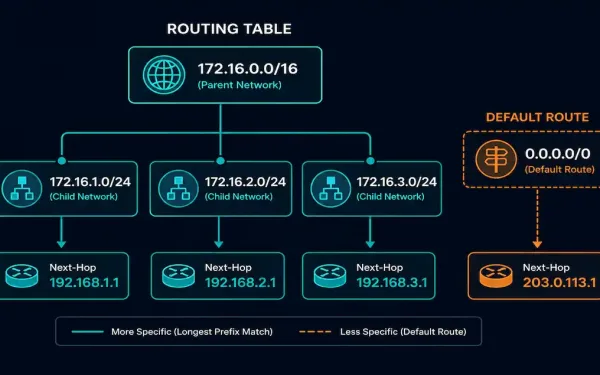
Best Route, Routing Table Terms, and the Lookup Process
When a router receives a packet, it doesn’t just glance at the destination address and pick whichever route looks close enough — it runs a specific, hierarchical process to find the single best match. Understanding that hierarchy, and the terminology Cisco uses to describe it, is essential CCNA and CCNP material that goes a level...
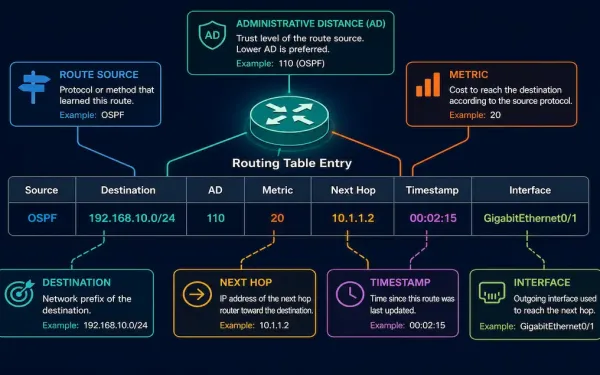
Routing Table Entries and How the Lookup Process Actually Works
A router’s core job is directing traffic across multiple networks, and it does that using a routing table — a list of known networks and the directions to reach them. Each entry in that table is called a route entry, or simply a route. Understanding what information a route entry actually contains, and how a...