CCNA
Cisco Certified Network Associate certification resources
What is RSTP and Rapid PVST+: Exclusive Details
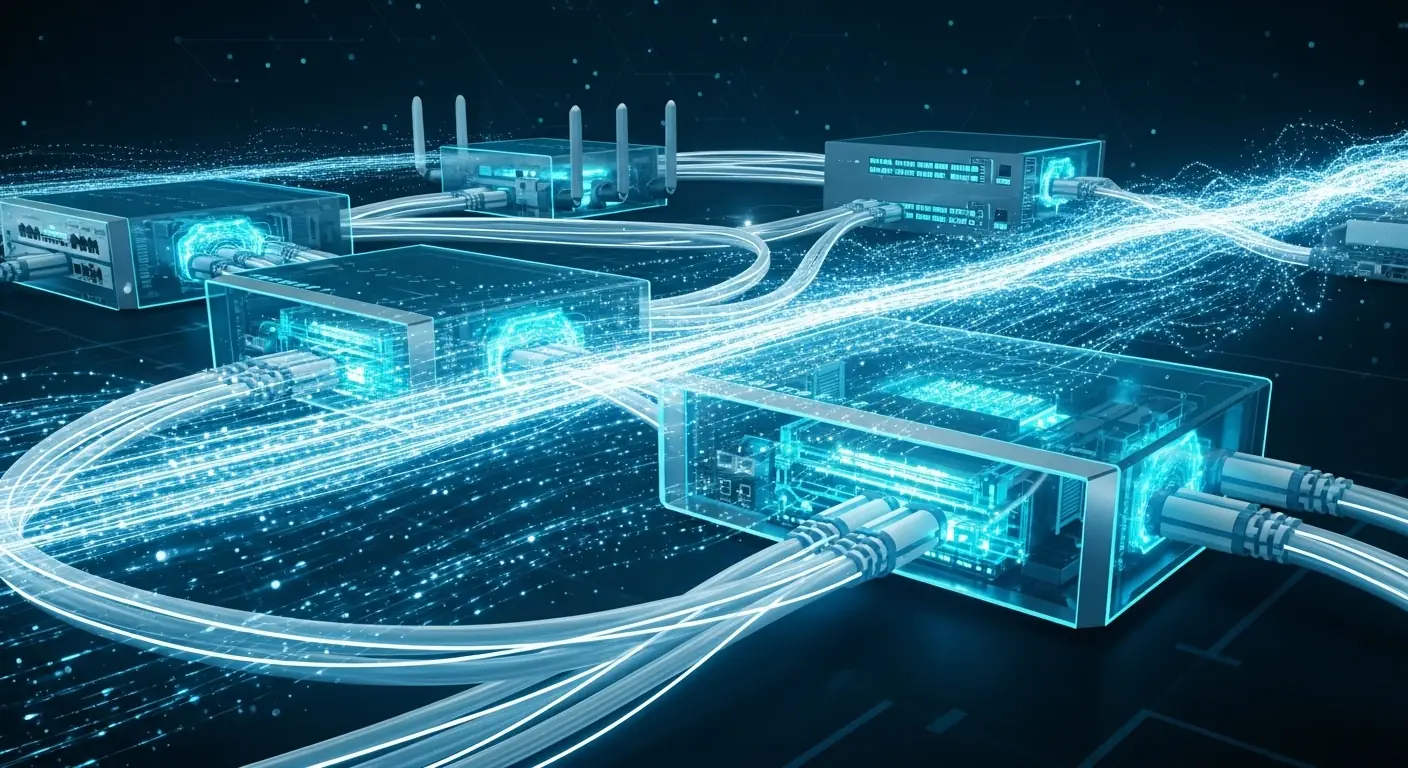
RSTP- IEEE 802.1w is the advanced version of STP, providing faster convergence than CST but holding with the same single root bridge in the topology. Most parameters in RSTP are the same as STP, so users who understand STP can effortlessly configure the RSTP. Rapid PVST+ is Cisco’s proprietary implementation of RSTP that operates on...
What is PVST+ – Revolutionize VLAN Load Balancing and Banish Network Loops Forever (Updated 2025)
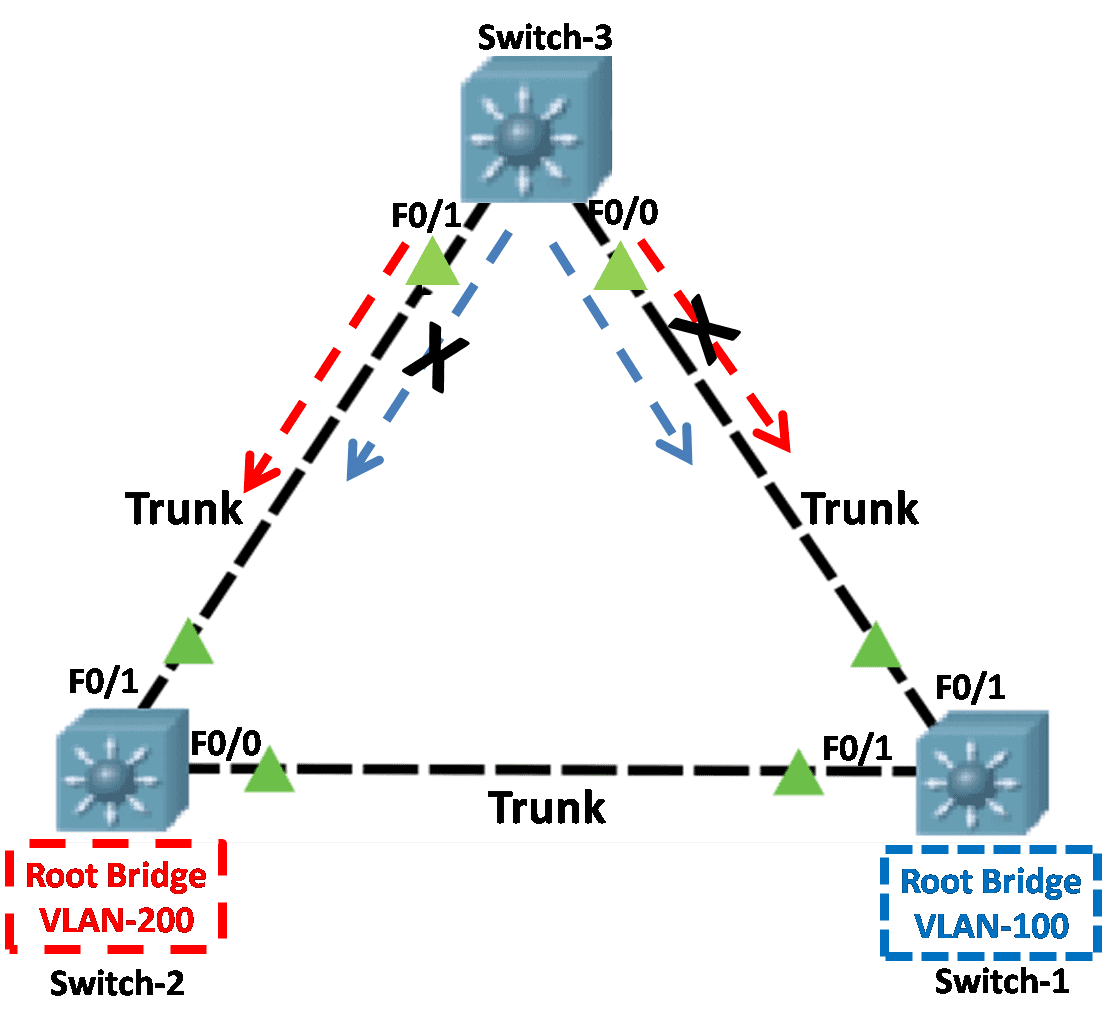
The original IEEE 802.1D standard spanning tree protocol assumes only one spanning-tree instance for the entire switched network, regardless of the number of VLANs. A network running cannot ensure load balancing because one uplink must block all VLANs, but the CPU is free because there is only one instance of a spanning tree working. The...
Types of Spanning Tree Protocols: STP, PVST+, RSTP, Rapid PVST+, and MSTP Compared
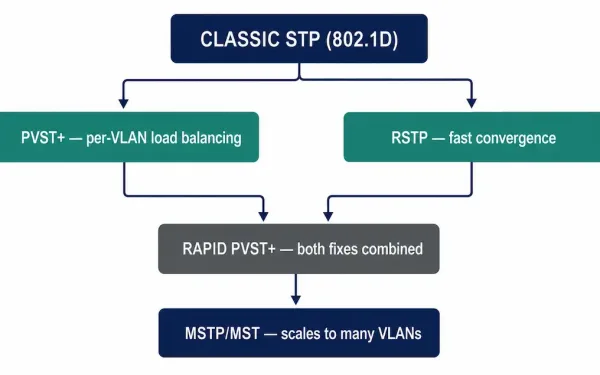
Spanning Tree Protocol prevents Layer 2 loops, but “STP” isn’t one single implementation — it’s a family of standards and Cisco extensions that evolved over three decades to fix the original protocol’s two biggest weaknesses: slow convergence and one-size-fits-all topology. This article ties together the whole family covered so far in this series — what...
Bridge Protocol Data Unit (BPDU): Frame Format, Fields, and How Root Bridge Election Actually Works
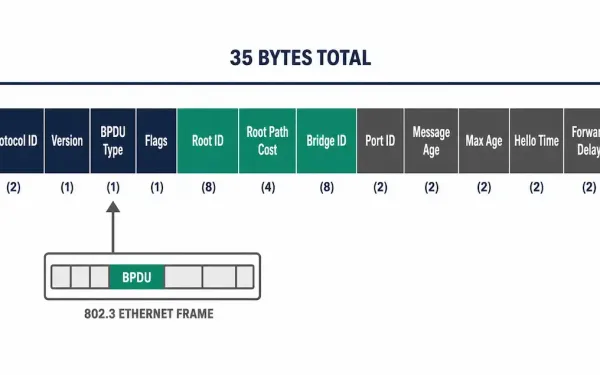
Every root bridge election, every port role assignment, and every failover this series has covered so far runs on one underlying mechanism: switches exchanging Bridge Protocol Data Units, or BPDUs. This article breaks down the BPDU frame field by field, walks through exactly how cost increments as a BPDU propagates through a topology, and clears...
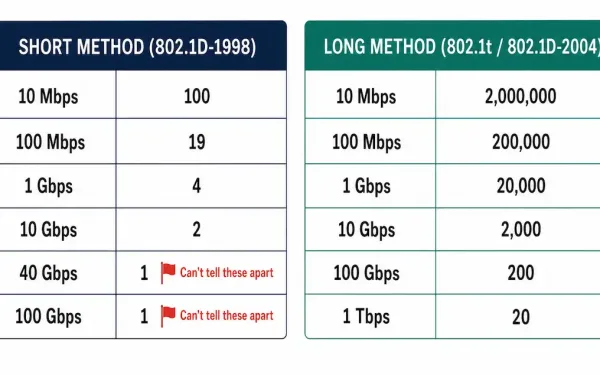
Spanning Tree Path Cost: Root Port Election Explained
When a loop occurs in the switched network, STP uses path cost to resolve which ports forward and which block. Path cost is derived from a port’s speed. If two connected ports end up with equal path cost, spanning tree falls back to the lowest port ID as the final tiebreaker. For CCNA students, understanding...
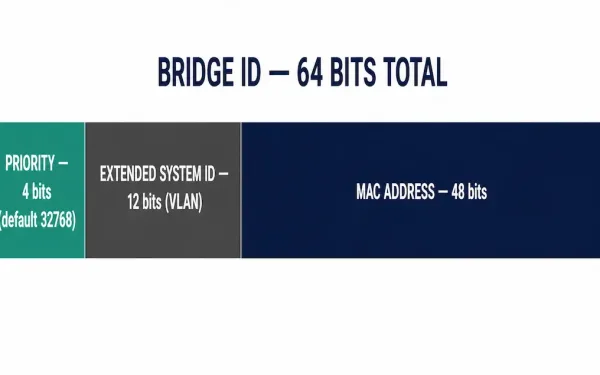
Spanning Tree Root Bridge: Election, Bridge ID, and Configuration
Every spanning-tree-enabled switched network has a single switch designated as the root bridge. It serves as the reference point every other switch in the broadcast domain measures its path against, and the spanning tree algorithm uses it to determine which redundant paths to block. The root bridge is chosen through an automatic election process every...
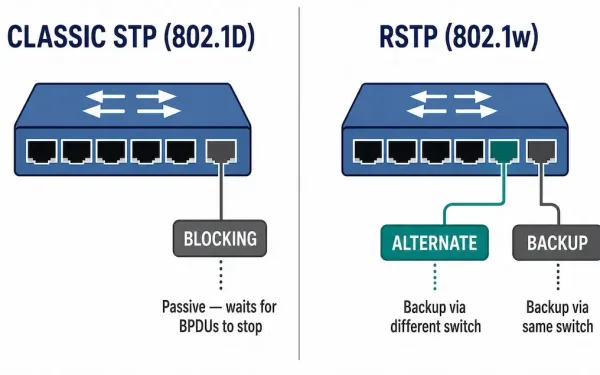
Spanning Tree Port Roles Explained: Root, Designated, Alternate, and Backup
Spanning Tree Protocol doesn’t block loops by disabling switches. It blocks loops by assigning every active port a specific role, then forwarding or blocking traffic based on that role alone. Understanding what each role does — and which roles belong to classic STP versus Rapid STP — is the difference between reading a show spanning-tree...
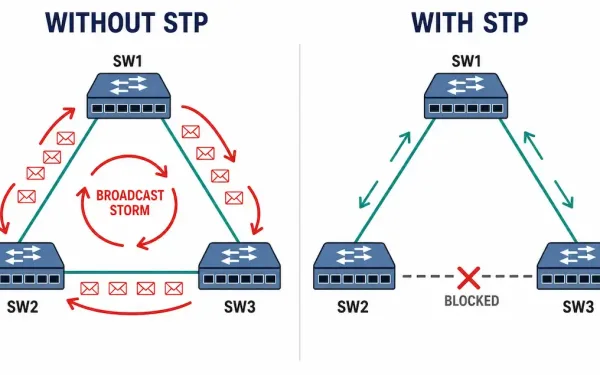
Spanning Tree Protocol (STP): The Complete Guide to Loop-Free Switched Networks
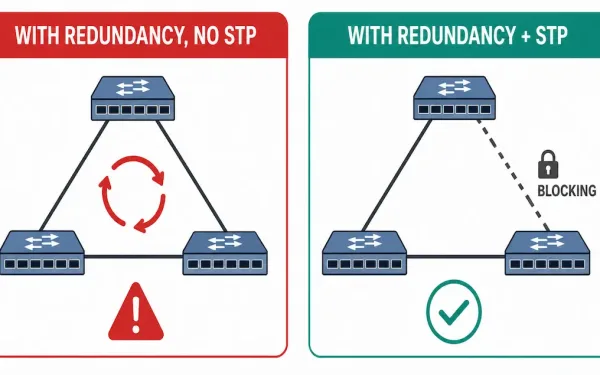
Redundant links keep a switched network alive when a cable or switch fails. But redundancy has a cost. Without a control mechanism, those extra paths create Layer 2 loops. Loops cause broadcast storms, duplicate frames, and MAC address table instability. Spanning Tree Protocol (STP) is that control mechanism. It lets you build physical redundancy without...
Network Redundancy: Layer 1/2 Loops, STP, and Failover Design
Network redundancy means building more than one path for data to travel, so a single failed link or device doesn’t take down access to network resources entirely. It’s a foundational design principle behind the three-tier hierarchical model (core, distribution, access), and it comes with a real, important trade-off: physical redundancy alone can create Layer 2...
NAT for IPv6: ULA, NAT64, and IPv6 Transition Mechanisms
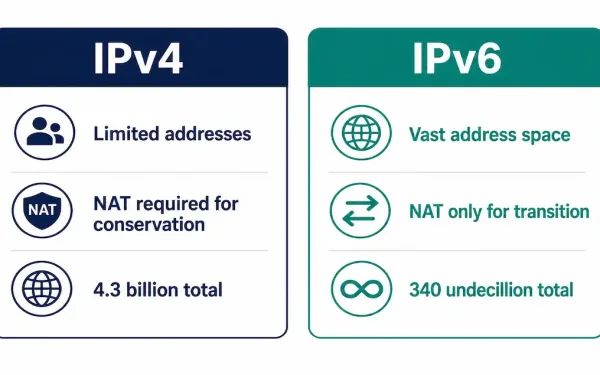
IPv6’s 128-bit address space — roughly 340 undecillion addresses — removes the core reason IPv4 needed NAT in the first place. But NAT hasn’t disappeared entirely from the picture; it’s just doing a different job now. Instead of conserving scarce addresses, IPv6-era NAT exists almost entirely to bridge the gap during the transition period —...