AES · RSA · ECC · Key Agreement · Hybrid Encryption
What You'll Learn
- How symmetric and asymmetric cryptography differ in their key structures and use cases.
- Why AES is efficient for bulk data encryption and why a shared secret must be protected.
- How public and private keys work in asymmetric cryptography.
- How RSA and ECC fit into public-key cryptography.
- Why Diffie-Hellman and ECDHE are key-agreement mechanisms, not bulk-data encryption algorithms.
- How hybrid encryption combines asymmetric techniques with symmetric encryption.
- How to recognize common cryptography clues in Security+ scenario questions.
Encryption protects confidentiality by transforming readable plaintext into ciphertext using a cryptographic algorithm and appropriate keying material. Different security problems require different characteristics: protecting a large database calls for efficient encryption, while establishing shared secret material between parties creates a different challenge.
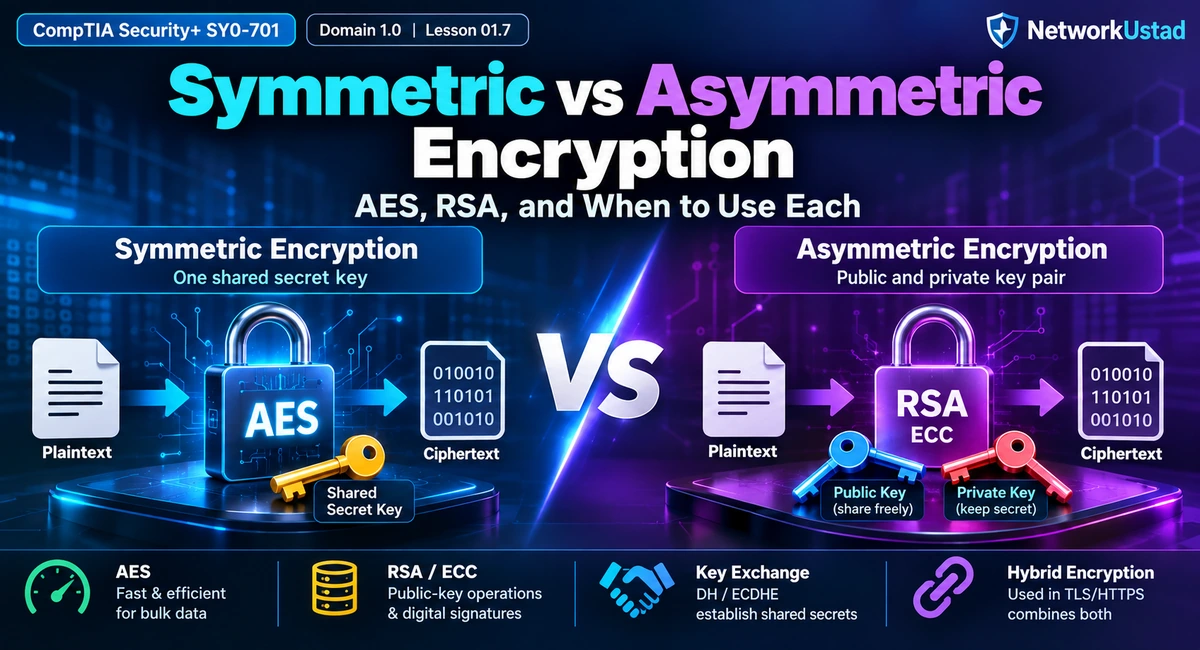
Symmetric cryptography uses a shared secret key. Asymmetric cryptography uses a related public key and private key pair. These approaches are not competing technologies in which one simply replaces the other. Modern systems often use both for different parts of the security process.
Symmetric Encryption
Symmetric cryptography, also known as secret-key cryptography, uses the same secret key for encryption and the corresponding decryption operation. Authorized parties need access to the required shared secret, and they must prevent unauthorized people from obtaining it.
Its major advantage is efficiency. Symmetric encryption is well suited to protecting large amounts of data, including disk contents, files, database backups and network traffic after the parties have established the required session key.

AES: The Key Symmetric Example
AES (Advanced Encryption Standard) is a major symmetric algorithm to recognize for Security+. AES uses a 128-bit block size and supports 128-bit, 192-bit and 256-bit key sizes.
Do not confuse an algorithm's block size with its key size. AES-256 means AES uses a 256-bit key; it does not mean that AES has a 256-bit block size.
AES-128
128-bit key
10 rounds
AES-192
192-bit key
12 rounds
AES-256
256-bit key
14 rounds
The Symmetric Key-Distribution Problem
A major challenge with symmetric cryptography is key distribution. Two parties need a way to obtain the shared secret without exposing it to an attacker. Protecting, storing, rotating and distributing shared keys becomes increasingly difficult as the number of parties and systems grows.
Public-key cryptography and key-agreement mechanisms help address this challenge. They do not remove the need to protect cryptographic keys; they provide different ways to establish, use and manage keying material.
Asymmetric Cryptography
Asymmetric cryptography, also called public-key cryptography, uses two mathematically related keys: a public key that may be shared and a private key that must be protected.
Public Key
Can be shared
- May be distributed openly.
- Can verify digital signatures created with the corresponding private key.
- In applicable public-key systems, can support encryption to the key owner.
- May be distributed with a digital certificate to help establish identity and trust.
Private Key
Must be protected
- Kept under the owner's control.
- Used to create digital signatures.
- In applicable public-key encryption systems, used for the corresponding decryption operation.
- Must be protected because compromise can undermine the security provided by the key pair.
Public and private keys have different roles. Depending on the algorithm and operation, public-key cryptography can support digital signatures, encryption, authentication or key agreement. The exact operation depends on the algorithm being used.
RSA and ECC
RSA
RSA is a well-known public-key algorithm associated with asymmetric cryptography. It can be used for digital signatures and, in applicable systems, public-key encryption or key-establishment operations. For Security+, associate RSA with public/private keys and asymmetric operations rather than efficient encryption of an entire large database.
Elliptic Curve Cryptography (ECC)
ECC is a family of public-key cryptographic techniques based on elliptic-curve mathematics. ECC-based algorithms can support functions such as digital signatures and key agreement. ECC is a family of approaches, not one single algorithm identical in role to AES.
Symmetric vs. Asymmetric: Side-by-Side
| Characteristic | Symmetric | Asymmetric |
|---|---|---|
| Key structure | Shared secret key | Related public and private keys |
| Typical performance | Efficient for bulk data | Generally more computationally expensive for comparable bulk-data tasks |
| Large data sets | Well suited to encryption of large data sets | Not normally used to encrypt every byte of a large data set directly |
| Key distribution | The shared secret must be distributed and protected | Public keys can be distributed, though authenticity still matters |
| Digital signatures | Not the standard public-key signature model | Common use case |
| Examples | AES | RSA and ECC-based algorithms |
Why Real-World Systems Use Both
A common misconception is that an organization must choose either symmetric or asymmetric cryptography. Secure protocols often combine both: public-key techniques help authenticate a party or establish session keying material, while symmetric encryption protects the actual data efficiently.

The Hybrid Model
Authentication or Key Establishment
Public-key certificates and/or key-agreement techniques perform their specific roles.
Session Keying Material
The parties establish the shared secret material needed for the secure session.
Data Protection
Symmetric encryption efficiently protects the application data.
This is a simplified conceptual model. Real protocols have specific handshake and algorithm requirements, but the key exam distinction remains: public-key mechanisms and symmetric data encryption have different roles.
TLS and the Symmetric/Asymmetric Relationship
When a Security+ question mentions HTTPS or TLS, do not assume RSA encrypts every application packet. Modern TLS can use certificates to authenticate the server, key-agreement mechanisms such as ECDHE to establish shared session secrets, and symmetric authenticated encryption to protect application data.
Diffie-Hellman and Key Agreement
Diffie-Hellman (DH) and elliptic-curve variants such as ECDH and ECDHE are associated with key agreement. They enable communicating parties to derive shared secret material without directly sending that final shared secret across the network in plaintext.
If a question asks which mechanism helps two parties establish a shared secret, think key agreement. If it asks which algorithm efficiently encrypts a large volume of data, think symmetric encryption such as AES.
| Technology | Category | Security+ Role |
|---|---|---|
| AES | Symmetric encryption | Efficient bulk-data encryption |
| RSA | Asymmetric / public-key | Public-key operations and digital signatures; other uses depend on the system |
| ECC | Asymmetric family | Public-key cryptography, including signature and key-agreement algorithms |
| DH / ECDH / ECDHE | Key agreement | Establish shared secret material |
| SHA-256 | Cryptographic hash | Integrity verification; it is not an encryption algorithm |
Common Security+ Exam Traps
“Asymmetric is always better.” No. The two approaches solve different problems and are frequently combined.
“RSA should encrypt a huge database.” Usually not. Symmetric encryption such as AES is designed for efficient bulk-data protection.
“DH encrypts all the traffic.” DH/ECDH/ECDHE are key-agreement mechanisms, not the bulk-data cipher.
“TLS means RSA encrypts everything.” Modern TLS can combine public-key authentication and key agreement with symmetric session encryption.
“Public keys must stay secret.” Public keys are designed to be shared. Their authenticity and the corresponding private key still matter.
“AES and RSA key lengths can be compared directly.” Do not compare their numeric key lengths as though they represent equivalent security strength.
How to Choose the Right Cryptographic Approach
Large amount of data?
Choose symmetric encryption such as AES.
Public/private key pair?
Think asymmetric cryptography, such as RSA or ECC-based algorithms.
Establish a shared secret?
Consider key agreement such as DH/ECDH/ECDHE.
Create or verify a digital signature?
Think of an asymmetric signature process: the private key signs and the corresponding public key verifies.
The best exam answers are driven by the requirement, not by the name of the most powerful-sounding algorithm. Identify whether the scenario asks for bulk encryption, key establishment, authentication, digital signatures or integrity verification.
Practice Questions
10 scenario-based questions. Select a question to reveal its answer and explanation.
Exam Quiz
Lesson 01.9 · Symmetric vs. Asymmetric Encryption · 15 questions · 10 minutes
Symmetric vs. Asymmetric Encryption — Exam Simulation
Test your understanding of AES, RSA, ECC, public and private keys, key agreement, hybrid encryption and TLS.
15 Questions
Lesson 01.9 scope
10 Minutes
Timed quiz
Instant Feedback
Explanation after each answer
Full Review
Correct, wrong and unanswered counts
Lesson 01.9 — Summary
Symmetric vs. Asymmetric Encryption: AES, RSA, ECC and Key Agreement · Domain 1.0 — General Security Concepts · 12% of the Security+ SY0-701 exam
Key Takeaways
One shared secret key. Efficient for bulk data. AES is the major example.
Public and private key pair. Used for public-key operations and digital signatures.
Public-key techniques plus symmetric encryption. Different methods handle key establishment and data protection.
DH/ECDH/ECDHE. Establish shared secret material; they are not bulk-data ciphers.
| Technology | Category | Primary Exam Use |
|---|---|---|
| AES | Symmetric | Efficient bulk-data encryption |
| RSA | Asymmetric | Public-key operations and digital signatures |
| ECC | Asymmetric family | Public-key algorithms, including signatures and key agreement |
| DH / ECDH / ECDHE | Key agreement | Establish shared secret material |
| TLS | Hybrid | May combine authentication, key agreement and symmetric data protection |
Exam Tips — Lesson 01.9
- Symmetric means a shared secret key and efficient bulk encryption.
- Asymmetric means a related public/private key pair.
- AES is symmetric and uses a 128-bit block size.
- RSA is a public-key/asymmetric algorithm.
- DH/ECDH/ECDHE are key-agreement mechanisms.
- TLS can combine public-key mechanisms with symmetric session encryption.
- Do not compare AES and RSA numeric key lengths as if they represent the same security strength.
Common Pitfalls
Asymmetric is always better. The approaches solve different problems.
RSA encrypts all TLS traffic. Modern TLS uses symmetric encryption to protect application data.
DH is a bulk encryption algorithm. DH-family mechanisms are used for key agreement.
Public keys must be hidden. Public keys are designed to be shared; private keys must be protected.
CompTIA Security+ SY0-701 — Exam Domains
Security Frameworks is a supplemental guide, not a numbered lesson in this sequence.
Further Reading and Related Guides
Continue learning with these NetworkUstad lessons and official terminology references.
- Security+ SY0-701 Guide Hub — browse the certification guides.
- Cryptography Basics: Encryption, Hashing and Cryptographic Keys — previous lesson, 01.8.
- Non-Repudiation and Digital Signatures — review the digital-signature concept.
- Public Key Infrastructure (PKI) — next lesson, 01.10.
- The CIA Triad — revisit confidentiality, integrity and availability.