
CCNA
Cisco Certified Network Associate certification resources
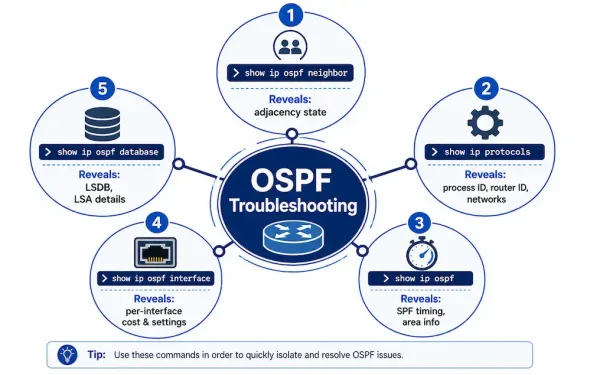
OSPF Troubleshooting and Verification Guide
OSPF (Open Shortest Path First) is a cornerstone of enterprise routing, widely tested in CCNA and CCNP exams. Its complexity stems from link-state operations, making OSPF troubleshooting and verification crucial for network stability and certification success. This guide explores real-world scenarios, like multi-area OSPF in large networks, to equip students with practical skills. Regular verification...
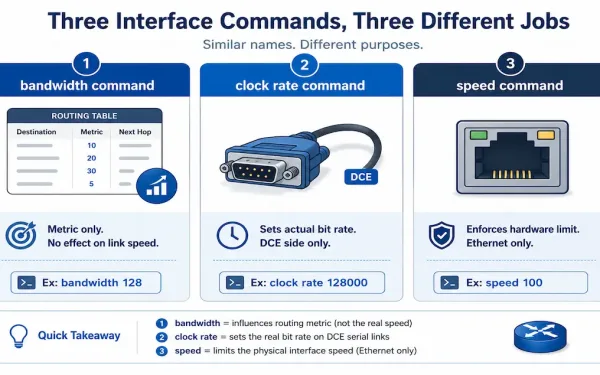
Understanding Cisco Interface Bandwidth: Configuration, Verification, and Routing Impacts
In Cisco networking, the interface bandwidth value plays a crucial role in routing decisions without affecting the actual link speed. For CCNA students, this is key to understanding basic router configurations and why routing protocols might choose suboptimal paths. CCNP learners will appreciate its ties to advanced topics like OSPF cost calculations and QoS policies....
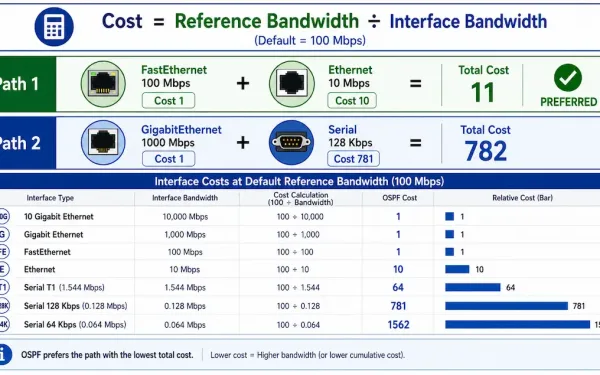
OSPF Metric and Reference Bandwidth: Complete Cost Calculation Guide
OSPF (Open Shortest Path First) relies on “cost” as its metric to select the best path in a network. For CCNA and CCNP students, understanding OSPF cost calculation is essential for exam topics covering route selection and path optimization. The default reference bandwidth is 100 Mbps (10^8 bps), and lower costs indicate preferred paths. This...
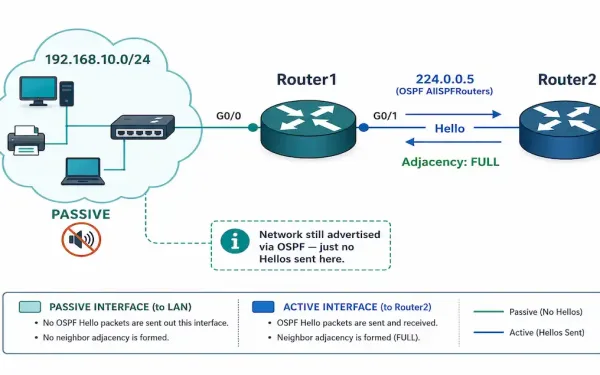
OSPF Passive Interfaces: Configuration and Best Practices
In OSPF (Open Shortest Path First), a passive interface is an interface on which the router stops sending OSPF Hello packets, while still advertising that interface’s connected network in OSPF. Because no Hellos are sent, no OSPF neighbor adjacency can form on that link — but the subnet remains reachable and advertised to the rest...
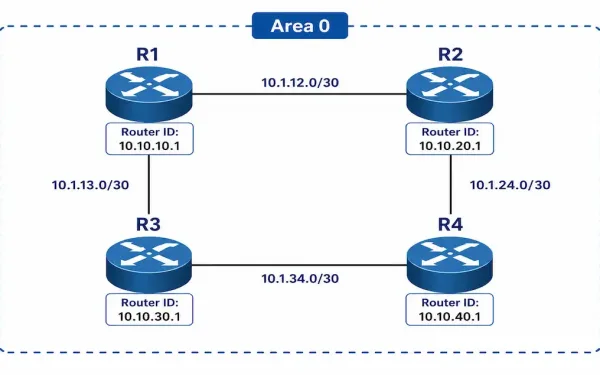
Configure Single-Area OSPFv2: A Comprehensive Guide
OSPFv2 is a link-state routing protocol for IPv4, first drafted in 1991 (RFC 1247) and standardized in 1998 (RFC 2328). It’s the scalable, classless alternative to the distance-vector Routing Information Protocol (RIP). OSPF uses Dijkstra’s algorithm to compute shortest paths, which is what makes it a solid fit for larger networks where RIP’s hop-count limit...
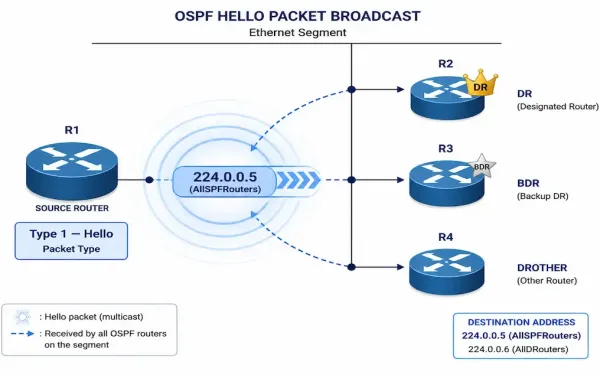
OSPF Hello Packets: Structure, Timers, and Troubleshooting
OSPF Hello packets are Type 1 packets. Routers send them out every OSPF-enabled interface, including virtual links. Their job is simple: find neighbors, and keep those neighbor relationships alive. It’s a small packet with a big job. Nearly every OSPF problem you’ll ever troubleshoot starts here. Routers send Hello packets as multicast, to 224.0.0.5 (AllSPFRouters)....
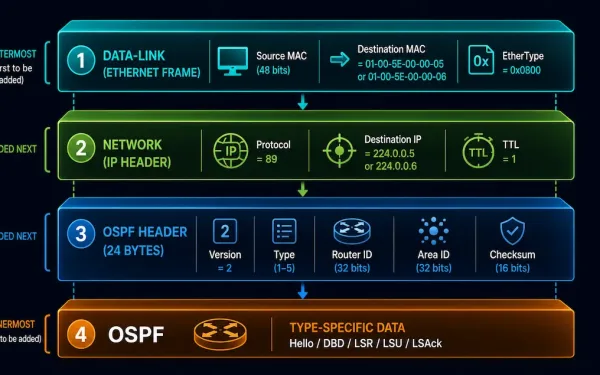
OSPF Encapsulation: How an OSPF Message Is Wrapped for Delivery
Open Shortest Path First (OSPF) operates at the network layer, but it doesn’t travel across a network on its own — every OSPF message gets wrapped in a stack of headers before it ever leaves a router’s interface. Understanding exactly how that wrapping works, layer by layer, is essential for reading a packet capture correctly...
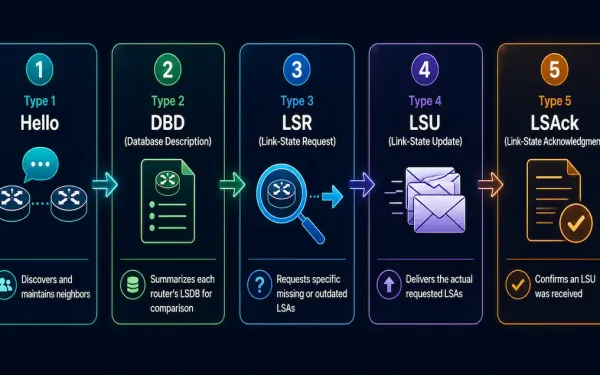
OSPF Packets Types: Hello, DBD, LSR, LSU, and LSAck Explained
Open Shortest Path First (OSPF) is a link-state routing protocol widely used in enterprise networks, and a key topic for CCNA and CCNP certifications. OSPF relies on five distinct packet types to establish neighbor adjacencies, exchange routing information, and maintain a consistent Link-State Database (LSDB) across every router in an area. Understanding these packets —...
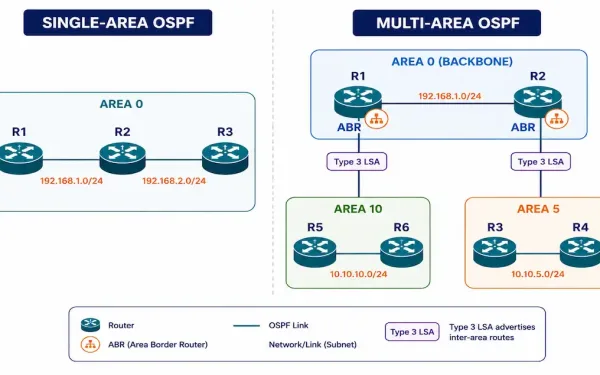
Single-Area OSPF vs. Multi-Area OSPF
Open Shortest Path First (OSPF) is a link-state routing protocol widely used in enterprise IP networks for its efficiency and scalability. Unlike distance-vector protocols like RIP, OSPF uses a hierarchical design, segmenting networks into areas to optimize routing. Each area consists of routers sharing identical Link-State Databases (LSDBs), containing topology information. For CCNA and CCNP...
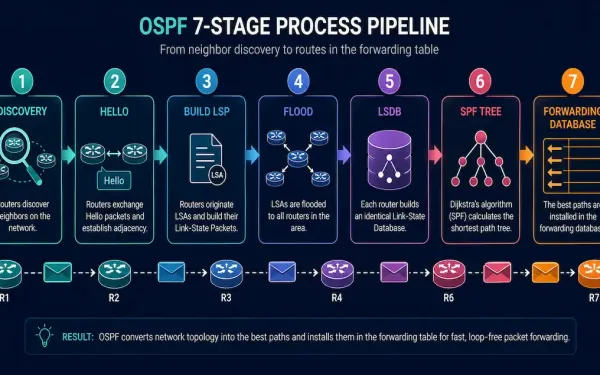
Link-State Routing Protocols Explained: Discovery, Flooding, and the SPF Tree
Link-state routing protocols are also known as shortest-path-first protocols. Every router running one maintains a complete picture of the entire network topology, built by having each router originate information about itself, its directly connected links, and the state of those links — then flooding that information to every other router in the area. OSPF is...