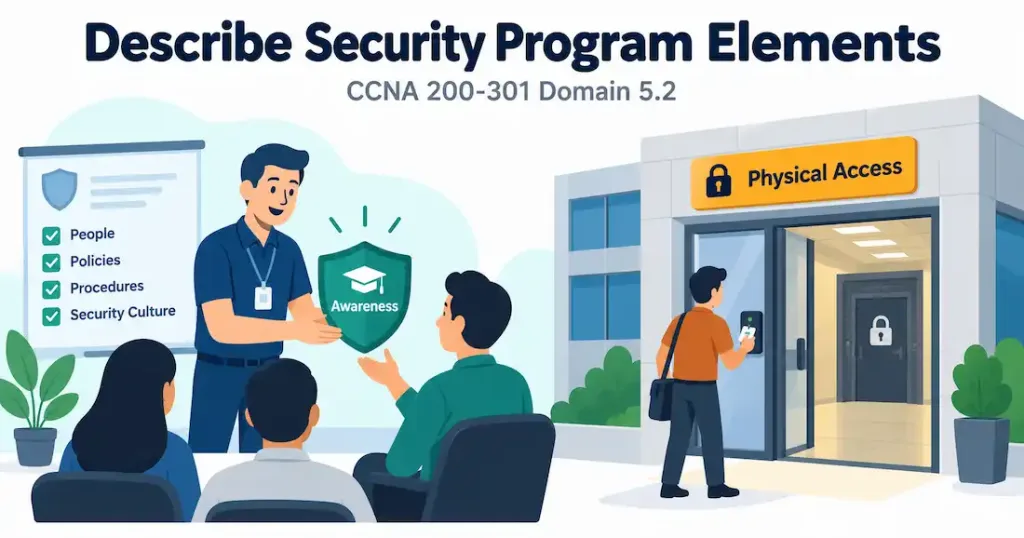
Domain 5.2 | Security Fundamentals — 15% of exam
Learning Objectives
By the end of this lesson, you will be able to:
- Explain why user awareness and training is considered a foundational security control, not an optional supplement to technical measures.
- Identify common social engineering techniques and the human vulnerability each one exploits.
- Describe physical access control as a layered defense, from perimeter to individual device.
- Explain why physical security failures can undermine even a well-designed technical security posture entirely.
- Connect security program elements back to the threat/vulnerability/mitigation vocabulary and CIA triad from objective 5.1.
Key Terms Glossary
| Term | Definition |
|---|---|
| Security awareness training | Ongoing education helping users recognize and appropriately respond to security threats, particularly social engineering. |
| Social engineering | Manipulating a person, rather than a system, into taking an action or revealing information that compromises security. |
| Phishing | A fraudulent message, typically email, designed to trick a recipient into revealing credentials or installing malware. |
| Pretexting | Fabricating a false scenario or identity to manipulate a target into divulging information or granting access. |
| Tailgating (piggybacking) | Following an authorized person through a secured door or checkpoint without independently authenticating. |
| Vishing | Voice-based phishing, conducted over a phone call rather than email or text. |
| Physical access control | Security measures restricting physical access to facilities, rooms, or equipment. |
| Defense in depth | A security strategy using multiple, layered controls so that a single failure doesn’t fully compromise a system. |
Why User Awareness and Training Is a Foundational Control
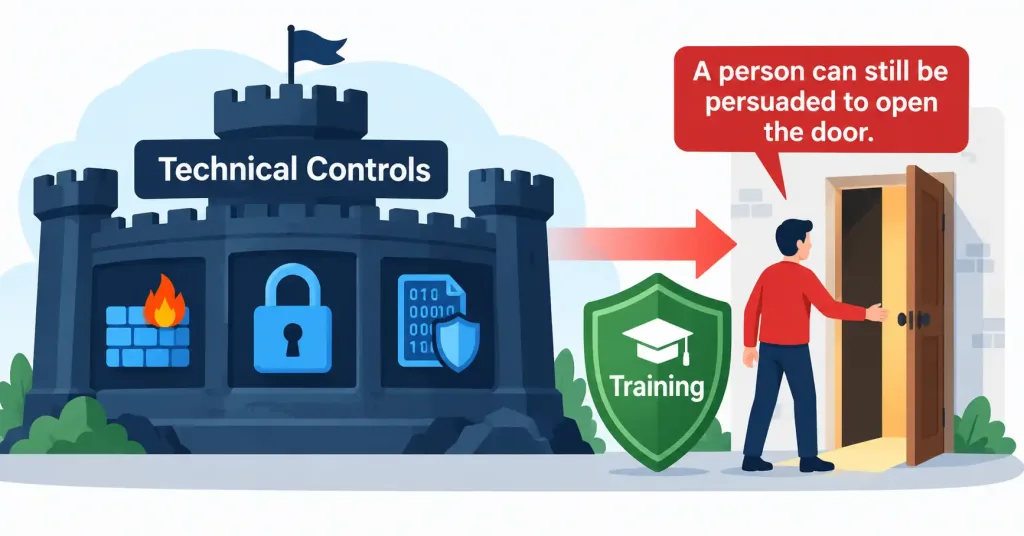
It would be easy to assume the most important security measures are technical — firewalls, encryption, access control lists — and treat user training as a secondary, almost optional addition layered on top. This gets the priority backward. Human error and social engineering remain among the leading causes of real-world security incidents, which means an organization can implement flawless technical controls and still suffer a serious breach because an employee was manipulated into handing over credentials, clicking a malicious link, or letting an unauthorized person walk through a secured door.
This connects directly back to objective 5.1’s vocabulary: a lack of security awareness is a genuine vulnerability, specifically a process/human vulnerability rather than a software or configuration flaw, and it’s exploitable regardless of how well every technical system has been hardened. No firewall rule stops an employee from voluntarily typing their password into a convincing fake login page, and no access control list prevents someone from politely holding a secured door open for a stranger carrying a heavy box. Security awareness training is the mitigation that specifically addresses this category of vulnerability, and it’s foundational precisely because no purely technical control can substitute for it.
Common Social Engineering Techniques
Social engineering covers a range of specific techniques, each exploiting human psychology rather than a technical flaw. Recognizing the common named categories helps parse both real incidents and exam scenarios:
- Phishing — a fraudulent email (or text message, in the case of “smishing”) designed to trick the recipient into revealing credentials, clicking a malicious link, or opening a malware-laden attachment. Phishing is typically broad and untargeted, cast widely in hopes that some percentage of recipients will fall for it.
- Spear phishing — a more targeted variant of phishing, customized for a specific individual or organization using researched details (a colleague’s name, a current project, an internal terminology) to appear far more convincing than a generic phishing attempt.
- Whaling — spear phishing specifically targeting high-value individuals, such as executives, where a successful compromise offers outsized value to the attacker.
- Pretexting — fabricating a false scenario or identity to manipulate a target, such as a caller impersonating IT support to convince an employee to reveal a password “for verification purposes.”
- Vishing — voice-based phishing, conducted over a phone call rather than email, often used to add pretexting’s fabricated scenario a sense of real-time urgency that’s harder to pause and scrutinize than a written message.
- Tailgating (piggybacking) — physically following an authorized person through a secured door or checkpoint without independently badging in or authenticating, exploiting simple social courtesy (holding a door open) rather than any digital vulnerability at all.
- Baiting — leaving a physical device (a USB drive left in a parking lot, for instance) or an enticing digital offer somewhere a target is likely to encounter it, relying on curiosity or greed to prompt the target into compromising their own system.
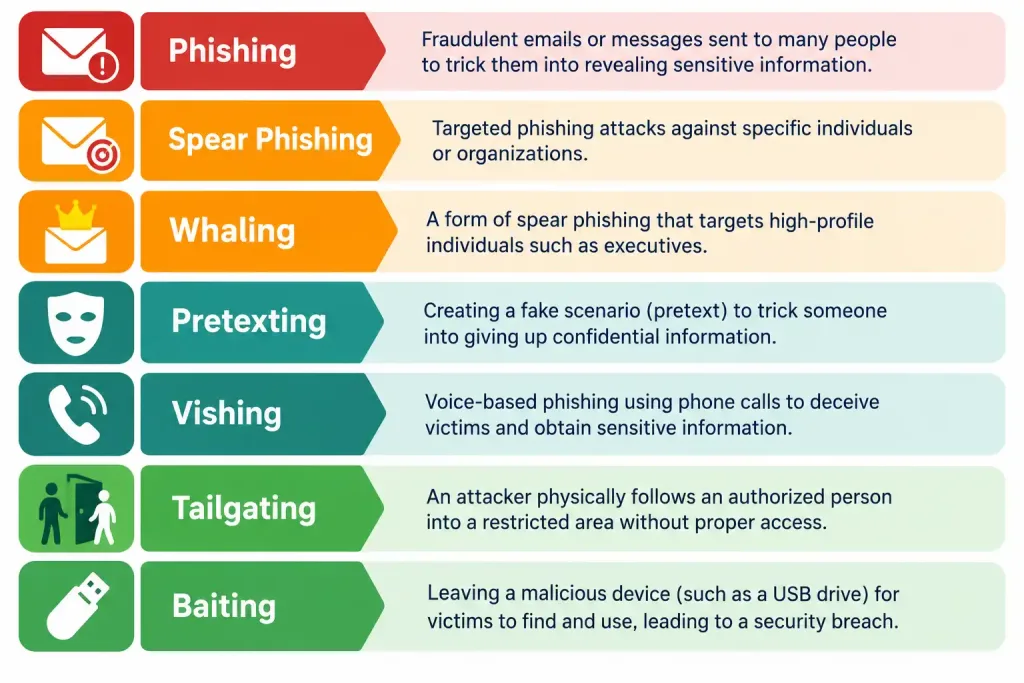
What unites all of these techniques is the target: not a piece of software or a misconfigured device, but a person’s judgment, trust, or urgency response. This is precisely why the mitigation has to be different in kind from a technical control — training that teaches recognition patterns (unexpected urgency, requests for credentials via unusual channels, unfamiliar senders impersonating familiar contacts) and encourages a habit of verification before acting.
A Worked Scenario Combining Both Elements
Consider a realistic incident chain that illustrates why this objective groups user training and physical security together rather than treating them as unrelated topics. An attacker calls an organization’s front desk, pretexting as a vendor technician scheduled for “routine equipment maintenance” that afternoon (pretexting, exploiting a fabricated but plausible scenario).
Arriving in person, they approach a badge-controlled entrance just as a legitimate employee is walking through, and simply follow them in without presenting credentials of their own (tailgating, exploiting ordinary social courtesy rather than any badge system flaw). Once inside, if the network room itself lacks its own additional room-level access control beyond general building entry, the attacker now has physical access to core infrastructure — despite never having defeated a single firewall rule, password policy, or encryption scheme along the way.
This scenario didn’t fail because of weak technical security; it succeeded because two separate human-facing vulnerabilities (an unverified caller being taken at face value, and a held door) went unaddressed by training and layered physical controls that could have interrupted the chain at either point. A receptionist trained to verify vendor appointments through an independent channel, or a room-level access control requiring a second, separate authentication beyond general building entry, would each have been sufficient to stop this specific chain — illustrating defense in depth in practice, not just as an abstract principle.
Physical Access Control: Security’s Often-Overlooked Foundation
A network’s technical security controls mean comparatively little if an attacker can simply walk up to a switch, router, or server and physically access it directly. Physical possession of a device frequently defeats controls that assume remote, network-based access is the only relevant threat model — console access, physical reset procedures, or simply removing a hard drive can bypass carefully configured remote authentication entirely. This is why physical access control belongs in the same foundational category as user training, rather than being treated as a facilities concern separate from “real” network security.
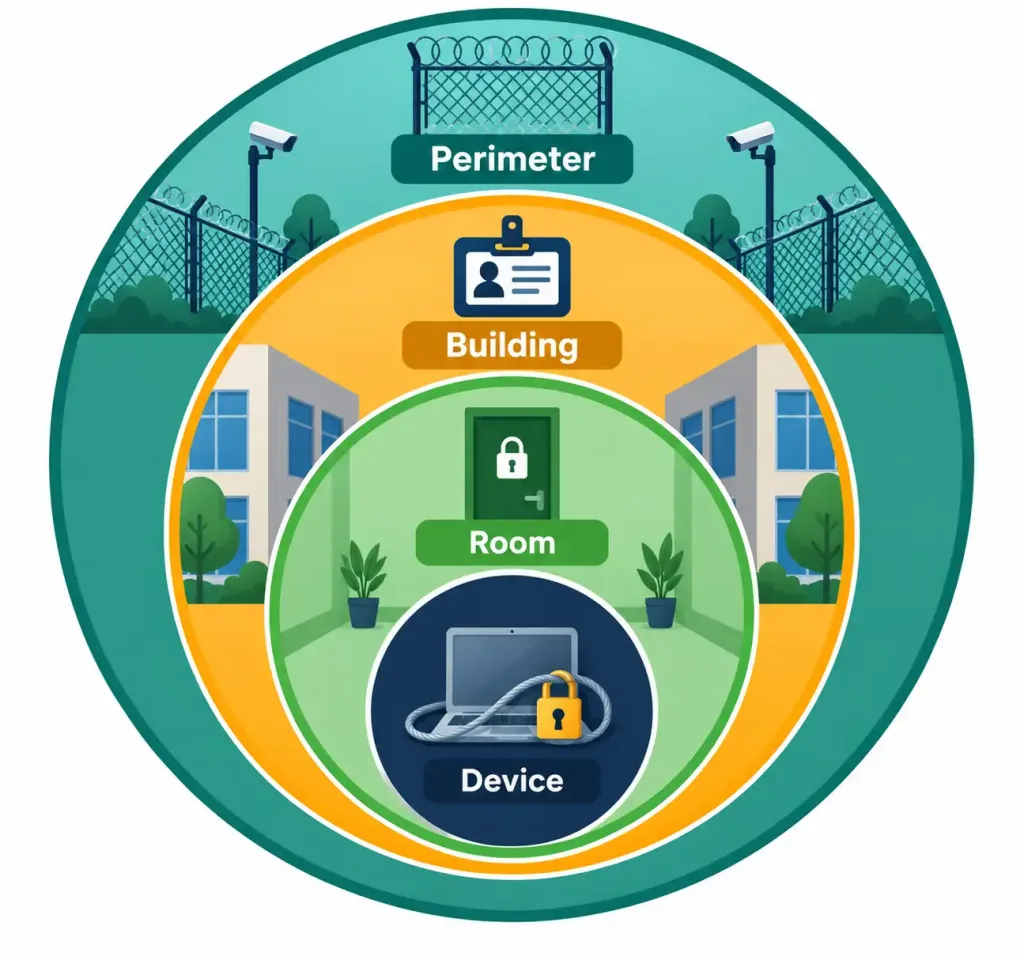
Physical access control is best understood as its own layered defense, echoing the defense-in-depth principle introduced in objective 5.1:
- Perimeter controls — fencing, gated entry, and site-level access restriction, forming the outermost layer around a facility.
- Building-level controls — badge access systems, reception checkpoints, and visitor sign-in procedures controlling who enters the building at all.
- Room-level controls — locked doors specifically for network and server rooms, often with additional badge or biometric requirements beyond general building access, since not every employee with building access needs access to core infrastructure.
- Device-level controls — cable locks, locked equipment racks, and asset tracking, providing a final layer even if someone reaches the physical room itself.
Biometric access systems (fingerprint, retina, or facial recognition) and security cameras commonly reinforce these layers — biometrics providing stronger identity assurance than a badge alone (which could be lost, stolen, or lent to someone else), and cameras providing both a deterrent effect and an investigative record if a physical security incident does occur.
Environmental Controls: Physical Security Protecting Availability
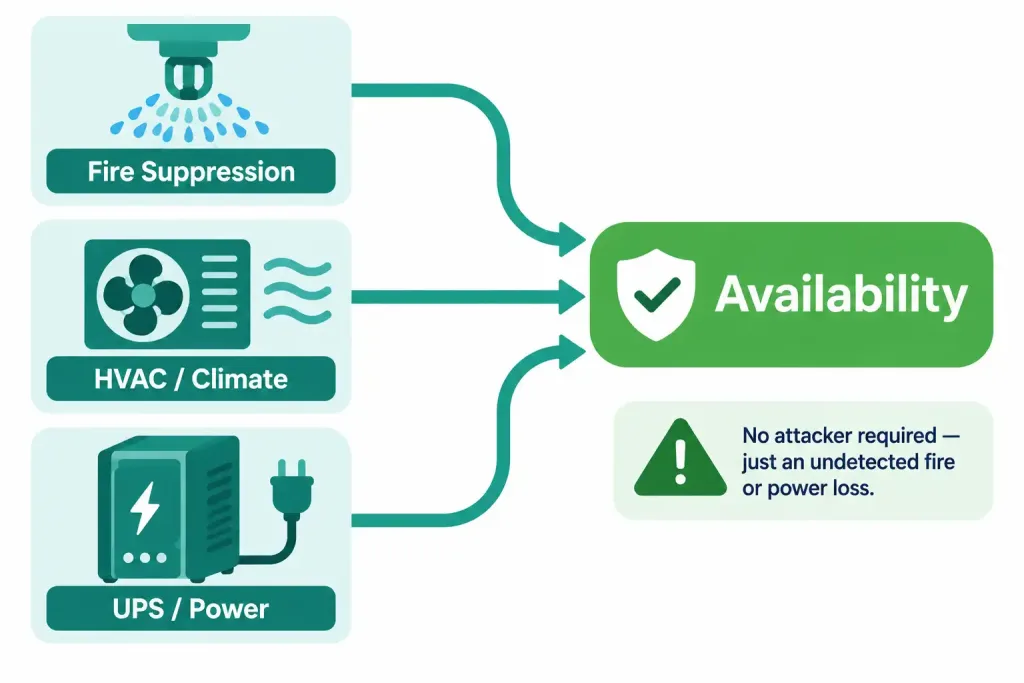
Physical security isn’t only about preventing unauthorized access — it also encompasses environmental controls that protect equipment from non-malicious physical threats: fire suppression systems, climate control (HVAC) preventing overheating, and uninterruptible power supplies (UPS) protecting against power loss. These controls map directly onto the availability leg of the CIA triad from objective 5.1 — a server destroyed by an undetected fire or taken offline by a power failure represents a genuine availability failure, even though no attacker or malicious actor was involved at all. A comprehensive security program treats these environmental risks with the same seriousness as deliberate attacks, since the practical impact — a critical system becoming unavailable — can be identical regardless of cause.
How Security Program Elements Connect to Objective 5.1’s Vocabulary
It’s worth explicitly tracing both elements of this objective back through the threat/vulnerability/exploit/mitigation chain, since doing so reinforces why they’re categorized as foundational rather than supplementary:
- Lack of security awareness is a process/human vulnerability. Social engineering techniques (phishing, pretexting, tailgating, and the rest) are the exploits targeting that vulnerability. Security awareness training is the mitigation.
- Inadequate physical access control is itself a vulnerability — an unlocked server room, an unmonitored building entrance. An attacker physically walking in and accessing equipment directly is the exploit. Layered physical access control (perimeter, building, room, device) is the mitigation.
Neither of these mitigations is purely technical, and that’s the point this objective is making: a comprehensive security program has to address vulnerabilities that exist entirely outside the network itself, in human behavior and physical space, using controls suited to that domain rather than attempting to solve every problem with a firewall rule.
Common Gaps in Real Security Programs
A few recurring gaps are worth naming explicitly, since they reflect where security programs most often fall short in practice despite good intentions.
Training delivered once at onboarding and never repeated is a common shortfall — a new employee’s initial security training fades from memory within months, and without periodic refreshers or simulated phishing exercises to reinforce recognition skills, the organization’s actual defense against social engineering quietly erodes over time even though a training program technically “exists” on paper.
Building-level access treated as sufficient for room-level sensitivity is a common physical security gap — an organization that badges everyone into the building but leaves the network closet unlocked (or locked with a key that’s been copied and distributed informally over the years) has effectively collapsed two layers of its intended defense in depth into one, without necessarily realizing it until an incident exposes the gap.
Visitor and vendor access procedures that exist on paper but aren’t consistently enforced round out the pattern — a sign-in sheet at reception does nothing if staff wave visitors through without checking it, which is exactly the kind of process/human vulnerability that a written policy alone doesn’t close; it requires the ongoing awareness and habit-forming that training programs specifically aim to build.
Common Misconceptions
- “Technical controls are more important than user training, since training can’t be enforced the way a firewall rule can.” Human error and social engineering are leading causes of real incidents precisely because technical controls can’t address vulnerabilities in human judgment — training is foundational, not secondary, even though it’s harder to enforce with certainty than a technical rule.
- “Physical security is a facilities department concern, separate from network security.” Physical possession of a device can bypass carefully configured remote security controls entirely, making physical access control a core network security concern, not a separate domain.
- “Tailgating requires some kind of technical skill or deception beyond just walking through a door.” It specifically exploits ordinary social courtesy — someone holding a door open for another person — making it one of the simplest and most commonly successful physical social engineering techniques precisely because it doesn’t require any technical sophistication at all.
- “All social engineering happens over email.” Phishing is email-based, but vishing (voice), tailgating (physical), and baiting (physical or digital) all target the same underlying human vulnerabilities through different channels.
- “Environmental controls like fire suppression aren’t really ‘security’ concerns.” They directly protect the availability leg of the CIA triad, and a comprehensive security program treats accidental, non-malicious risks to availability with the same seriousness as deliberate attacks, since the practical business impact can be identical.
Frequently Asked Questions
Is security awareness training a one-time event or an ongoing process?
Ongoing — social engineering techniques evolve, and a single training session delivered once tends to fade from memory and fails to address new tactics that emerge afterward. Effective programs repeat and refresh training periodically, often through simulated phishing exercises, rather than treating it as a box checked once.
How does badge access differ from biometric access in practice?
A badge proves possession of a credential, which could theoretically be lost, stolen, borrowed, or shared; biometric access ties authentication to a physical characteristic of the specific individual, providing stronger assurance that the person presenting for access is actually who they claim to be. Many higher-security deployments combine both, requiring a badge and a biometric factor together rather than relying on either alone.
Why would an organization use both cameras and badge access rather than just one?
They serve different purposes — badge access controls who can physically pass through a checkpoint in the first place, while cameras provide deterrence and an investigative record afterward, including documenting situations badge logs alone wouldn’t capture, such as a successful tailgating attempt.
Does physical security matter equally for every piece of network equipment?
Practically, no — a core router or server holding sensitive data warrants the most restrictive physical controls (room-level and device-level layers), while a less sensitive access-layer switch in a semi-public area might reasonably receive a lighter physical security posture, reflecting a risk-based approach rather than applying maximum controls uniformly everywhere regardless of actual risk.
Can training alone fully eliminate the risk of successful social engineering?
No — even well-trained users can occasionally be deceived by a sufficiently sophisticated or well-timed attempt, which is why training is typically paired with technical controls like email filtering and multifactor authentication (covered in the next objective) that limit the damage even if a social engineering attempt does succeed.
Recognizing Social Engineering in Practice
Beyond naming the categories, it’s worth internalizing a few practical recognition patterns that cut across nearly all social engineering techniques, since attackers often reuse the same underlying psychological levers regardless of channel.
Manufactured urgency is one of the most common tells — a message or call insisting immediate action is required, with an implied or stated consequence for delay (“your account will be suspended,” “this invoice is overdue and will be sent to collections”). Urgency is deliberately used to short-circuit the pause a target might otherwise take to verify a request through an independent channel.
Authority impersonation is another recurring pattern — a message or caller claiming to be from IT support, a senior executive, a vendor, or a regulatory body, relying on the target’s reluctance to question someone presenting as an authority figure. Pretexting and vishing both lean heavily on this lever.
Requests that bypass normal process are a third pattern worth flagging specifically — a request to reset a password over the phone without the organization’s normal verification steps, or a request to grant building access to someone without the usual visitor sign-in procedure, both represent a deviation from established process that should itself prompt scrutiny, regardless of how plausible the requester’s story sounds. Training that emphasizes “if the normal process is being skipped, that’s worth pausing on” tends to generalize well across social engineering techniques that haven’t even been specifically named yet, since new variants continue to emerge that fit the same underlying patterns even when the specific pretext changes.
Security Program Elements, User Awareness & Physical Security: Practice Quiz
Test your knowledge of social engineering, phishing, physical security, environmental controls, and security awareness.
Summary
- User awareness and training is a foundational security control because human error and social engineering are leading causes of real-world incidents that technical controls alone cannot address — it directly mitigates the process/human vulnerability category introduced in objective 5.1, and no firewall rule or access control list can substitute for it.
- Common social engineering techniques — phishing, spear phishing, whaling, pretexting, vishing, tailgating, and baiting — all target human judgment and trust rather than a technical flaw, requiring a human-focused mitigation rather than a purely technical one. Manufactured urgency, authority impersonation, and requests that bypass normal process are recognition patterns that cut across nearly all of them.
- Physical access control is a layered defense spanning perimeter, building, room, and device-level controls, reinforced by badge access, biometrics, and security cameras, mirroring the same defense-in-depth principle introduced in objective 5.1.
- Physical possession of a device can bypass remote technical security controls entirely, which is why physical security is a core network security concern rather than a separate facilities issue.
- Environmental controls like fire suppression, climate control, and UPS systems protect the availability leg of the CIA triad against non-malicious physical risks, deserving the same seriousness as deliberate attacks given their identical potential business impact.
- Real security programs most often fall short not from a missing policy on paper, but from training that isn’t repeated, physical layers that collapse into one another over time, and enforcement gaps between what a written procedure says and what actually happens day to day.