Domain 5.1 | Security Fundamentals — 15% of exam
Learning Objectives
By the end of this lesson, you will be able to:
- Define threat, vulnerability, exploit, and mitigation, and explain how they relate to each other in sequence.
- Apply the threat → vulnerability → exploit → mitigation chain to a concrete real-world scenario.
- Explain the CIA triad (Confidentiality, Integrity, Availability) as the foundational goal security controls exist to protect.
- Classify threats and vulnerabilities into common categories to correctly parse scenario-based exam questions.
Key Terms Glossary
| Term | Definition |
|---|---|
| Threat | A potential danger capable of exploiting a vulnerability — an actor, event, or condition that could cause harm. |
| Vulnerability | A weakness in a system that could be exploited — a flaw in software, configuration, or process. |
| Exploit | The specific technique, code, or method used to actually take advantage of a given vulnerability. |
| Mitigation | A control or practice that reduces overall risk by addressing a threat, vulnerability, or the impact of a successful exploit. |
| Risk | The likelihood and potential impact of a threat successfully exploiting a vulnerability. |
| CIA triad | Confidentiality, Integrity, and Availability — the three foundational properties most security controls exist to protect. |
| Attack surface | The complete set of points where an unauthorized actor could attempt to exploit a vulnerability. |
The Vocabulary Chain: Threat, Vulnerability, Exploit, Mitigation
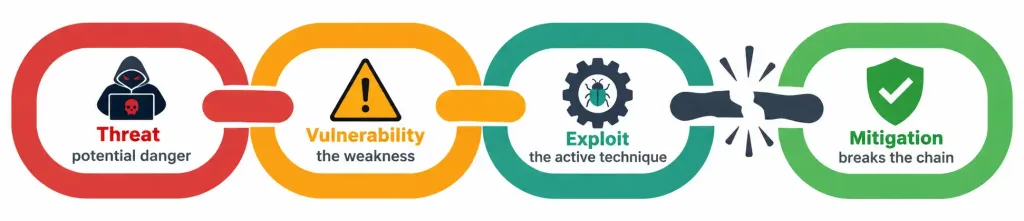
Security discussions rely on a handful of terms that sound similar in casual conversation but mean genuinely different things in a professional and exam context. Getting the distinctions precise matters, because CCNA scenario questions frequently describe a specific situation and ask you to correctly identify which category a described element falls into — and the four terms in this chain aren’t interchangeable synonyms for “bad thing,” they describe different links in the same causal sequence.
A threat is a potential danger — something capable of causing harm if the right conditions align. A threat can be a malicious external actor deliberately trying to break in, a piece of malware executing automatically once triggered, or something far less dramatic: an untrained employee clicking a phishing link or misconfiguring a device by honest mistake. The common thread across all of these is potential, not certainty — a threat exists whether or not it ever successfully causes harm.
A vulnerability is a weakness in a system that a threat could exploit. Unpatched software with a known flaw, a weak or unchanged default password, an overly permissive firewall rule, or a misconfigured access control list are all vulnerabilities — they don’t cause harm by themselves, but they create the opening a threat could use.
An exploit is the specific technique, code, or method that actually takes advantage of a vulnerability. Where a vulnerability is a passive weakness, an exploit is the active mechanism that turns that weakness into an actual security incident — a piece of malicious code targeting a specific unpatched flaw, or a scripted brute-force attempt targeting a known weak default password.
A mitigation is a control or practice that reduces risk somewhere along this chain — by patching the vulnerability directly, by detecting and blocking the exploit attempt, or by limiting the impact if an exploit does succeed. Patching, firewalls, access control lists, network segmentation, monitoring, and user training are all mitigations, each addressing a different point in the sequence.
A Worked Example
Abstract definitions are easier to hold onto with a concrete scenario walked through step by step. Consider a router running an old IOS version with a publicly known remote-code-execution flaw:
- The vulnerability is the specific unpatched flaw in that IOS version.
- The threat is any actor or automated tool capable of targeting that flaw — could be a specific attacker, or simply “anyone running internet-wide scanning tools looking for exposed devices with this flaw.”
- The exploit is the specific piece of code or technique that actually leverages the flaw to gain unauthorized access or execute arbitrary commands on the device.
- The mitigation is patching the IOS version to close the flaw — though in practice, additional mitigations like restricting management interface access via an access control list, or segmenting management traffic onto a separate VLAN, add further layers of protection even before the patch is applied.
Notice that a single scenario can have multiple applicable mitigations addressing different points in the chain — patching removes the vulnerability entirely, while restricting access reduces the threat’s ability to reach the vulnerability in the first place, and network segmentation limits the damage even if an exploit somehow succeeds. This layered thinking — sometimes referred to as “defense in depth” — reflects how real security programs operate rather than relying on any single control to carry the entire burden.
A Second Worked Example: Social Engineering
Not every scenario in this vocabulary chain involves software or configuration at all. Consider a phishing email designed to trick an employee into revealing their login credentials:
- The vulnerability here isn’t a piece of code — it’s a lack of security awareness training, leaving the employee unprepared to recognize a phishing attempt for what it is.
- The threat is the party sending the phishing email, hoping to harvest credentials.
- The exploit is the phishing email itself — its specific wording, urgency, and disguised sender address, all crafted to manipulate the recipient into acting without pausing to verify legitimacy.
- The mitigation is user awareness training, alongside technical controls like email filtering that catch known phishing patterns before they ever reach an inbox, and multifactor authentication that limits the damage even if credentials are successfully harvested.
This example matters because it illustrates something easy to overlook when security is discussed primarily through a technical lens: vulnerabilities aren’t always code-based, and the strongest technical mitigations in the world don’t help if the vulnerability being exploited is a gap in human awareness rather than a software flaw. This is exactly why the next objective in this domain treats user training as a foundational security program element, on equal footing with technical controls rather than as an afterthought.
A Concrete Example Already Familiar From Earlier Objectives
Two examples from earlier in this course illustrate this vocabulary cleanly, worth revisiting specifically because they’re already familiar. SNMP’s default community strings (public/private) are a textbook vulnerability — a weak, well-known default credential. The exploit is simply attempting those default values against a device’s SNMP agent, something automated scanning tools do routinely. The mitigation is migrating to SNMPv3 with genuine authentication, or at minimum changing the default community strings. Similarly, Telnet’s plaintext credential transmission — discussed as the reason SSH replaced it for remote access — is a vulnerability (unencrypted credentials in transit); the exploit is passively capturing traffic on the path between an administrator and a device; the mitigation is migrating to SSH’s encrypted session entirely.
Risk: Where Threat and Vulnerability Meet
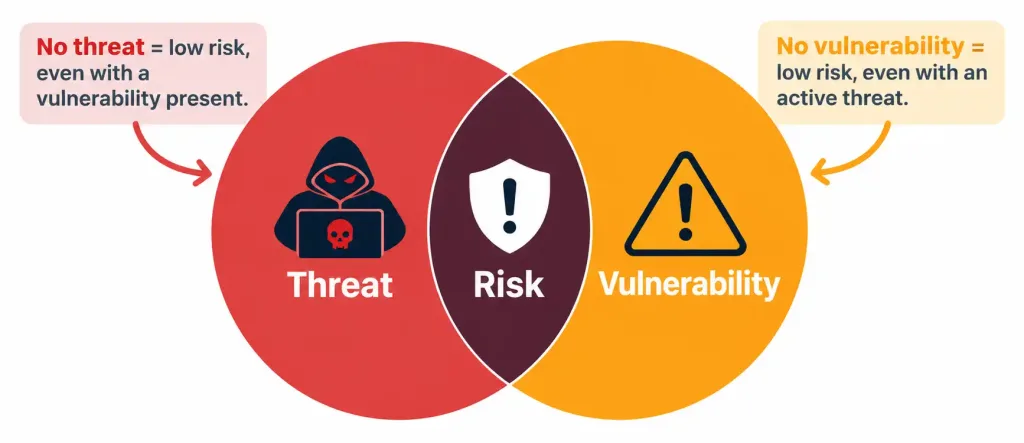
Risk is often described conceptually as the intersection of threat and vulnerability — a system can have a known vulnerability with essentially no realistic threat capable of reaching it (an air-gapped device with no network connectivity at all, for instance) and carry very low practical risk, while the same vulnerability on an internet-facing device with active threats scanning for exactly that flaw carries very high risk. This is why risk assessment isn’t just “does a vulnerability exist,” but “how likely is a credible threat to actually exploit this vulnerability, and how severe would the impact be if it did.”
Real security programs generally approach this in one of two ways. Qualitative risk assessment ranks risks in relative terms — high, medium, low — based on judgment and experience, useful when precise numbers aren’t available or practical to calculate. Quantitative risk assessment attempts to assign actual numeric values — an estimated dollar cost of a potential incident, multiplied by an estimated probability of it occurring — producing a more precise figure that can be directly compared against the cost of a proposed mitigation.
Neither approach is inherently superior; qualitative assessment is faster and more broadly applicable, while quantitative assessment better supports a concrete cost-benefit decision when the data to support it actually exists. For CCNA purposes, recognizing that risk assessment is a deliberate, structured process — not just an intuitive gut feeling — is the useful takeaway, without needing to perform either type of calculation yourself at this level.
Attack Surface: Where Vulnerabilities Could Be Reached
A related concept worth defining precisely: the attack surface is the complete set of points where an unauthorized actor could attempt to exploit a vulnerability — every exposed service, every open port, every remotely accessible management interface, and every user who could be targeted by social engineering all contribute to it. A larger attack surface doesn’t automatically mean more vulnerabilities exist, but it does mean more opportunities for a threat to find and reach whatever vulnerabilities do exist.
This is why reducing the attack surface is itself a common and effective mitigation strategy, independent of patching any specific vulnerability: disabling unused services, closing unnecessary open ports, restricting management access to specific trusted source addresses, and removing unused user accounts all shrink the attack surface without needing to identify or fix any particular flaw first. A device running only the services it actually needs, reachable only from the specific management subnet that legitimately needs to reach it, presents a meaningfully smaller attack surface than the same device with every service enabled and reachable from anywhere — even if neither configuration currently has any known vulnerability.
The CIA Triad: What Security Controls Actually Protect
Underlying nearly every mitigation covered throughout this domain is a foundational goal, commonly summarized as the CIA triad:
- Confidentiality — ensuring information is only accessible to those authorized to see it. Encryption (covered extensively in the VPN and SSH-related objectives) is a primary confidentiality control.
- Integrity — ensuring information isn’t altered, whether accidentally or maliciously, without detection. Checksums, digital signatures, and validation mechanisms support integrity.
- Availability — ensuring systems and data remain accessible to authorized users when needed. Redundancy (recall FHRP/HSRP from earlier in this course, which exists specifically to prevent a single router failure from taking down gateway availability) is a classic availability control.
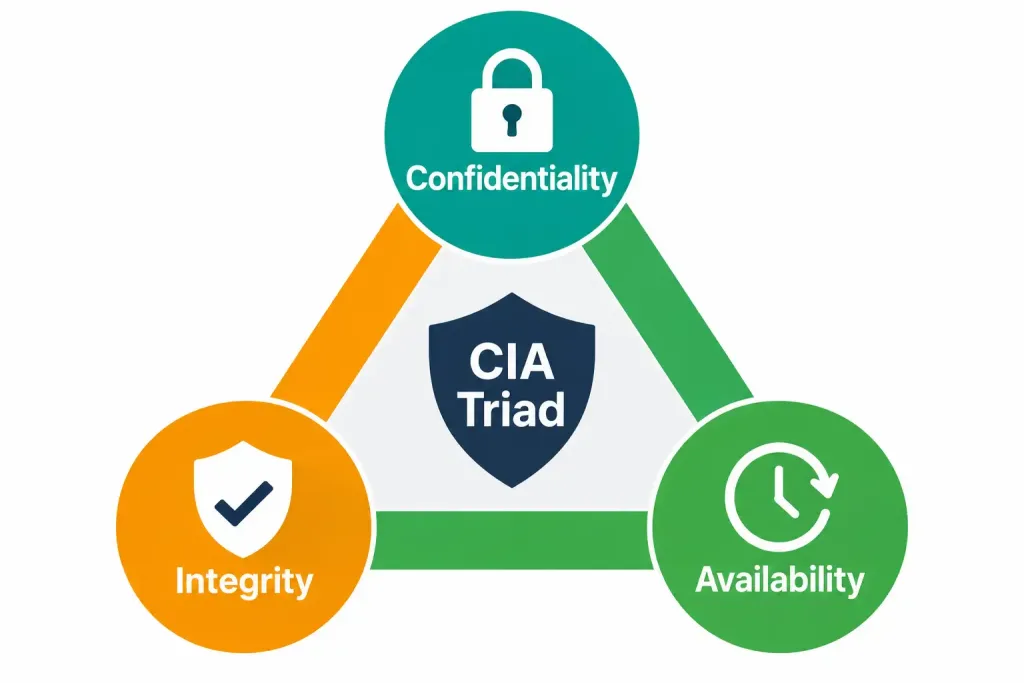
Every mitigation discussed throughout this security domain ultimately serves one or more of these three properties. An access control list protects confidentiality by restricting who can reach certain traffic; a firewall rule blocking a known exploit protects integrity and availability by preventing unauthorized modification or a denial-of-service condition; user training protects all three simultaneously by reducing the likelihood of a successful social engineering attack in the first place.
Classifying Threats and Vulnerabilities
Scenario-based questions often benefit from being able to categorize what’s being described, beyond just naming it correctly.
Threats are commonly classified along a couple of useful dimensions:
- External vs. internal — an outside attacker versus a threat originating from within the organization (a disgruntled employee, or simply an authorized user making an honest mistake).
- Malicious vs. accidental — a deliberate attack versus unintentional harm, such as an employee misconfiguring a device or falling for a phishing attempt without malicious intent themselves.
Vulnerabilities are commonly classified by their origin:
- Software vulnerabilities — flaws in code, such as an unpatched application or operating system flaw.
- Configuration vulnerabilities — weaknesses introduced by how a system is set up, such as an overly permissive access control list or a default credential left unchanged.
- Process/human vulnerabilities — weaknesses in procedure or awareness, such as a lack of user training or an absent change-management process that allows risky configuration changes to go unreviewed.
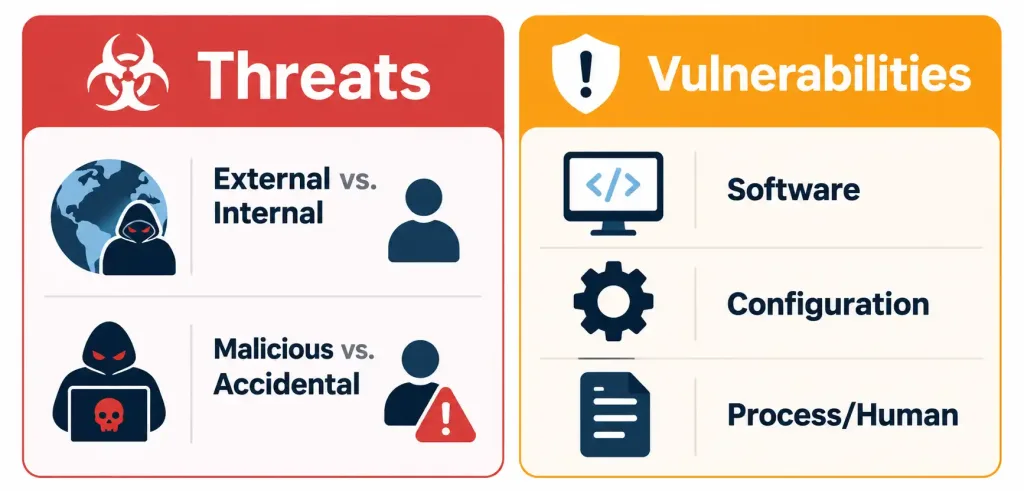
Recognizing these categories helps parse exam scenarios efficiently — a question describing “an employee who clicked a link in a suspicious email” is describing a malicious external threat exploiting an internal, human/process vulnerability (lack of awareness), for instance, and being able to break a scenario down this way is often exactly what the question is testing.
It’s worth practicing this classification skill on a few more examples before moving on. “A former employee’s account was never disabled after they left the company” describes a process/human vulnerability (a missing offboarding procedure) that could be exploited by either an external threat (if the credentials were ever compromised) or the former employee themselves acting as an internal threat. “A switch was shipped with a default administrative password that was never changed” describes a configuration vulnerability, exploitable by any threat capable of reaching the device’s management interface
Which is exactly why reducing the attack surface around that management interface, discussed above, matters even independently of eventually changing the password itself. Working through examples like these — rather than only memorizing the category definitions in isolation — is what actually builds the pattern-recognition skill this objective is testing for.
Common Misconceptions
- “Threat and vulnerability mean the same thing.” A threat is a potential source of harm; a vulnerability is the weakness that harm could exploit. A threat can exist with no exploitable vulnerability present, and a vulnerability can exist with no credible threat currently targeting it.
- “An exploit and a vulnerability are the same thing.” A vulnerability is the passive weakness; an exploit is the active technique or code that takes advantage of it. The vulnerability can exist for a long time before any exploit targeting it is developed or used.
- “Mitigation always means eliminating the vulnerability entirely.” Mitigation can also mean reducing a threat’s ability to reach a vulnerability, or limiting the impact if an exploit succeeds — patching isn’t the only valid mitigation, and layered mitigations addressing different points in the chain are a standard, expected security practice.
- “Risk is the same as vulnerability.” A vulnerability can exist with very low associated risk if no credible threat is realistically positioned to exploit it — risk requires considering both the vulnerability and the threat capable of reaching it.
- “All threats are malicious.” An untrained employee making an honest configuration mistake is still a legitimate threat in this vocabulary, even without any malicious intent — the chain doesn’t require intent, only potential for harm.
Frequently Asked Questions
Can a single vulnerability have multiple different exploits targeting it? Yes — a well-known vulnerability, especially one that’s been public for a long time, often has multiple independently developed exploits, sometimes with different levels of sophistication or reliability, all targeting the same underlying weakness.
Is it possible to fully eliminate risk? Realistically, no — security programs aim to reduce risk to an acceptable level given available resources and the actual value of what’s being protected, rather than pursuing an unattainable zero-risk state, which would generally be prohibitively costly or would make systems unusably restrictive.
Does a mitigation always need to be technical? No — user awareness training, physical security policies, and process controls like change management are all legitimate, often highly effective mitigations that aren’t purely technical in nature, and this domain’s later objectives cover several of these non-technical elements explicitly.
How does the CIA triad relate to specific technologies covered elsewhere in this course? Nearly every technology covered so far maps onto it in some way — encryption (confidentiality), routing protocol authentication (integrity, preventing a spoofed routing update), and redundancy protocols like HSRP (availability) are all concrete examples of CIA triad principles already covered before this domain even began.
Why does this objective matter if it’s not a hands-on configuration skill? This vocabulary is the foundation the rest of the Security Fundamentals domain builds on — ACLs, AAA, Layer 2 security features, and VPNs are all mitigations addressing specific threats and vulnerabilities, and having this shared vocabulary precise makes every subsequent objective in this domain easier to reason about clearly.
Is it possible for a mitigation to introduce a new vulnerability of its own? Yes, and this is a genuinely important nuance in real security practice — a poorly implemented mitigation can create new problems, such as an overly restrictive access control list accidentally blocking legitimate traffic (an availability problem), or a complex password policy that drives employees to write passwords down somewhere insecure (a human/process vulnerability introduced by the very policy meant to prevent one). Effective mitigations need to be evaluated not just for whether they address the intended risk, but for what new risks they might introduce in the process.
Do all four terms in the chain need to be present for a security incident to occur? A completed incident requires all four in sequence — a vulnerability exists, a threat capable of reaching it exists, an exploit is actually used, and the absence or failure of an adequate mitigation allows it to succeed. Missing any single link (no exploitable vulnerability, no credible threat, or an effective mitigation already in place) breaks the chain before an actual incident occurs, which is exactly the goal every mitigation strategy is working toward.
Security Terminology and Risk: Practice Quiz
Test your knowledge of threats, vulnerabilities, exploits, mitigations, the CIA triad, and practical security risk.
Summary
- Threat, vulnerability, exploit, and mitigation form a causal chain: a threat is potential danger, a vulnerability is the weakness it could exploit, an exploit is the specific technique used to do so, and a mitigation reduces risk at any point along that chain. A completed incident requires all four links present in sequence.
- Risk considers both a vulnerability’s existence and the likelihood of a credible threat actually reaching and exploiting it — a vulnerability alone doesn’t automatically mean high risk.
- The CIA triad (Confidentiality, Integrity, Availability) is the foundational goal nearly every security mitigation covered in this domain ultimately serves, from encryption through redundancy to access control.
- Threats can be classified as external/internal and malicious/accidental; vulnerabilities can be classified as software, configuration, or process/human in origin — both classifications help parse scenario-based exam questions efficiently.
- Familiar examples from earlier objectives — SNMP’s default community strings, Telnet’s plaintext transmission — are concrete, already-covered illustrations of this vocabulary chain in action.
- Reducing the attack surface and choosing mitigations that don’t introduce new vulnerabilities of their own are both practical extensions of this vocabulary worth carrying forward into the rest of this domain and every objective that follows it.