Domain 5.9 | Security Fundamentals — 15% of exam
Learning Objectives
By the end of this lesson, you will be able to:
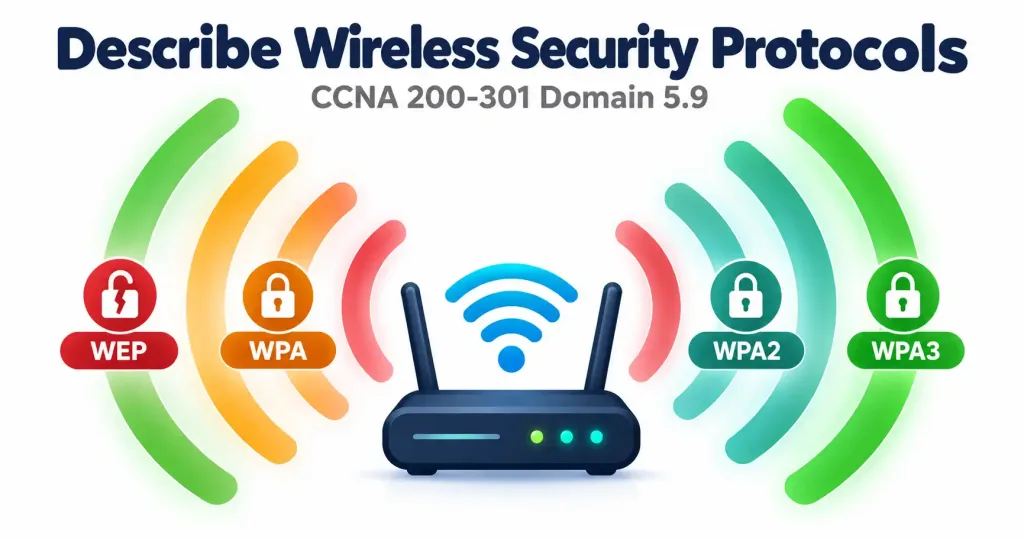
- Describe the evolution from WEP through WPA, WPA2, to WPA3, and why each successor existed.
- Explain WPA3’s two headline improvements over WPA2: SAE and encryption on open networks.
- Distinguish between Personal (PSK) and Enterprise (802.1X) modes across WPA2 and WPA3.
- Explain the offline dictionary attack vulnerability in WPA2-PSK and how SAE specifically closes it.
- Identify the encryption algorithms associated with each WPA generation.
Key Terms Glossary
| Term | Definition |
|---|---|
| WEP (Wired Equivalent Privacy) | The original, now badly broken wireless security protocol, superseded by WPA. |
| WPA (Wi-Fi Protected Access) | The original replacement for WEP, itself now considered obsolete. |
| WPA2 | The long-standing wireless security standard introducing AES-CCMP encryption. |
| WPA3 | The current wireless security standard, improving on WPA2 with SAE and open-network encryption. |
| SAE (Simultaneous Authentication of Equals) | WPA3’s replacement for the WPA2 four-way PSK handshake, resistant to offline dictionary attacks. |
| PSK (Pre-Shared Key) | A shared passphrase-based authentication mode, commonly called “Personal” mode. |
| 802.1X | A port-based authentication framework using individual per-user credentials against a RADIUS server, commonly called “Enterprise” mode. |
| Offline dictionary attack | An attack where a captured authentication exchange is brute-forced against a password list without further interaction with the target. |
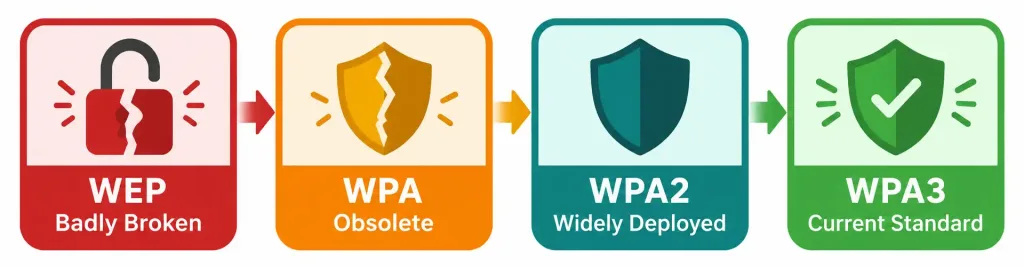
The Evolution: WEP to WPA3
Wireless security has gone through several generations, and understanding why each one replaced its predecessor is more useful than simply memorizing the sequence of names.
WEP (Wired Equivalent Privacy) was the original wireless security protocol, and it was badly broken almost from the start. Its core weaknesses — a static encryption key shared by every device on the network, and a flawed use of the RC4 cipher with a short, frequently reused initialization vector — meant that capturing enough traffic allowed an attacker to mathematically recover the encryption key entirely, regardless of how strong the passphrase itself was. WEP is essentially never seen in current deployments, existing today only as a historical reference point for how badly wireless security started out.
WPA (Wi-Fi Protected Access) was designed as WEP’s replacement, introduced specifically to patch WEP’s most severe flaws without requiring entirely new hardware to be purchased. WPA is itself now considered obsolete, having been superseded by WPA2’s stronger encryption — WPA is rarely seen in current deployments either, serving mainly as a transitional step in the historical sequence rather than a protocol still actively recommended today.
WPA2 introduced AES-CCMP encryption, a genuinely strong encryption scheme (as opposed to WEP’s broken RC4 implementation and WPA’s improved-but-still-imperfect TKIP), and WPA2 remains widely deployed as the long-standing enterprise and consumer wireless security standard, even years after WPA3’s introduction.
WPA3 is the current standard, improving on WPA2 in two specific, headline ways that this lesson covers in depth and in detail below.
WPA3’s First Improvement: SAE Replaces the Four-Way PSK Handshake
To understand why this improvement matters, it’s necessary to understand the vulnerability it closes. WPA2-PSK’s original authentication process — the four-way handshake — has a specific, well-documented weakness: an attacker who captures this handshake exchange (simply by observing wireless traffic during a legitimate device’s connection, or by forcing a disconnection to trigger a new one) can take that captured data completely offline and attempt to brute-force the shared passphrase against it, using a dictionary of common passwords or a systematic guessing approach, without any further interaction with the actual access point at all.
This is what’s meant by an offline dictionary attack — once the handshake is captured, the cracking attempt happens entirely on the attacker’s own hardware, at whatever speed their computing resources allow, completely invisible to the network being attacked and with no way for that network to detect or rate-limit the attempt.
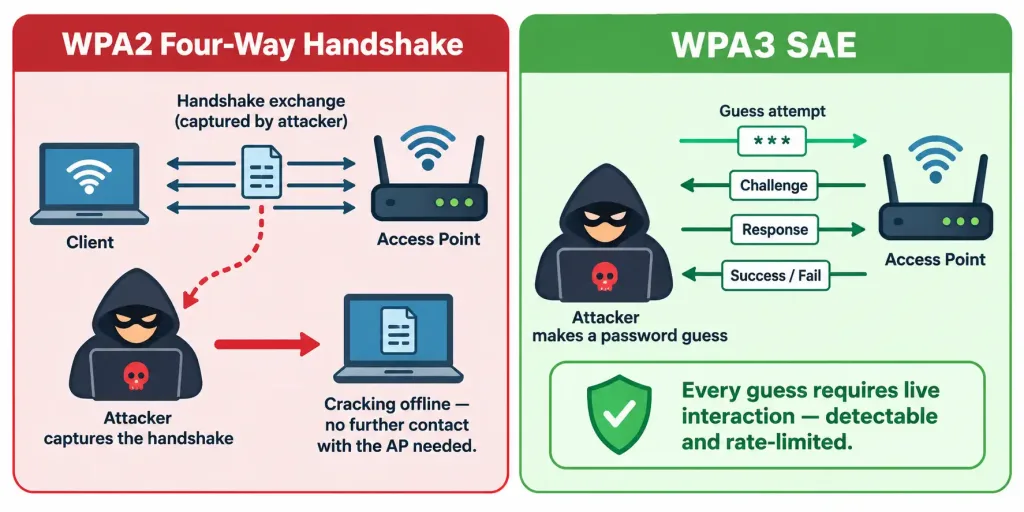
WPA3 replaces the four-way handshake with SAE (Simultaneous Authentication of Equals), sometimes referred to by its technical name, the Dragonfly handshake. SAE is specifically designed so that each individual password guess requires actual interaction with the access point — an attacker can no longer capture one exchange and then brute-force it offline at their own pace.
Every single guess must be attempted live, against the real access point, which can detect and rate-limit repeated failed attempts in a way that’s completely impossible to do against an offline attack. This single design change closes the offline dictionary attack vulnerability that affected WPA2-PSK, without requiring users to do anything differently — the passphrase-based user experience remains the same, but the underlying cryptographic exchange protecting that passphrase is fundamentally more resistant to this specific attack.
SAE also provides forward secrecy as a secondary benefit — even if a passphrase is eventually compromised, previously captured encrypted traffic from past sessions cannot be retroactively decrypted using that recovered passphrase, since each session’s encryption keys are derived in a way that doesn’t simply reduce back to the shared passphrase directly. WPA2’s handshake didn’t provide this property, meaning a compromised passphrase could theoretically be used to decrypt previously captured traffic if that traffic had also been recorded.
A Related Historical Vulnerability Worth Knowing
The offline dictionary attack isn’t the only handshake-related weakness that affected WPA2 over its long deployment history. A separate, more technically involved vulnerability known as KRACK (Key Reinstallation Attack), disclosed in 2017, exploited a flaw in how the four-way handshake could be manipulated to force reuse of an already-used encryption key, under certain conditions allowing an attacker within range to decrypt some traffic without ever needing the passphrase at all. KRACK was addressed through vendor patches to existing WPA2 implementations rather than requiring an entirely new protocol.
It’s also worth recognizing as a separate example of how the underlying handshake mechanism itself — not just passphrase strength — has been a genuine, actively researched area of wireless security weakness over WPA2’s lifetime, reinforcing why WPA3’s handshake redesign wasn’t merely a defensive-sounding marketing improvement but a response to real, demonstrated attack research.
WPA3’s Second Improvement: Encryption Even on Open Networks
WPA2 and every protocol before it shared a significant gap: an open network — one with no password at all, common in cafes, airports, and other public hotspots — provided no encryption whatsoever. Traffic on an open network was transmitted in the clear, meaning anyone else connected to that same open network (or simply within radio range) could potentially observe unencrypted traffic, a genuine and long-standing privacy problem for public Wi-Fi usage that predates even the specific PSK-handshake weakness discussed above.
WPA3 addresses this through a companion technology often referred to as Enhanced Open, based on OWE (Opportunistic Wireless Encryption). This provides encryption between an individual client and the access point even when no password is required to join the network at all — each client still gets its own unique encryption keys, meaning one connected user can no longer simply observe another connected user’s traffic on the same open network, even though neither one needed a password to join.
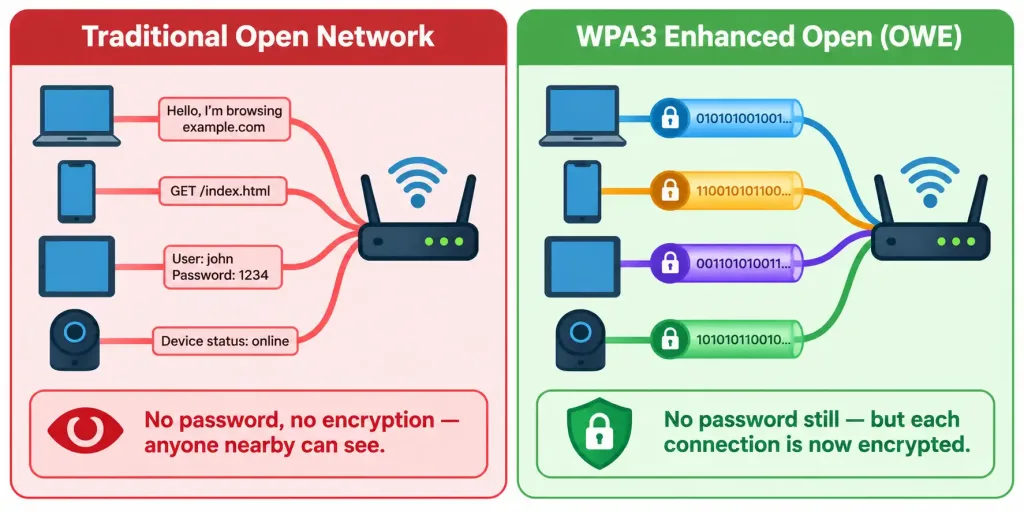
It’s worth being precise about what this improvement does and doesn’t provide: OWE encrypts traffic between the client and access point, protecting against passive eavesdropping by other nearby devices, but it doesn’t provide the kind of authentication a passworded network provides — anyone can still join an OWE-protected open network without any credential at all, exactly as before. The improvement is specifically about confidentiality on an otherwise-open network, not about restricting who can join it, which remains a deliberate design choice for networks meant to be genuinely open to any visitor.
Personal vs. Enterprise Mode: A Distinction That Applies Across WPA2 and WPA3
Both WPA2 and WPA3 support two distinct authentication modes, and this distinction connects directly back to objective 5.8’s AAA discussion.
Personal mode, using PSK (Pre-Shared Key), is what most people encounter in home and small-business networks: a single shared passphrase is configured once and distributed to every device connecting to that SSID. Every device uses the identical passphrase, and the network has no way to distinguish one connected user from another beyond that single shared credential — there’s no individual accountability built into this model at all.
Enterprise mode, using 802.1X, requires each individual user to authenticate with their own personal credentials against a centralized authentication server — specifically, a RADIUS server, the exact protocol covered in objective 5.8 as the typical choice for network access control. This provides genuine per-user authentication and accountability: each connecting user’s identity is individually verified, individual credentials can be revoked without affecting anyone else (unlike a shared PSK, which requires reconfiguring every device if it needs to change), and accounting logs can record which specific user accessed the network and when.
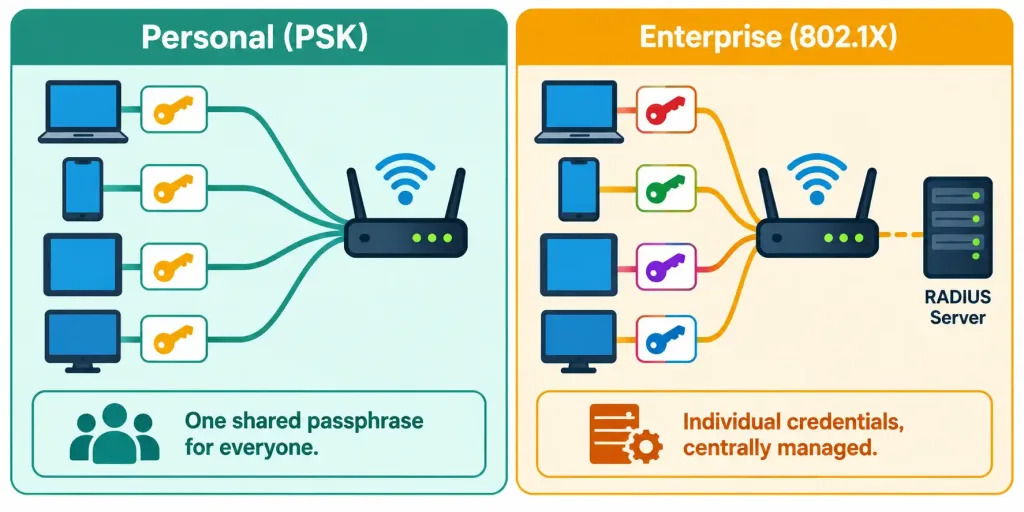
This is precisely why Enterprise mode is the appropriate choice for organizations needing individual accountability and centralized credential management, while Personal mode remains entirely appropriate and sufficient for home networks and smaller deployments where that level of per-user infrastructure isn’t warranted. Both WPA2 and WPA3 support both modes — the WEP-through-WPA3 evolution discussed earlier is about the underlying encryption and handshake security, while Personal versus Enterprise is a separate, orthogonal choice about how users authenticate in the first place.
Encryption Algorithms Across Generations
| Protocol | Primary Encryption |
|---|---|
| WEP | RC4 (broken implementation overall) |
| WPA | TKIP (an improvement over WEP, itself now considered weak) |
| WPA2 | AES-CCMP |
| WPA3 | AES-GCMP (stronger, particularly in WPA3-Enterprise’s 192-bit security mode) |
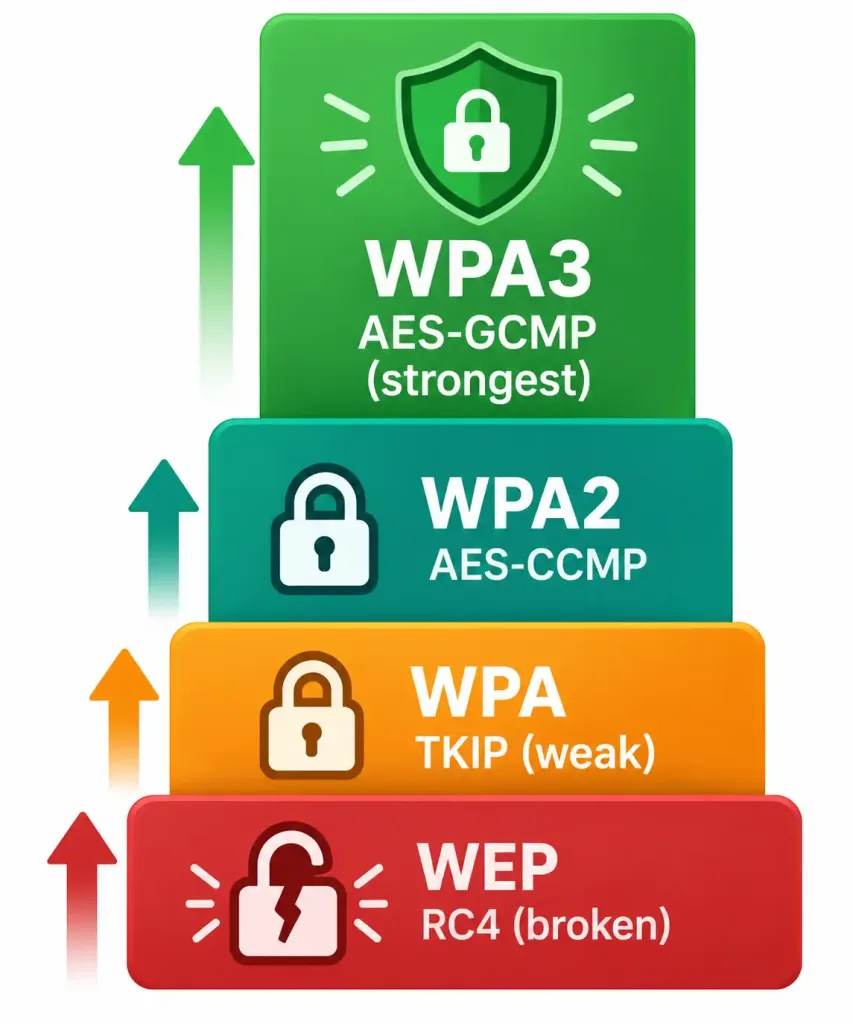
This table reinforces the same evolutionary story from a purely cryptographic angle: each generation’s encryption is a genuine, meaningful improvement over its predecessor, not merely a marketing refresh of the same underlying mechanism.
WPA3-Enterprise’s Optional 192-Bit Security Mode
Worth knowing at a recognition level: WPA3-Enterprise offers an optional, more stringent 192-bit security mode, intended for environments with particularly demanding security requirements — government, defense, and similarly sensitive sectors. This mode mandates the use of specific, stronger cryptographic algorithms throughout the entire connection, rather than the baseline AES-GCMP configuration that satisfies standard WPA3-Enterprise requirements. This isn’t a separate protocol generation the way WPA2-to-WPA3 represents a full evolutionary step — it’s better understood as an optional, higher-assurance configuration profile available within WPA3-Enterprise specifically, for organizations whose risk profile genuinely calls for it, rather than a change every deployment needs to adopt by default.
Common Misconceptions
- “WPA3’s improvements are entirely about encryption strength.” WPA3’s headline improvements are specifically SAE (replacing the vulnerable four-way handshake) and encryption on open networks (via OWE) — genuine encryption algorithm strength (AES-GCMP) is a related but separate improvement, not the only or even the primary story.
- “An offline dictionary attack against WPA2-PSK requires actively attacking the access point in real time.” The defining characteristic of this attack is that it happens entirely offline, on the attacker’s own hardware, after capturing just one handshake — no ongoing interaction with the access point is needed once the handshake is captured.
- “WPA3’s Enhanced Open makes an open network require a password.” It doesn’t — anyone can still join an Enhanced Open network without credentials, exactly as with a traditional open network; the improvement is encrypting traffic between the client and access point, not restricting who can join.
- “Personal and Enterprise mode are different protocols, like WPA2 versus WPA3.” They’re both available within either WPA2 or WPA3 — Personal/Enterprise describes the authentication model (shared passphrase versus individual per-user credentials), while WPA2/WPA3 describes the underlying handshake and encryption generation; these are two independent dimensions.
- “WPA is a reasonably secure fallback option if WPA2 or WPA3 isn’t available.” WPA is itself now considered obsolete — a network still relying on WPA rather than WPA2 or WPA3 has a genuinely outdated security posture, not merely a slightly older but still acceptable one.
Frequently Asked Questions
Can a device connect to a WPA3 network if it only supports WPA2? Generally no for a WPA3-only network, though many access points support a transitional mode allowing both WPA2 and WPA3 clients to connect simultaneously during a migration period, at the cost of only providing WPA3’s stronger protections to the clients actually capable of using them.
On the Practicalities of Migrating from WPA2 to WPA3
Organizations rarely flip every access point over to WPA3-only in a single step, since doing so would immediately disconnect any device that hasn’t yet been updated to support WPA3 client-side — older laptops, older IoT devices, and legacy equipment can all lag behind current wireless standards for years after a new protocol is officially released. Transition mode configurations, which broadcast both WPA2 and WPA3 compatibility simultaneously on the same SSID, are the practical bridge most organizations rely on during this migration window.
It’s worth understanding that transition mode is a deliberate trade-off, not a free upgrade: devices still connecting via WPA2 within a transition-mode network don’t gain SAE’s protection against offline dictionary attacks just because WPA3 is also available on the same network — each connecting device only benefits from the protocol version it actually negotiates, meaning a network’s real-world security posture during a transition period is only as strong as its least-capable regularly connecting device, and a network administrator planning a migration should budget for this gradual, uneven security improvement rather than expecting the full benefit to arrive the moment WPA3 support is first enabled.
Does SAE change anything about how a user actually connects to a WPA3-Personal network? No — from the user’s perspective, they still simply enter the shared passphrase exactly as they would for WPA2-Personal; SAE’s improvement happens entirely in the underlying cryptographic exchange, invisible to the everyday connection experience.
Is Enterprise mode only relevant for very large organizations? Not necessarily by size alone — any organization valuing individual user accountability, centralized credential management, or the ability to revoke a single compromised credential without reconfiguring every other device benefits from Enterprise mode, regardless of overall organization size, though the RADIUS infrastructure it requires does represent additional complexity smaller organizations may reasonably choose to avoid, particularly if they lack existing IT staff to maintain that infrastructure ongoing.
Why doesn’t WPA3’s Enhanced Open require a password if it provides encryption? Enhanced Open is specifically designed for networks intended to remain genuinely open to any visitor — a coffee shop wants any customer to connect freely — while still providing a meaningful confidentiality improvement over completely unencrypted traffic; requiring a password would defeat the “genuinely open” use case this feature is designed to preserve.
How does WPA3’s forward secrecy relate to the CIA triad from objective 5.1? Forward secrecy is a confidentiality-strengthening property specifically — it limits the damage a future credential compromise can do to past traffic, meaning a single point-in-time compromise doesn’t retroactively expose everything that came before it, extending confidentiality protection across time rather than just at a single moment.
Does upgrading to WPA3 require replacing existing wireless access point hardware? It depends on the specific hardware’s age and capability — many access points manufactured in recent years can be upgraded to support WPA3 through a firmware update alone, while older hardware predating WPA3’s introduction may lack the processing capability or radio features needed and would genuinely require replacement to gain WPA3 support, making this a case-by-case hardware assessment rather than a universal answer either way.
Wireless Security: WEP, WPA2, WPA3 and Enterprise Authentication
Quiz #47 — Wireless Encryption, Handshakes, SAE, OWE, PSK and 802.1X
Summary
- Wireless security evolved from WEP (badly broken) through WPA (obsolete) and WPA2 (AES-CCMP, still widely deployed) to WPA3 (the current standard), with each generation representing a genuine security improvement over the last.
- WPA3’s SAE replaces WPA2’s vulnerable four-way handshake, requiring live interaction with the access point for every password guess and closing the offline dictionary attack that affected WPA2-PSK, while also providing forward secrecy against future credential compromise affecting previously captured traffic.
- WPA3’s Enhanced Open (OWE) provides encryption between clients and the access point even on password-free open networks, improving confidentiality without restricting who can join, addressing a privacy gap that had existed in every wireless security generation before it.
- Personal (PSK) mode uses a single shared passphrase; Enterprise (802.1X) mode uses individual per-user credentials authenticated against a RADIUS server, exactly the protocol covered in objective 5.8 — both modes are available across WPA2 and WPA3, independent of the WEP-to-WPA3 evolution described throughout this lesson.
- Encryption has genuinely strengthened at each generation: RC4 (WEP, broken) → TKIP (WPA, weak) → AES-CCMP (WPA2) → AES-GCMP (WPA3, stronger still), with an optional 192-bit mode available for particularly demanding WPA3-Enterprise deployments.