
Domain 3.0 | Network Operations — 19% of exam
Learning Objectives
By the end of this lesson, you will be able to:
- Define RPO and RTO and explain how each shapes disaster recovery planning differently
- Explain MTTR and MTBF and what each measures about reliability and recovery speed
- Compare hot, warm, and cold disaster recovery site types
- Explain how high availability (HA) approaches reduce reliance on disaster recovery in the first place
- Describe why disaster recovery plans must be regularly tested, not just written and filed away
Key Terms
| Term | Definition |
|---|---|
| RPO (Recovery Point Objective) | The maximum acceptable amount of data loss, measured as a point in time before a failure |
| RTO (Recovery Time Objective) | The maximum acceptable amount of downtime before a system must be restored |
| MTBF (Mean Time Between Failures) | The average time a system operates before experiencing a failure — a reliability measure |
| MTTR (Mean Time To Repair) | The average time required to repair a system after a failure occurs — a recovery speed measure |
| Hot Site | A fully operational duplicate facility, ready for near-instant failover |
Explanation
Monitoring and Backups Feed Disaster Recovery Planning
Everything covered so far in this module — configuration backups and rollback plans, and baseline-driven monitoring — supports disaster recovery, but disaster recovery itself is a broader, more deliberate planning discipline: preparing for a genuinely severe event (a data center fire, a regional outage, a catastrophic hardware failure) rather than a routine, contained incident.RPO and RTO: Two Different Recovery Questions
RPO (Recovery Point Objective) and RTO (Recovery Time Objective) are the two foundational numbers behind any disaster recovery plan, and they answer genuinely different questions:
- RPO asks: how much data can we afford to lose? It’s measured backward in time from the moment of failure — an RPO of 4 hours means the organization can tolerate losing up to 4 hours of data, which directly determines how frequently backups need to be taken. A tighter RPO requires more frequent backups.
- RTO asks: how long can we afford to be down? It’s measured forward in time from the moment of failure — an RTO of 2 hours means systems must be restored and operational again within 2 hours of the disaster occurring.
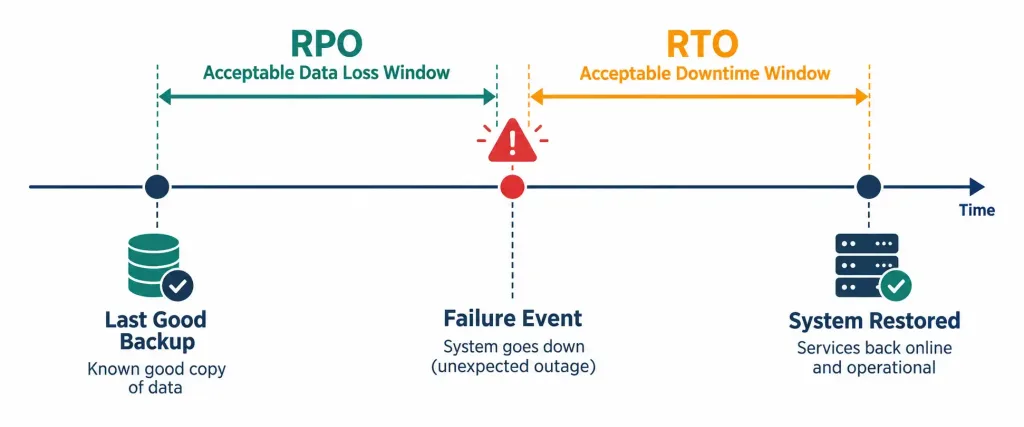
These two numbers are independent and both matter: a system could have an aggressive RTO (back up fast) but a loose RPO (some data loss is fine), or the reverse — frequent backups (tight RPO) but a longer acceptable restoration window (loose RTO). The specific business requirement determines which matters more for a given system, and the infrastructure investment needed to hit an aggressive RPO or RTO scales up sharply as those targets tighten.
MTTR and MTBF: Measuring Reliability and Recovery Speed
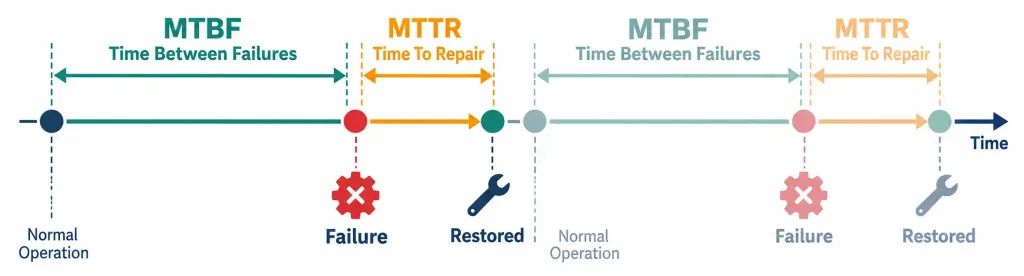
MTBF (Mean Time Between Failures) and MTTR (Mean Time To Repair) measure two different things about a system’s overall reliability:
- MTBF measures how long a system typically runs before failing — a reliability metric. A higher MTBF means a more reliable system that fails less often.
- MTTR measures how long it typically takes to fix a system once it has failed — a recovery speed metric. A lower MTTR means faster recovery when something does go wrong.
DR Site Types: Hot, Warm, and Cold
When a primary facility becomes unusable, organizations rely on a pre-arranged alternate site, and these sites come in three general tiers:
- A hot site is a fully operational duplicate of the primary environment — systems running, data replicated, ready for near-instant failover. It’s the fastest option to activate and by far the most expensive to maintain continuously.
- A warm site has some infrastructure and data already in place but isn’t fully live — it requires some setup and synchronization time before becoming operational, sitting between hot and cold in both cost and recovery speed.
- A cold site provides only basic facility infrastructure — power, space, connectivity — with no equipment or data pre-staged. It’s the cheapest option to maintain, but activating it after a disaster takes significantly longer, since hardware needs to be installed and data restored essentially from scratch.
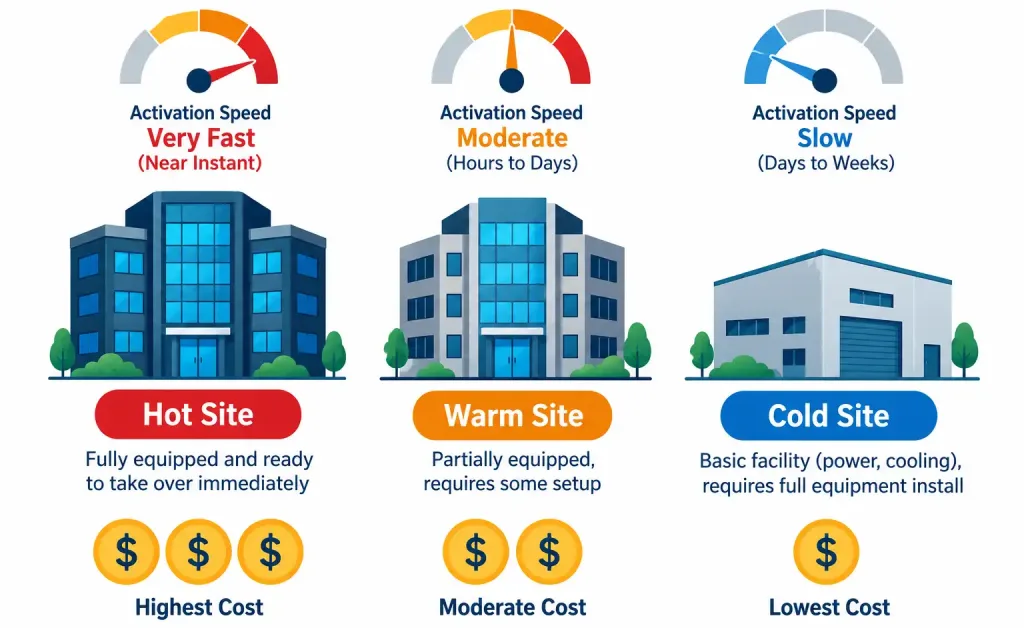
The right choice depends directly on the RTO the organization needs: a business requiring near-zero downtime justifies a hot site’s ongoing expense, while a business that can tolerate a longer recovery window can save significantly with a warm or cold site instead.
High Availability and Redundancy
High availability (HA) takes a different approach: instead of planning how to recover after a failure, HA designs reduce how often a failure actually causes an outage in the first place. This includes concepts already covered earlier in the course, like FHRP gateway redundancy, along with broader concepts like server clustering, load balancing across multiple instances, and geographically distributing redundant infrastructure across separate physical locations.HA and disaster recovery work together rather than competing: HA reduces how often the organization needs to invoke its DR plan at all, while DR provides the fallback for the genuinely severe events that HA alone can’t fully prevent — a full site loss, for instance, that no amount of local redundancy can protect against.
Testing Disaster Recovery Plans
A disaster recovery plan that’s written and filed away, but never actually tested, is largely an assumption rather than a real capability. Testing ranges from lightweight to comprehensive:
- A tabletop exercise walks through the plan conversationally, without actually executing any technical steps — useful for catching logical gaps in the plan itself.
- A walkthrough or simulation goes further, actually exercising specific technical procedures in a controlled, non-production way.
- A full failover test genuinely cuts over to the DR site or alternate systems, verifying the entire plan works end to end under real conditions.
Skipping regular testing is one of the most common disaster recovery failures in practice: a plan that assumed a certain backup would restore cleanly, or that a warm site’s data sync was actually working, can fail silently for months until the exact moment it’s actually needed — which is the worst possible time to discover a gap.
Recognition-Level Verification Concepts
A few patterns are worth recognizing on sight:
- A stated maximum acceptable data loss window (e.g., “up to 4 hours of data”) is an RPO figure; a stated maximum acceptable downtime window is an RTO figure.
- A metric describing how often a system fails is MTBF; a metric describing how fast it gets fixed afterward is MTTR.
- A DR site description mentioning live, continuously replicated systems ready for immediate failover describes a hot site; one describing bare facility space with no pre-staged equipment describes a cold site.
- A DR exercise that only discusses the plan conversationally, without touching actual systems, is a tabletop exercise, not a full failover test.
Common Exam Traps
- RPO and RTO measure different directions relative to the failure event. RPO looks backward (data loss tolerance); RTO looks forward (downtime tolerance) — mixing these two up is one of the most common mistakes on this topic.
- A lower MTTR is better (faster repair), while a higher MTBF is better (longer time between failures). The “better direction” is opposite for these two metrics, which trips people up.
- Hot, warm, and cold sites exist on a cost-versus-speed spectrum, not a strict good/bad ranking. A cold site isn’t simply “worse” — it’s the right, cost-effective choice for an organization with a genuinely relaxed RTO.
- High availability and disaster recovery are complementary, not the same thing. HA reduces the frequency of failures causing outages; DR provides the plan for recovering when a failure does happen anyway.
- An untested DR plan should not be treated as a reliable safety net. Regular testing, at whatever level (tabletop through full failover), is what actually validates that the plan works.
Lesson 3.3.1 Practice Quiz — Disaster Recovery Concepts
17 questions covering RPO, RTO, MTBF, MTTR, hot/warm/cold DR sites, high availability, and DR testing.
N10-009 · Domain 3.3Summary
RPO defines acceptable data loss (measured backward from the failure); RTO defines acceptable downtime (measured forward from the failure) — both shape backup frequency and recovery infrastructure investment.
MTBF measures average time between failures (higher is better); MTTR measures average time to repair after a failure (lower is better).
Hot sites offer near-instant failover at high ongoing cost; warm sites balance cost and recovery speed; cold sites are cheapest but slowest to activate.
High availability reduces how often failures cause outages in the first place, complementing rather than replacing disaster recovery planning for genuinely severe events.
Disaster recovery plans must be regularly tested — from tabletop exercises through full failover tests — since an untested plan is an assumption, not a verified capability.