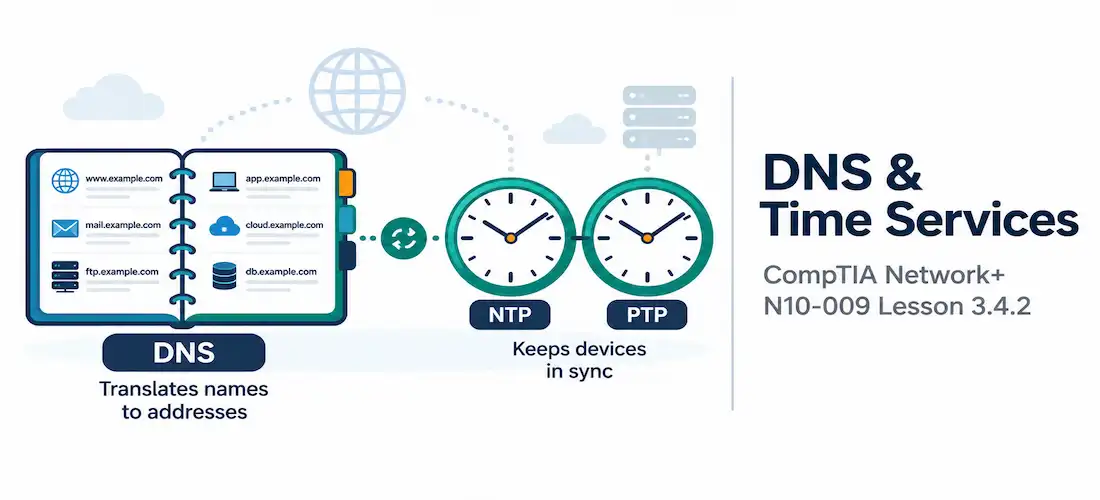
Domain 3.0 | Network Operations — 19% of exam
Learning Objectives – DNS & Time Services
By the end of this lesson, you will be able to:
- Explain the purpose of DNS and identify common DNS record types
- Describe the DNS resolution process, including recursive and iterative queries
- Explain the purpose of NTP and why time synchronization matters across a network
- Compare PTP to NTP and identify scenarios where PTP’s higher precision is necessary
- Explain NTS and why authenticated time synchronization matters
Key Terms
| Term | Definition |
|---|---|
| DNS (Domain Name System) | A hierarchical system that translates human-readable domain names into IP addresses |
| Recursive Query | A DNS query where the resolver does all the work of finding the final answer on the client’s behalf |
| NTP (Network Time Protocol) | A protocol used to synchronize device clocks across a network, typically to within milliseconds |
| PTP (Precision Time Protocol) | A protocol providing sub-microsecond clock synchronization, used where NTP’s precision isn’t sufficient |
| NTS (Network Time Security) | An extension to NTP that adds cryptographic authentication to time synchronization, preventing spoofed time sources |
Explanation
From Addressing to Naming and Timing
The previous lesson covered how devices get an IP address — and DHCP typically hands out DNS server addresses as part of that same configuration. This lesson covers what that DNS server actually does, along with a service that’s easy to overlook but genuinely critical: keeping every device’s clock in sync.DNS: Resolving Names to Addresses
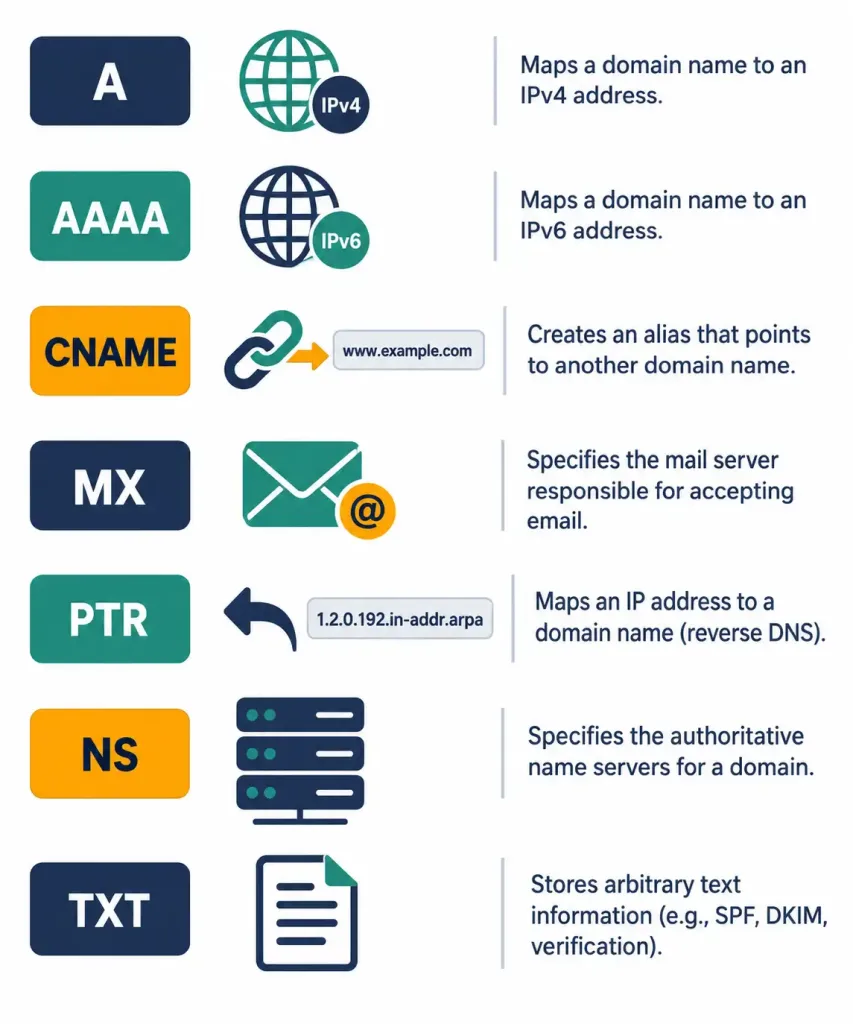
DNS (Domain Name System) exists because people and applications work far more naturally with names like mail.example.com than with raw IP addresses. DNS is a distributed, hierarchical system that translates those human-readable names into the actual IP addresses needed to establish a connection, and it operates over well-known port 53.DNS stores information in several distinct record types, each serving a different purpose:
| Record Type | Purpose |
|---|---|
| A | Maps a hostname to an IPv4 address |
| AAAA | Maps a hostname to an IPv6 address |
| CNAME | Creates an alias pointing one hostname to another hostname |
| MX | Identifies the mail server responsible for a domain |
| PTR | Maps an IP address back to a hostname (reverse lookup) |
| NS | Identifies the authoritative name server for a domain |
| TXT | Stores arbitrary text, commonly used for domain verification and email security policies |
The DNS Resolution Process
When a client needs to resolve a name, it typically sends a recursive query to its configured DNS resolver — often a local server or one provided by an ISP — asking it to figure out the final answer and return just that. The resolver, if it doesn’t already have the answer cached, then does the actual work by sending a series of iterative queries: first to a root server, which points it toward the correct top-level domain (TLD) server, which in turn points it toward the domain’s actual authoritative server, which finally provides the real answer.
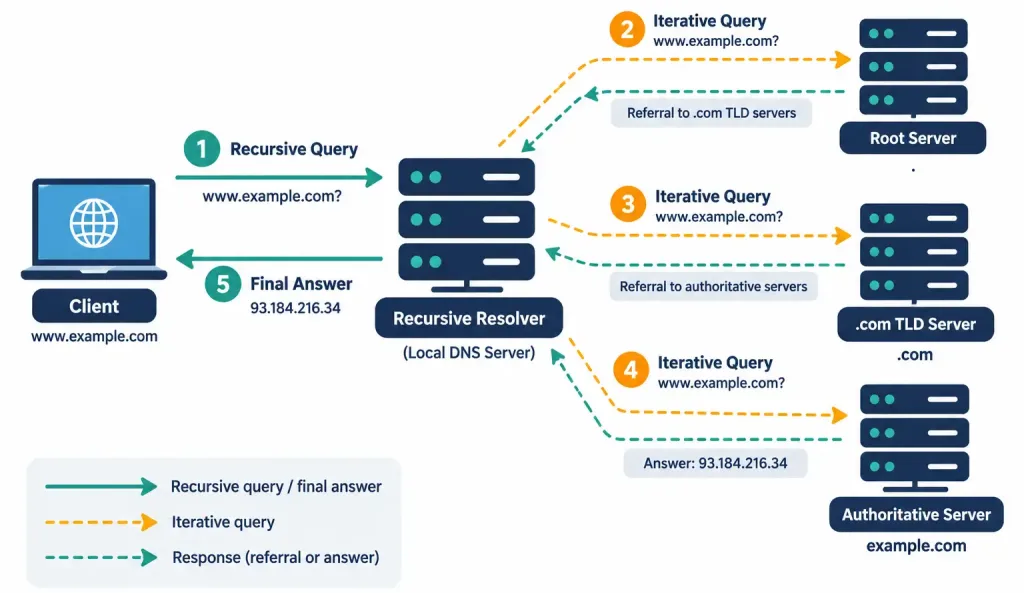
From the client’s perspective, this entire chain happens invisibly behind one simple request — the client only ever sees its single recursive query and the final answer, while the resolver handles all the iterative back-and-forth needed to actually track that answer down.
NTP: Keeping Clocks in Sync
NTP (Network Time Protocol) synchronizes device clocks across a network, typically achieving accuracy within milliseconds. This might sound like a minor convenience, but accurate, consistent time is quietly load-bearing for a surprising number of things: correlating syslog entries from different devices during an incident only works cleanly if their timestamps actually agree, and both digital certificate validation and Kerberos authentication depend on clocks being reasonably close together or they’ll reject otherwise-valid requests outright.NTP organizes time sources into a hierarchy of stratum levels: stratum 0 devices are highly accurate reference clocks (like atomic clocks or GPS receivers) that aren’t directly on the network; stratum 1 servers are directly connected to those reference clocks; stratum 2 servers sync from stratum 1, and so on down the hierarchy, with accuracy generally decreasing slightly at each additional level.
PTP: When Microseconds Matter
PTP (Precision Time Protocol) exists for situations where NTP’s millisecond-level accuracy simply isn’t good enough. PTP can achieve sub-microsecond synchronization accuracy — orders of magnitude tighter than NTP — making it the standard choice in environments like financial trading platforms (where transaction ordering and timing have real regulatory and competitive significance), industrial automation systems, and telecommunications infrastructure.
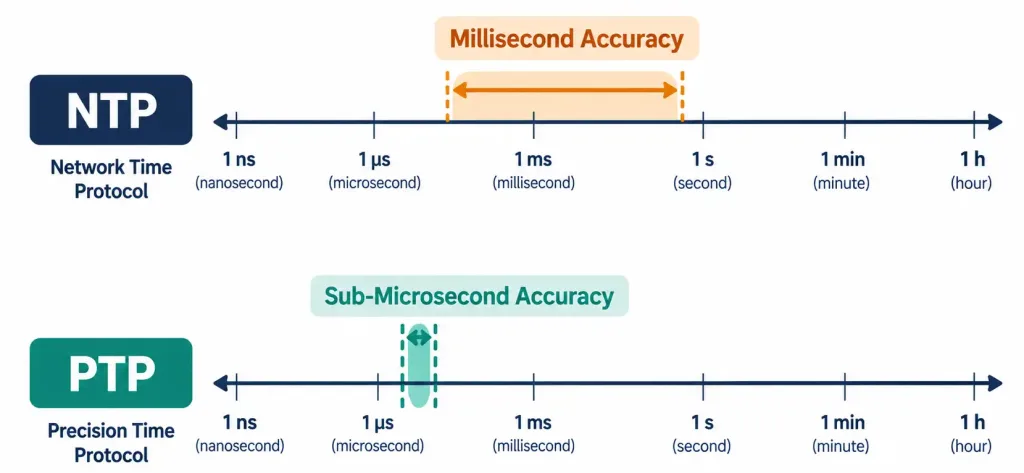
The tradeoff is that PTP generally requires specialized hardware support (often built into network interface cards) to achieve its full precision, and it’s genuinely unnecessary overhead for the vast majority of ordinary business networks, where NTP’s millisecond accuracy is already more than sufficient.
NTS: Securing Time Synchronization
Traditional NTP has a real weakness: it doesn’t authenticate its time sources by default, which means a malicious actor capable of intercepting or spoofing NTP traffic could feed a device an incorrect time — potentially undermining certificate validation or other time-dependent security mechanisms that assume the clock can be trusted. NTS (Network Time Security) addresses this by adding cryptographic authentication to the NTP exchange, allowing a client to verify that the time it’s receiving genuinely comes from the trusted server it expects, rather than an attacker positioned somewhere on the path.
Recognition-Level Verification Concepts
A few patterns are worth recognizing on sight:
- A record mapping a hostname to an IPv4 address is an A record; the IPv6 equivalent is an AAAA record.
- A single client query answered completely by one resolver, which then performs multiple queries on the client’s behalf, describes a recursive query triggering a chain of iterative ones.
- A time synchronization requirement measured in microseconds, especially in finance, industrial control, or telecom, points to PTP rather than NTP.
- An NTP exchange that includes cryptographic verification of the time source is using NTS, not standard unauthenticated NTP.
Common Exam Traps
- A CNAME record is an alias to another hostname, not directly to an IP address. Resolving a CNAME requires an additional lookup of whatever hostname it points to.
- Recursive and iterative queries aren’t interchangeable terms for the same thing. The client’s query is recursive (asking someone else to do the work); the resolver’s own follow-up queries to root/TLD/authoritative servers are iterative.
- PTP’s precision advantage comes with a real hardware dependency. Don’t assume PTP can simply be enabled in software for the same accuracy — full precision typically requires PTP-aware network hardware.
- Standard NTP has no built-in authentication. Assuming NTP traffic is inherently trustworthy overlooks exactly the gap NTS was created to close.
- Time synchronization issues can silently break unrelated things — certificate validation and Kerberos authentication failures are classic, non-obvious symptoms of clock drift, not something people immediately associate with an NTP problem.
Lesson 3.4.2 Practice Quiz — DNS & Time Services
17 questions covering DNS record types, recursive/iterative queries, NTP, PTP, and NTS.
N10-009 · Domain 3.4Summary
DNS translates human-readable names into IP addresses using a hierarchy of record types — A and AAAA for IPv4/IPv6 addresses, CNAME for aliases, MX for mail servers, PTR for reverse lookups, and more.
A client's recursive query triggers a chain of iterative queries from its resolver through root, TLD, and authoritative servers to find the final answer.
NTP synchronizes clocks across a network to within milliseconds, organized in a stratum hierarchy, and accurate time underpins log correlation, certificate validation, and authentication protocols like Kerberos.
PTP provides sub-microsecond precision for environments like financial trading, industrial automation, and telecom, at the cost of requiring specialized hardware support.
NTS adds cryptographic authentication to NTP, ensuring a device's time actually comes from a trusted source rather than a spoofed or intercepted one.