Domain 5.0 | Network Troubleshooting — 24% of exam
Learning Objectives
By the end of this lesson, you will be able to:
- Explain the impact of using an incorrect cable type for a given application
- Describe crosstalk, interference, and attenuation as distinct signal degradation issues
- Explain improper termination as a common cabling fault
- Describe TX/RX transposition and how it typically presents
Key Terms
| Term | Definition |
|---|---|
| Crosstalk | Signal bleeding between adjacent wire pairs within the same cable |
| Interference (EMI) | External electrical or electromagnetic sources disrupting a signal |
| Attenuation | Gradual weakening of a signal as it travels over distance |
| Improper Termination | A connector wired incorrectly against the intended pinout or wiring standard |
| TX/RX Transposed | Transmit and receive connections swapped, breaking or reversing communication on a link |
Explanation
From Methodology to Category-Specific Troubleshooting
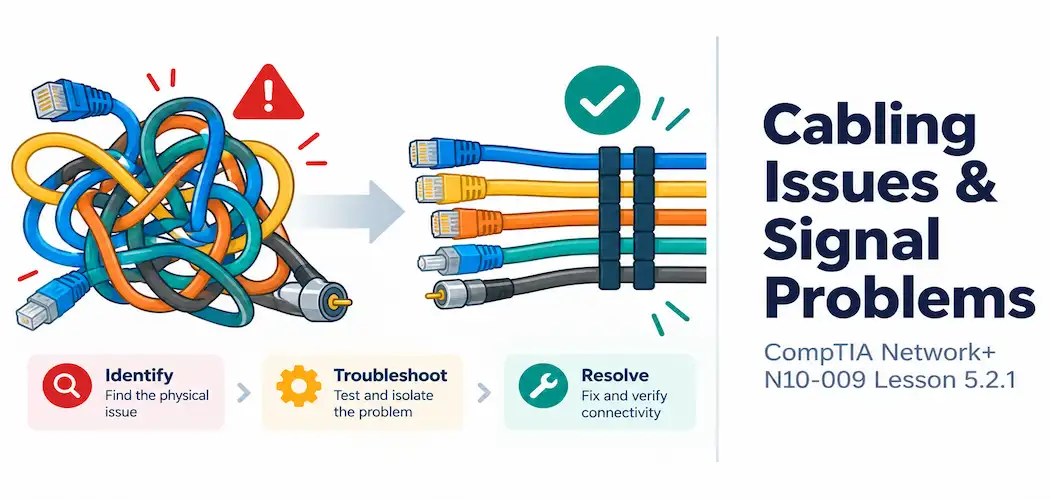
The previous lesson covered the structured process for approaching any network problem. This lesson applies that process to the first specific category: physical cabling faults, which remain one of the most common sources of network problems despite (or perhaps because of) how simple they often turn out to be once identified.
Incorrect Cable Type
Using the wrong cable for a given application produces symptoms ranging from degraded performance to a connection that never establishes at all:
- Single-mode vs. multimode fiber mismatch — these two fiber types use different core sizes and light sources, and connecting mismatched equipment or cabling generally results in a link that either won’t establish or performs far below expectations.
- Copper category mismatch — using a lower-category cable (Cat5 where Cat6a or higher was specified) than the deployed speed requires, a distinction covered in the cabling standards lesson back in Module 1, can cap achievable throughput well below what the network equipment on either end is actually capable of.
- STP vs. UTP mismatch — using unshielded twisted pair in an environment with heavy electrical interference, where shielded twisted pair was actually warranted, leaves the cable considerably more vulnerable to the interference issues covered next.
Signal Degradation: Crosstalk, Interference, and Attenuation
Three distinct mechanisms degrade signal quality, each with a different underlying cause:
- Crosstalk occurs when a signal on one wire pair bleeds over and affects an adjacent pair within the same cable — an internal problem, arising from the cable’s own construction and the proximity of its internal conductors to one another.
- Interference (EMI) comes from external sources entirely — electrical motors, fluorescent lighting, other nearby cabling — disrupting the signal from outside the cable rather than from within it. This is exactly why cabling standards care about routing cable away from things like fluorescent light fixtures and heavy electrical equipment wherever possible.
- Attenuation is the gradual weakening of a signal simply from traveling over distance, which is precisely why the 90-meter horizontal cabling limit covered earlier in this course exists — beyond that distance, attenuation degrades the signal enough that reliable communication is no longer guaranteed.
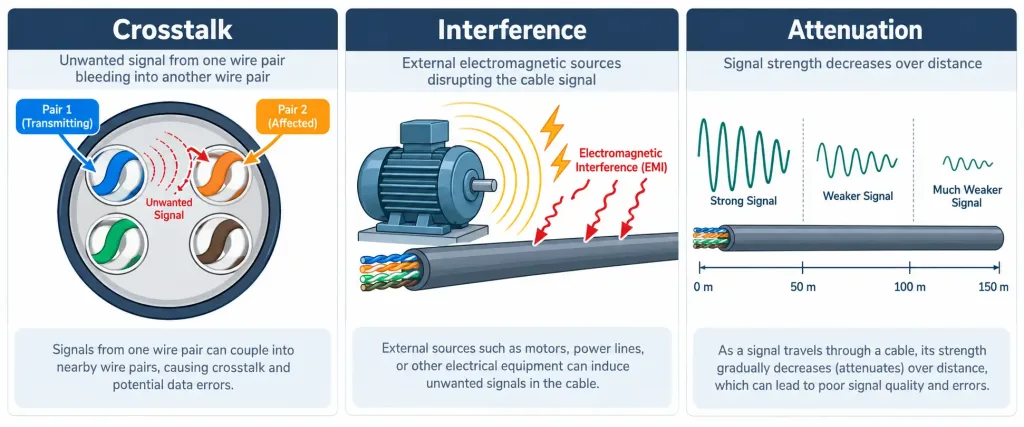
Distinguishing these three matters for troubleshooting: crosstalk points toward a cable-internal issue (often solved by better cable quality or construction), interference points toward external sources needing to be identified and routed around, and attenuation points toward a distance problem that no amount of cable quality alone can fully solve.
Improper Termination
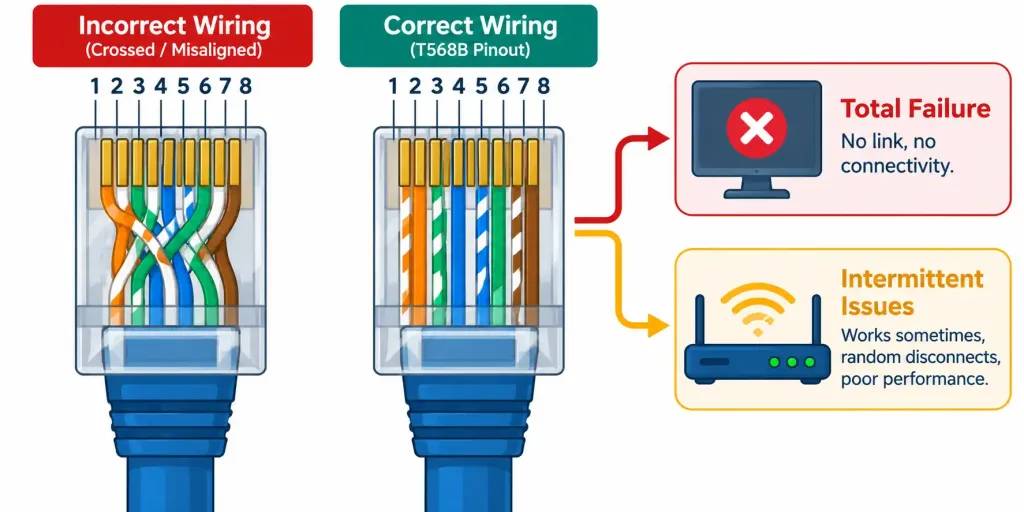
Improper termination happens when a connector is wired incorrectly against its intended pinout or wiring standard — mismatching wire pairs against the wrong pins, for instance, relative to the TIA/EIA-568 wiring standards covered earlier. The symptoms range from a connection that fails to establish at all to a connection that works intermittently or performs unreliably — improper termination doesn’t always produce an obviously dead link, which is exactly what makes it a genuinely tricky category of fault to diagnose without proper testing equipment.
TX/RX Transposed
TX/RX transposed describes a specific wiring mistake where the transmit and receive connections are swapped — a device’s transmit pin or fiber strand ends up connected to the far end’s transmit pin or strand instead of its receive, rather than the correct crossed pairing. This is a particularly common issue on fiber connections, where transmit and receive typically run on physically separate strands that must be correctly crossed between the two ends.
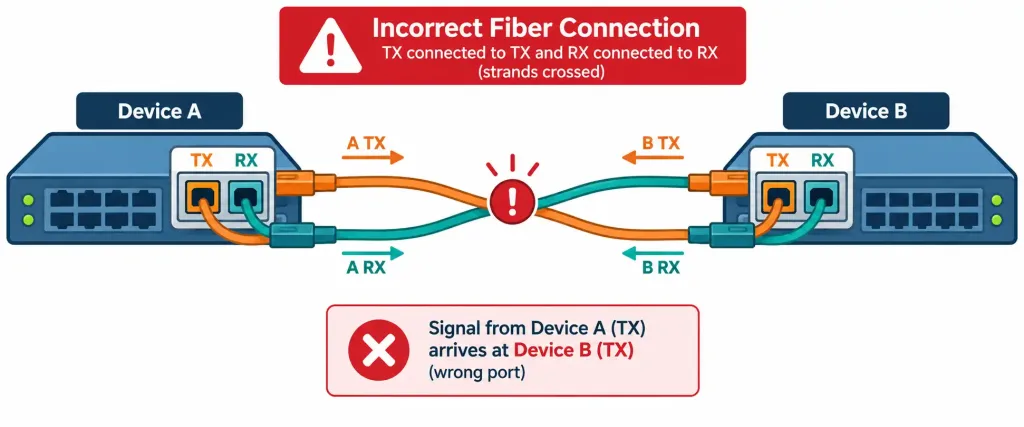
The typical symptom is a link that shows as down entirely, or in some cases a connection that appears to work in only one direction — one end can seemingly “hear” the other, but not the reverse — which is a strong, distinctive clue pointing directly at a TX/RX transposition rather than a more general cabling fault.
Recognition-Level Verification Concepts
A few patterns are worth recognizing on sight:
- A link performing well below its rated speed, despite otherwise correct configuration, points to a possible cable category mismatch rather than a configuration issue.
- Signal degradation traced to internal wire pair proximity within the same cable is crosstalk; degradation traced to an external electrical source is interference; degradation correlated specifically with cable length is attenuation.
- A connection that fails intermittently rather than completely, with no other obvious cause, is a reasonable candidate for improper termination.
- A link reported down, or working in only one direction, on a fiber connection specifically, is a strong indicator of TX/RX transposition.
Common Exam Traps
- Crosstalk, interference, and attenuation are frequently confused with one another, but each has a distinct cause and a distinct fix. Don’t treat “signal degradation” as one undifferentiated category — the specific mechanism determines the appropriate remedy.
- Attenuation is a distance problem, not a cable-quality problem. A higher-quality cable doesn’t meaningfully extend the practical distance limit before attenuation becomes an issue.
- Improper termination doesn’t always mean the link is completely dead. Intermittent, unreliable performance is a genuinely common presentation, not just an outright connection failure.
- TX/RX transposition on fiber is a distinctive fault pattern — a one-directional link or a link reported down with otherwise correct-looking configuration should specifically bring this possibility to mind.
- An incorrect cable category doesn’t necessarily prevent a link from establishing at all — it often just caps the achievable speed well below what the network equipment could otherwise support, which can be a more subtle symptom to catch than an outright failure.
Lesson 5.2.1 Practice Quiz — Cabling Issues & Signal Problems
17 questions covering incorrect cable types, crosstalk, interference, attenuation, improper termination, and TX/RX transposition.
N10-009 · Domain 5.2Summary
Using an incorrect cable type — mismatched fiber mode, wrong copper category, or UTP where STP was warranted — caps performance or prevents a working link depending on the specific mismatch.
Crosstalk (internal wire-pair bleed), interference (external electrical sources), and attenuation (distance-based signal weakening) are three distinct signal degradation mechanisms, each requiring a different troubleshooting approach.
Improper termination — an incorrectly wired connector against the intended pinout standard — can cause anything from total connection failure to intermittent, unreliable performance.
TX/RX transposition swaps transmit and receive connections, commonly on fiber links, typically producing a fully down link or one that works in only one direction.