Domain 5.0 | Network Troubleshooting — 24% of exam
Learning Objectives
By the end of this lesson, you will be able to:
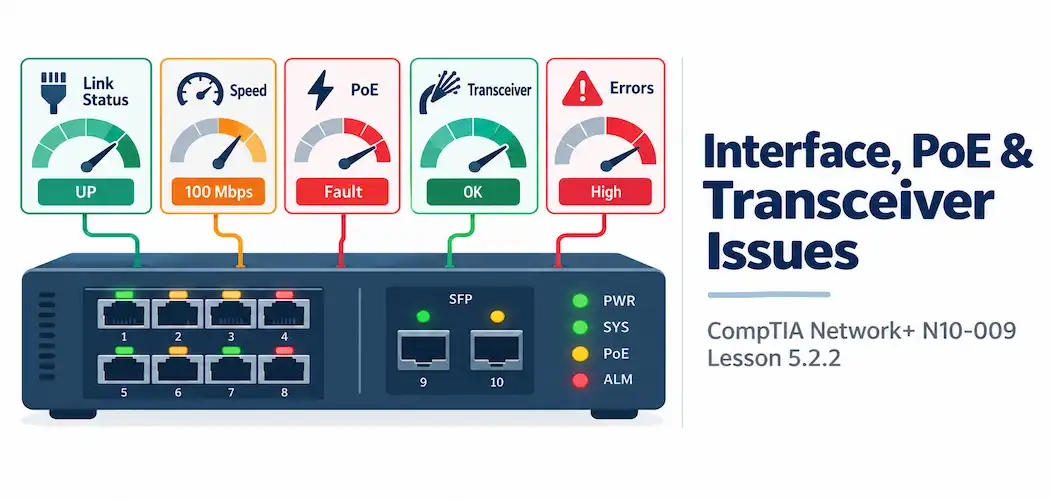
- Explain what increasing interface counters typically indicate about a link’s health
- Describe the difference between error disabled, administratively down, and suspended port states
- Explain PoE power budget exhaustion and PoE standard mismatches
- Describe transceiver mismatch and signal strength issues
Key Terms
| Term | Definition |
|---|---|
| Interface Counters | Running statistics on a port — errors, collisions, drops — that reveal ongoing link health issues |
| Error Disabled (err-disabled) | A port automatically shut down by the switch after detecting a specific violation |
| Administratively Down | A port intentionally and manually shut down by an administrator |
| Power Budget (PoE) | The total power a switch can supply across all its PoE-enabled ports combined |
| Transceiver Mismatch | Incompatible or mismatched transceiver types connected on either end of a fiber link |
Explanation
From Cabling to Interfaces and Power
The previous lesson covered problems with the cable itself. This lesson moves one step further along the physical path: the interface the cable connects to, and the power that interface might also be responsible for delivering.
Interface Counters: What the Numbers Are Telling You
Every switch and router interface tracks running interface counters — statistics that, when they climb, point toward specific underlying problems rather than a vague “something’s wrong.” Common counters include:
- CRC errors — often trace back to a physical-layer problem, connecting directly to the cabling issues covered in the previous lesson: a damaged cable, interference, or a marginal connection can all produce rising CRC error counts.
- Collisions — commonly point to a duplex mismatch between the two connected devices, or, on older or legacy shared-media segments, genuine contention for the medium.
- Input/output errors and drops — a broader category suggesting the interface is dropping or mishandling traffic, worth investigating alongside the more specific counters above rather than in isolation.
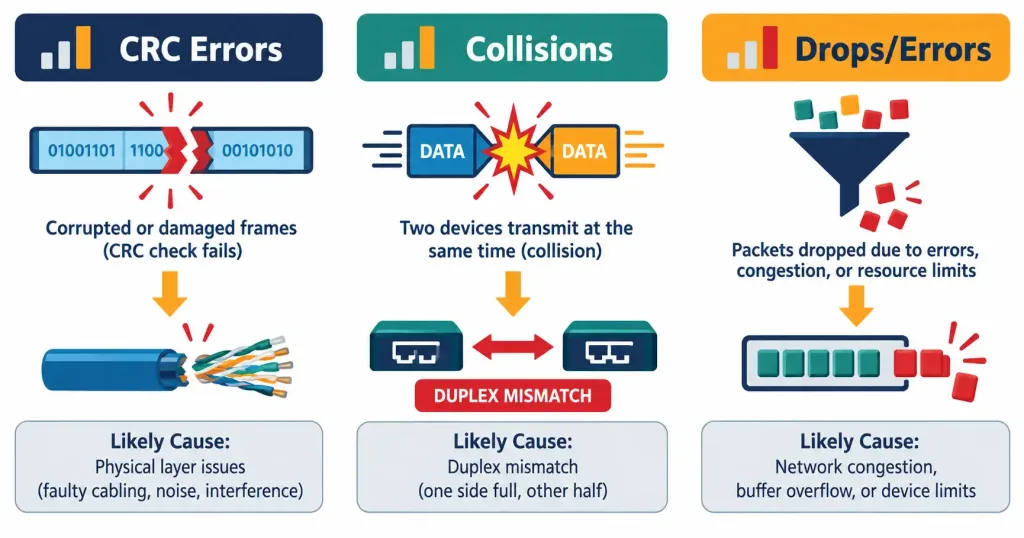
These counters are exactly the kind of data an SNMP monitoring platform, covered earlier in this course, would collect continuously — a steadily climbing error count against an established baseline is a clear, quantifiable signal that something on that specific link needs attention, well before it might become a fully failed connection.
Port Status: Error Disabled, Administratively Down, and Suspended
A port’s status carries specific meaning that changes the troubleshooting approach entirely:
- Error disabled (err-disabled) means the switch itself automatically shut the port down after detecting a specific violation — commonly a port security violation covered earlier in this course, but also possible causes like a detected loop or a BPDU guard trigger. Recovering from err-disabled typically requires actually addressing the underlying violation, then manually (or automatically, if configured) re-enabling the port.
- Administratively down means a human intentionally shut the port off — there’s no fault to diagnose here at all; the port is doing exactly what it was told to do.
- Suspended describes a port that’s temporarily inactive, often pending a specific negotiation process or protocol state rather than reflecting either an outright fault or an administrator’s deliberate action.
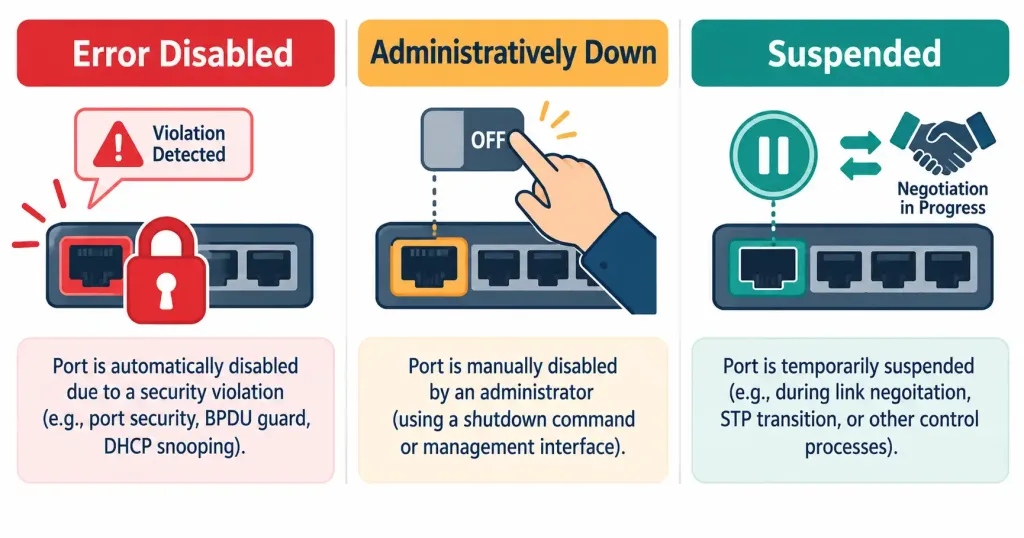
Confusing these three states leads directly to wasted troubleshooting effort: chasing a phantom fault on a port that was simply shut down on purpose, or conversely, assuming a port will just come back on its own when it’s actually sitting in err-disabled, waiting for the underlying violation to be addressed.
PoE Issues: Power Budget and Standard Mismatch
Power over Ethernet introduces failure modes that have nothing to do with data transmission at all:
- Power budget exceeded happens when the total power demanded by every connected PoE device on a switch exceeds that switch’s overall power budget — the total capacity it can supply across all its ports combined. When this happens, some devices may be denied power entirely, or negotiated down to a lower power tier than they actually need, even though their individual cable and port connections are perfectly fine. This connects directly to power planning concepts covered earlier in this course — PoE budget is exactly the kind of capacity constraint that needs to be accounted for before deploying additional powered devices.
- Incorrect standard describes a mismatch between the PoE standard a switch port supports (802.3af, 802.3at, or 802.3bt, each offering progressively more power) and what the connected device actually requires. A device needing more power than an older standard can deliver may fail to power on at all, or may negotiate down to reduced functionality rather than failing outright.
Transceiver Issues: Mismatch and Signal Strength
Fiber connections introduce their own device-specific failure category:
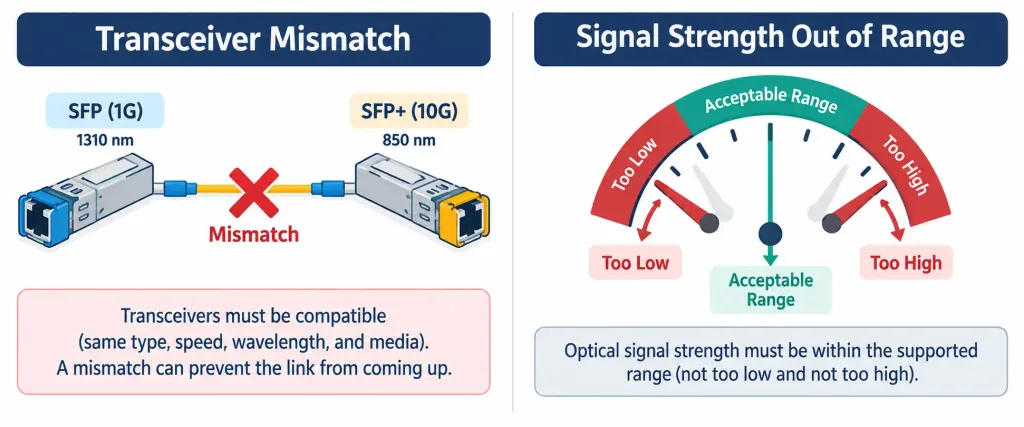
- Transceiver mismatch occurs when incompatible transceiver types are installed on either end of a fiber link — different vendors with incompatible coding, mismatched speed ratings, or a transceiver rated for the wrong distance or fiber type entirely for the actual cable run in use.
- Signal strength issues arise when the optical power arriving at a transceiver is either too high (potentially from being too close to a high-power source without appropriate attenuation) or too low — often connecting back to the attenuation concept from the previous lesson, where a fiber run exceeding its intended distance, or degraded connectors along the way, weakens the signal below what the transceiver can reliably interpret.
Recognition-Level Verification Concepts
A few patterns are worth recognizing on sight:
- Steadily rising CRC errors on one specific interface points toward a physical-layer cabling issue on that link specifically.
- A port that shut itself down automatically, tied to a specific detected violation, is error disabled — distinct from a port an administrator deliberately shut down (administratively down).
- Multiple PoE devices failing to power on (or running at reduced capability) simultaneously across one switch, despite good individual connections, points toward the switch’s overall power budget being exceeded.
- A fiber link failing between two mismatched transceiver models, or one exceeding its rated distance, points toward a transceiver-specific issue rather than a cable fault.
Common Exam Traps
- Different interface counters point to different root causes — don’t treat “errors” as one undifferentiated category. CRC errors and collisions, in particular, suggest genuinely different underlying problems.
- Error disabled, administratively down, and suspended are three distinct port states with three different appropriate responses. Treating them interchangeably wastes troubleshooting effort in the wrong direction.
- A PoE power budget problem can look identical to an individual port or cable fault at first glance, even though the actual cause is the switch’s aggregate capacity, not anything wrong with that specific connection.
- PoE standard mismatches don’t always cause outright failure — a device may still power on at reduced functionality if it can negotiate down, which can be a more subtle symptom than a device simply refusing to power up at all.
- Transceiver signal strength issues can occur even when the transceivers themselves are the correct, compatible type. Excessive or insufficient optical power is a distinct problem from a model/vendor mismatch, even though both fall under “transceiver issues.”
Lesson 5.2.2 Practice Quiz — Interface, PoE & Transceiver Issues
17 questions covering interface counters, port status states, PoE power budget/standard mismatches, and transceiver issues.
N10-009 · Domain 5.2Summary
Interface counters like CRC errors, collisions, and drops each point toward different underlying causes, and rising values against an established baseline are a strong, quantifiable early warning sign.
Error disabled describes a switch-triggered automatic shutdown after a detected violation; administratively down describes an intentional manual shutdown; suspended describes a temporary, often negotiation-pending inactive state — each requiring a different response.
PoE power budget exhaustion affects multiple devices across a switch when total demand exceeds overall capacity; PoE standard mismatches can prevent a device from powering on fully or at all.
Transceiver mismatch involves incompatible hardware on either end of a fiber link; signal strength issues involve optical power being too high or too low for reliable interpretation, often tracing back to distance and attenuation.
This lesson completes N10-009 objective 5.2 (Cabling and Physical Interface Issues) at 2/2 lessons; the next lessons move into objective 5.3, network services issues.