Domain 5.0 | Network Troubleshooting — 24% of exam
Learning Objectives
By the end of this lesson, you will be able to:
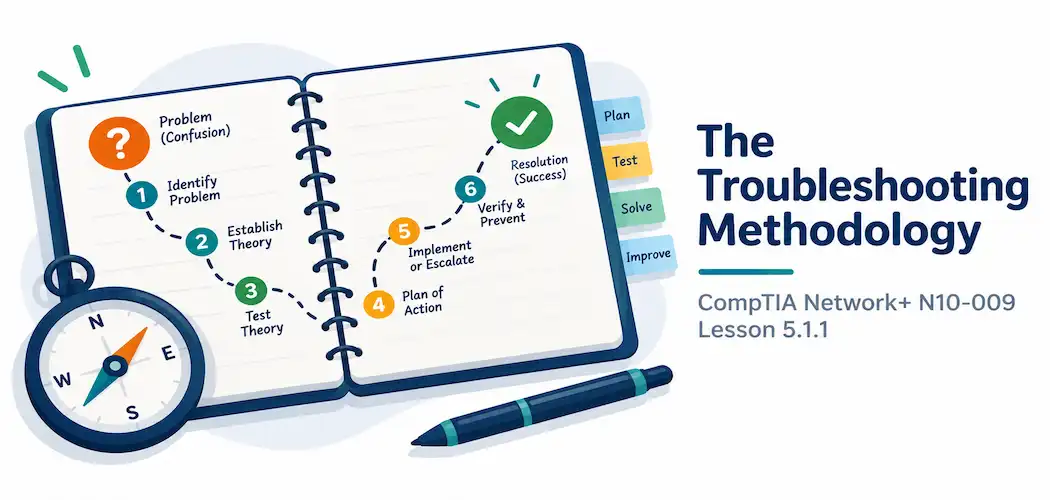
- List and explain the seven steps of the standard network troubleshooting methodology
- Describe how to properly identify a problem, including gathering information and questioning users
- Explain how to establish and test a theory of probable cause, including top-down/bottom-up and divide-and-conquer approaches
- Explain the importance of planning, implementation, verification, and documentation as distinct final steps
Key Terms
| Term | Definition |
|---|---|
| Troubleshooting Methodology | A structured, repeatable seven-step process for identifying and resolving network problems |
| Theory of Probable Cause | A working hypothesis about what’s causing a problem, formed before testing begins |
| Divide and Conquer | A troubleshooting approach that isolates a problem by testing at a middle point in the network path and narrowing from there |
| Root Cause | The actual underlying source of a problem, as opposed to a symptom masking it |
| Preventive Measures | Steps taken after a fix to reduce the likelihood the same problem recurs |
Explanation
Starting Module 5: A Structured Approach to Problems
This final module draws on nearly everything covered earlier in the course — addressing, routing, switching, wireless, monitoring, security — because real troubleshooting requires recognizing symptoms across all of those areas. Before getting into specific categories of problems, this lesson covers the structured methodology that should guide the process regardless of what’s actually broken.
Step 1: Identify the Problem
The first step is gathering enough information to actually understand what’s happening, not jumping straight to a fix. This includes:
Questioning users — asking what they were doing, what they expected, and what actually happened.
Identifying symptoms — what is actually observable and reproducible, as distinct from a user’s interpretation of the problem.
Determining if anything has changed — recent changes are one of the most common root causes of new problems, which is exactly why the change management practices covered earlier in this course matter here — a documented, reviewed change history makes this question far easier to answer than trying to reconstruct what happened from memory.Duplicating the problem, if possible — confirming the issue actually reproduces helps separate a genuine, consistent problem from a one-off fluke.
Approaching multiple problems individually — when several issues appear to be happening at once, resist the urge to treat them as one problem; they may have entirely separate causes.
Step 2: Establish a Theory of Probable Cause
With the problem clearly identified, the next step is forming a working hypothesis about the likely cause. Two habits matter here:
Question the obvious first. The simplest, most common explanation is often the correct one — checking whether a cable is actually plugged in before suspecting a complex routing misconfiguration saves considerable time.
Consider multiple approaches for narrowing down the cause. A top-to-bottom or bottom-to-top OSI model approach systematically checks each layer in sequence — starting either from the physical layer and working up, or from the application layer and working down — which connects directly back to the OSI model covered at the very start of this course. Alternatively, divide and conquer starts by testing at a logical midpoint in the network path, then narrows in whichever direction the test results point.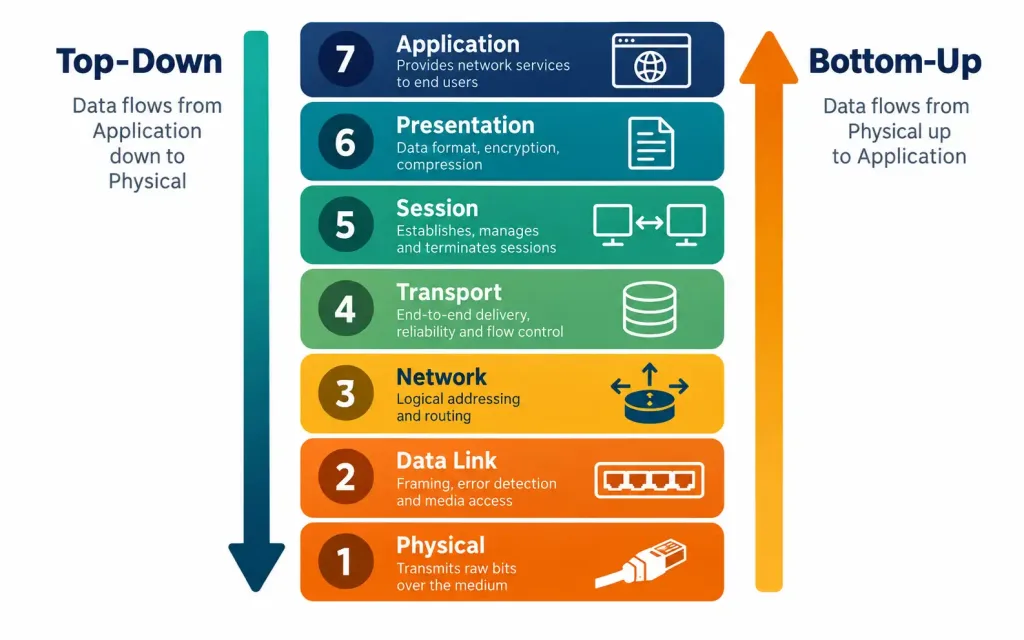
Step 3: Test the Theory to Determine Cause
Once a theory exists, it needs to actually be tested, not simply assumed. If testing confirms the theory, the process moves forward to planning a fix. If testing disproves it, a new theory needs to be established — and if repeated theories fail to hold up, escalating to someone with deeper expertise or access is a reasonable and expected outcome, not a failure of the process.
Step 4: Establish a Plan of Action and Identify Potential Effects
Before actually making a change, it’s worth pausing to consider what else that change might affect — exactly the same thinking behind the impact assessment step of formal change management. A fix that resolves the immediate symptom but breaks something else entirely isn’t really a successful resolution.
Step 5: Implement the Solution or Escalate
With a plan in place, the fix gets implemented. If the plan reveals the fix is beyond the current troubleshooter’s access, expertise, or authority, escalating to the appropriate team or tier is the correct move at this stage — not something to delay until every other option has been exhausted.
Step 6: Verify Full System Functionality and Implement Preventive Measures
Confirming the fix actually worked is a distinct step from implementing it — a symptom disappearing temporarily doesn’t necessarily mean the underlying root cause was actually addressed. This step also includes considering preventive measures: changes that reduce the likelihood the same problem recurs, rather than just resolving this one instance of it.
Step 7: Document Findings, Actions, and Outcomes
The final step ties directly back to the documentation practices covered earlier in this course: recording what the problem actually was, what was done to resolve it, and what was learned in the process. Skipping this step means the next person facing a similar issue — quite possibly a future version of the same troubleshooter — has to rediscover everything from scratch.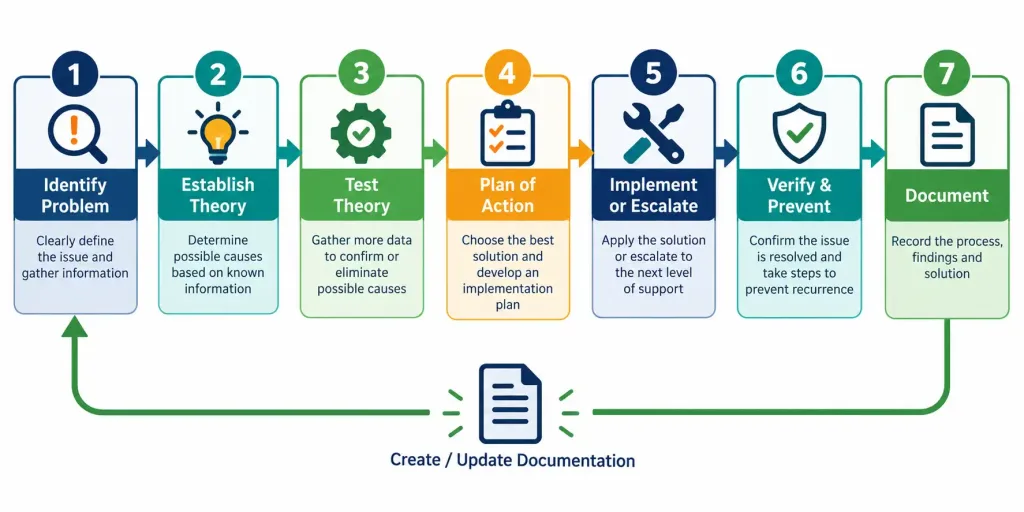
Recognition-Level Verification Concepts
A few patterns are worth recognizing on sight:
- A scenario describing gathering symptoms, questioning users, and checking for recent changes describes Step 1, identifying the problem.
- A described approach of checking the physical layer first, then working upward through each OSI layer, describes a bottom-to-top methodology.
- A fix that resolves symptoms immediately but is never actually verified afterward has skipped Step 6.
- A resolved issue with no record of what happened or how it was fixed reflects a skipped or incomplete Step 7.
Common Exam Traps
- The seven steps have a specific order, and skipping ahead is itself the mistake being tested. Implementing a fix (Step 5) before testing a theory (Step 3) is a common trap in scenario questions.
- Escalation is a legitimate outcome of Step 3 or Step 5, not a failure of the troubleshooter. The methodology explicitly includes escalation as an expected path, not an admission of defeat.
- Verifying functionality (Step 6) is distinct from implementing the fix (Step 5). A temporarily resolved symptom isn’t the same as a confirmed, verified fix.
- Documentation (Step 7) is a required final step, not an optional afterthought. A scenario showing a resolved issue with no documentation step described is showing an incomplete process.
- “Question the obvious” isn’t a dismissive shortcut — it’s a genuinely recommended first move, precisely because simple explanations are so often the actual answer.
Lesson 5.1.1 Practice Quiz — The Troubleshooting Methodology
17 questions covering the seven-step troubleshooting process, theory testing, OSI-layer approaches, and documentation.
N10-009 · Domain 5.1Summary
The troubleshooting methodology is a structured seven-step process: identify the problem, establish a theory, test the theory, plan a solution, implement or escalate, verify and prevent recurrence, and document.
Identifying the problem includes questioning users, identifying symptoms, and checking whether anything has recently changed — directly connecting to change management practices.
Establishing a theory benefits from questioning the obvious first, then applying a top-down/bottom-up OSI approach or divide-and-conquer to narrow down the cause.
Verification (Step 6) and documentation (Step 7) are distinct, required final steps — a fix isn't complete until it's confirmed working and recorded for future reference.
This lesson opens Module 5 (Network Troubleshooting), the largest domain on the exam, with the structured process the rest of the module's category-specific lessons will apply.