Domain 2.0 | Network Implementation — 20% of exam
Learning Objectives
By the end of this lesson, you will be able to:
- Explain the purpose of a UPS and a PDU in protecting and distributing power to network equipment
- Describe how redundant power supplies and dual power paths protect against a single power failure
- Explain key environmental factors affecting equipment, including temperature and humidity
- Describe why clean agent fire suppression is used in data centers and equipment rooms instead of traditional sprinklers
- Recognize common power and environmental monitoring gaps
Key Terms
| Term | Definition |
|---|---|
| UPS (Uninterruptible Power Supply) | A battery-backed device that provides short-term power during an outage, bridging the gap until generator power kicks in or equipment can shut down gracefully |
| PDU (Power Distribution Unit) | A device that distributes power from one source to multiple rack-mounted devices, sometimes with remote monitoring or per-outlet control |
| Redundant Power Supply | A design where a device has two power supplies, each fed from a separate power path, so a single failure doesn’t take the device down |
| Environmental Monitoring | Sensors and systems tracking temperature, humidity, and other conditions in an equipment room, triggering alerts when thresholds are exceeded |
| Clean Agent Fire Suppression | A fire suppression system using gas rather than water, designed to extinguish fire without damaging electronic equipment |
Explanation
Closing Out Physical Installations
The previous lesson covered the structural side of a facility — racks, cabling, and distribution hierarchy. None of that structure matters if the equipment inside it loses power unexpectedly or overheats. This final lesson in the module covers exactly that: keeping equipment powered and environmentally stable.UPS: Bridging the Gap During a Power Outage
A UPS (Uninterruptible Power Supply) sits between the wall power and the equipment it protects, using an internal battery to keep that equipment running for a limited time if utility power fails. A UPS isn’t meant to run equipment indefinitely — most UPS units are sized to provide anywhere from a few minutes to perhaps half an hour of runtime, just enough to bridge the gap until a backup generator starts and stabilizes, or to give equipment time to shut down gracefully rather than losing power abruptly.
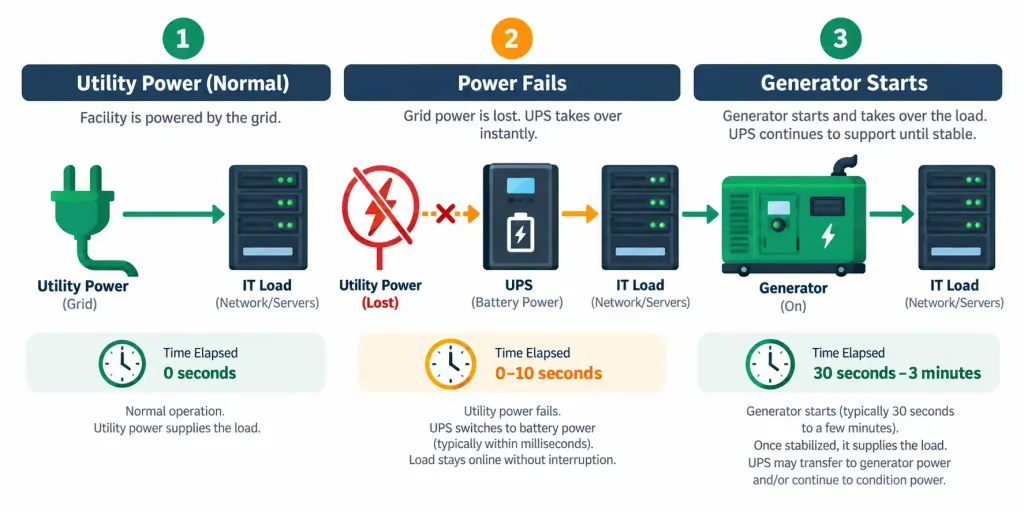
An abrupt, unplanned power loss is genuinely damaging — beyond the obvious risk of losing unsaved data, a hard power cut to active storage systems can corrupt data mid-write in a way a clean shutdown avoids entirely. This is why even a UPS with a fairly short runtime is worth having: the goal usually isn’t riding out the entire outage, it’s avoiding the specific damage caused by an uncontrolled loss of power.
PDU: Distributing Power Within the Rack
A PDU (Power Distribution Unit) takes a single power feed and distributes it to the many individual devices mounted in a rack, functioning much like a very robust power strip built specifically for rack-mounted equipment. Basic PDUs simply distribute power with no additional intelligence, while metered or switched PDUs add remote monitoring (tracking power draw per outlet) or even remote control (the ability to power-cycle a specific outlet remotely) — a genuinely useful capability when a piece of equipment needs a hard reset and nobody wants to physically visit a remote site just to unplug and replug one device.
Redundant Power Supplies and Power Path Diversity
Critical equipment — core switches, routers, servers — often ships with dual power supplies, letting the device keep running even if one power supply fails. That redundancy only provides real protection, though, if each power supply is actually fed from a genuinely separate power path: connecting both power supplies to the same PDU, same UPS, and same electrical circuit defeats the purpose entirely, since a single failure anywhere in that shared path still takes the whole device down.
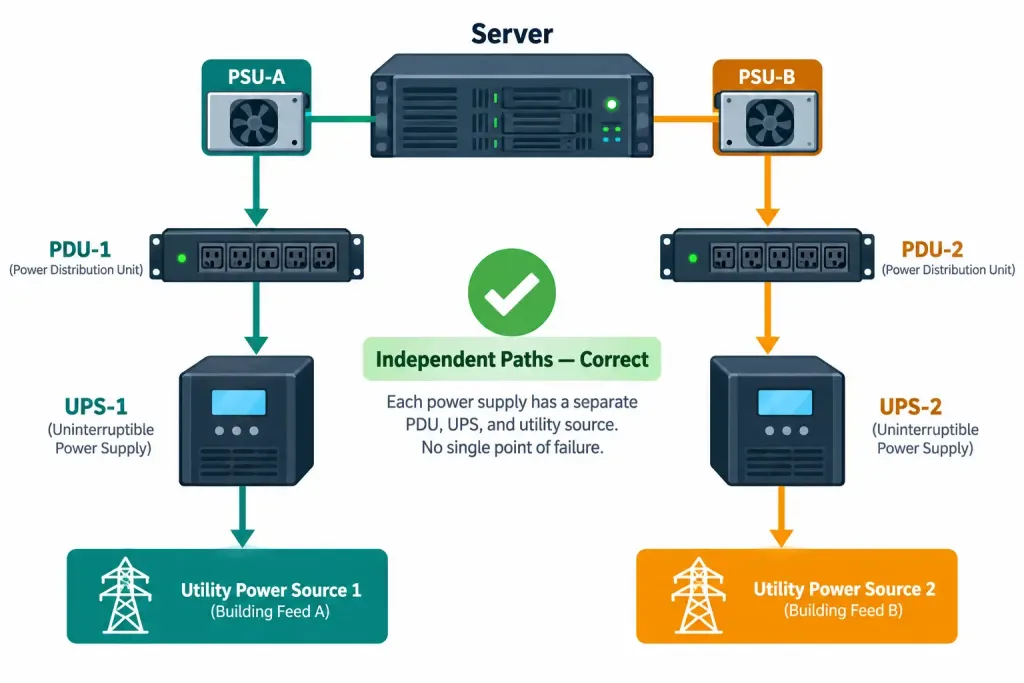
Proper power path diversity means each power supply connects to a separate PDU, ideally backed by a separate UPS, so that even a failure upstream of the device itself — a tripped breaker, a failed UPS, a dead PDU — doesn’t bring the equipment down along with it.
Environmental Factors: Temperature and Humidity
Network and server equipment has an operating temperature range specified by the manufacturer, and running consistently outside that range shortens component lifespan and increases the risk of unexpected failure — this is exactly why data centers and larger equipment rooms invest in dedicated HVAC systems rather than relying on general building climate control.
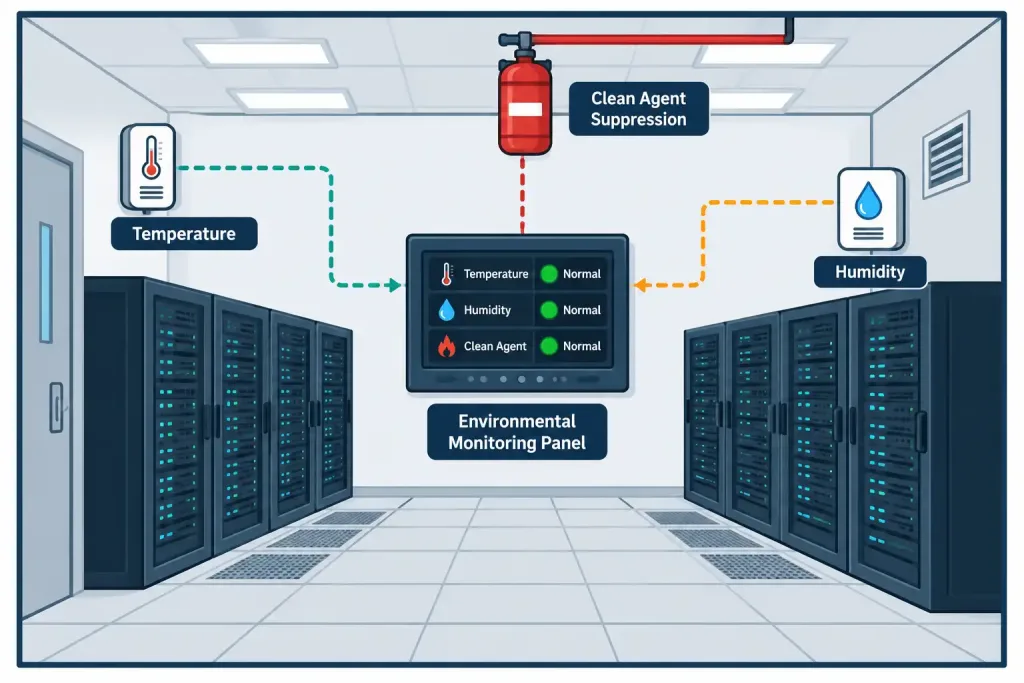
Humidity matters in both directions: air that’s too dry increases the risk of electrostatic discharge (ESD) damaging sensitive components, while air that’s too humid risks condensation forming on equipment, which can lead to corrosion and short circuits over time. Environmental monitoring systems track both temperature and humidity continuously, triggering alerts when either drifts outside acceptable thresholds — catching a failing HVAC unit or a blocked airflow path before it causes actual equipment damage, rather than discovering the problem only after something has already failed.
Fire Suppression
Traditional water-based sprinkler systems, while effective against fire, are genuinely destructive to electronic equipment — a data center that survives a fire but gets soaked by sprinklers afterward may end up with just as much equipment loss either way. For this reason, data centers and dedicated equipment rooms typically use clean agent fire suppression systems instead: gas-based systems (using agents like FM-200 or inert gases) that extinguish fire by displacing oxygen or interrupting the combustion process, without leaving behind the residue or moisture damage that water or traditional chemical extinguishers would cause.
Recognition-Level Verification Concepts
A few patterns are worth recognizing on sight:
- Equipment continuing to run briefly after a power outage, then shutting down gracefully a few minutes later, reflects a UPS doing its job as intended, not a failure to provide full backup power.
- Two power supplies in one device both plugged into the same PDU is a power redundancy design flaw, even though it looks redundant at a glance.
- A gas-based suppression system in a server room, rather than water sprinklers, is a deliberate equipment-protection choice, not an oversight.
- An environmental alert for humidity or temperature drift, with no equipment failure yet, is monitoring working correctly — catching a developing problem before it causes damage.
Common Exam Traps
- A UPS is meant to bridge a gap, not provide indefinite power. Don’t assume a UPS should keep equipment running through an extended outage — that’s what a generator is for.
- Redundant power supplies only protect against failure if each one has a genuinely separate power path. Two power supplies on the same PDU, UPS, or circuit share a single point of failure despite appearing redundant.
- Humidity problems exist at both extremes. Too dry risks ESD damage; too humid risks condensation and corrosion — don’t assume only one direction is a concern.
- Water-based sprinklers are specifically avoided in data centers because of equipment damage, not fire-fighting effectiveness. Clean agent systems exist to protect the equipment itself, not because gas suppresses fire better in general.
- Environmental monitoring triggering an alert is the system working, not a sign something has already failed. The whole point is catching drift before it causes damage.
Lesson 2.4.2 Practice Quiz — Power and Environmental Factors
17 questions covering UPS, PDU, redundant power paths, temperature/humidity, and fire suppression.
N10-009 · Domain 2.4Summary
A UPS provides short-term battery backup during a power outage, bridging the gap until generator power starts or allowing equipment to shut down gracefully rather than losing power abruptly.
A PDU distributes power to rack-mounted devices, with metered or switched variants adding remote monitoring or per-outlet control.
Redundant power supplies only provide real protection when each one is fed from a genuinely separate power path — shared PDUs, UPS units, or circuits undermine that redundancy.
Temperature and humidity both need active management: extreme temperatures shorten equipment lifespan, while humidity that's too low risks ESD and too high risks condensation and corrosion.
Clean agent fire suppression systems protect data centers and equipment rooms from fire without the water damage traditional sprinklers would cause to electronic equipment.
This lesson completes N10-009 objective 2.4 (physical installations) and closes out Module 2 (Network Implementation) at 15/15 lessons.