Domain 1.0 | Networking Concepts — 23% of exam
Learning Objectives
By the end of this lesson, you will be able to:
- Describe IPv6 address format and the rules for compressing it
- Identify IPv6 address types, including why IPv6 has no broadcast
- Distinguish global unicast addresses from link-local addresses
- Explain dual stack, NAT64, and tunneling as ways to bridge IPv4 and IPv6 networks
Key Terms
| Term | Definition |
|---|---|
| IPv6 | A 128-bit addressing scheme designed to replace IPv4 and its limited address space |
| Hextet | One of the eight 16-bit groups that make up an IPv6 address, written in hexadecimal |
| Global Unicast Address | A publicly routable IPv6 address, the IPv6 equivalent of a public IPv4 address |
| Link-Local Address | An IPv6 address automatically assigned to every interface, usable only on the local segment |
| Dual Stack | Running IPv4 and IPv6 simultaneously on the same device or network |
| NAT64 | A translation mechanism that lets an IPv6-only network communicate with an IPv4-only resource |
| Tunneling | Encapsulating one protocol’s packets inside another, letting IPv6 traffic cross an IPv4-only network, or vice versa |
Explanation
Why IPv6 Exists
Lesson 1.7.1 touched on how classful addressing wasted IPv4 space. Here’s the bigger issue underneath that: IPv4 only has about 4.3 billion addresses total, full stop. That sounded like plenty in the 1980s. It isn’t anymore — not with billions of phones, laptops, servers, and IoT devices all needing one. IPv6 exists to fix that permanently, using 128 bits instead of IPv4’s 32. That’s not a modest bump. It’s enough addresses that running out again isn’t a realistic concern.
Put the scale in perspective: doubling the bit length doesn’t double the address space, it squares it repeatedly. IPv4’s 32 bits give roughly 4.3 billion addresses. IPv6’s 128 bits give a number so large — around 340 undecillion — that comparing the two side by side barely means anything. The point isn’t the exact figure. It’s that IPv6 was deliberately sized so far beyond any foreseeable need that address exhaustion simply stops being a design constraint anyone has to plan around.
What an IPv6 Address Looks Like
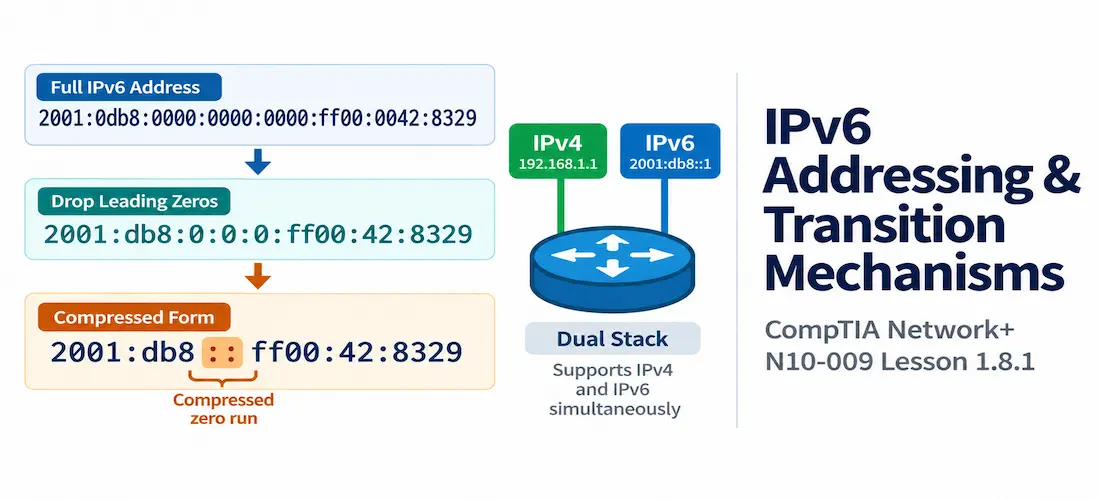
An IPv6 address is 128 bits, written as eight groups of four hexadecimal digits, separated by colons. Each group is called a hextet. A full address looks like this:
2001:0db8:0000:0000:0000:ff00:0042:8329
Nobody wants to type that every time, so two compression rules exist:
Leading zeros in any hextet can be dropped. 0db8 becomes db8. 0000 becomes 0.
One run of consecutive all-zero hextets can be collapsed to a double colon, ::. Apply both rules to the address above:
2001:db8::ff00:42:8329
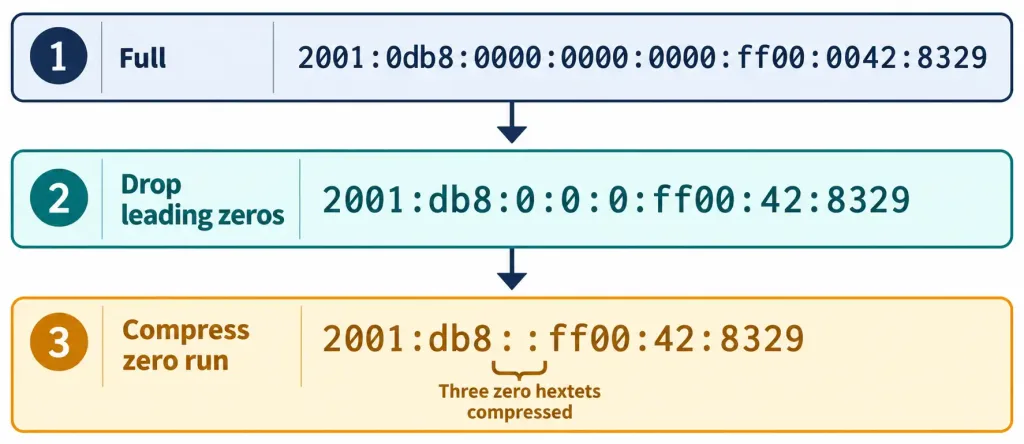
One rule matters a lot here: :: can only appear once in an address. If an address had two separate runs of zero hextets, using :: twice would make it impossible to tell how many zero hextets belong to each gap. The notation only works because there’s exactly one ambiguous stretch to expand back out.
Address Types: No More Broadcast
Lesson 1.4.3 already flagged this, so it shouldn’t be a surprise: IPv6 has no broadcast address type at all. Unicast, multicast, and anycast all carry over from IPv6 — broadcast doesn’t. Anything IPv4 used broadcast for, including ARP’s role in mapping IP to MAC addresses, gets handled through multicast instead, using specific reserved multicast addresses. It’s a deliberate design choice — multicast’s targeted delivery is simply more efficient than broadcasting to everyone.
Global Unicast vs. Link-Local
Two address categories come up constantly in IPv6 networking, and they serve very different purposes.
A global unicast address is publicly routable — the IPv6 equivalent of a public IPv4 address. These addresses typically start with 2000::/3 and are meant to be reachable across the internet, the same way a public IPv4 address would be.
A link-local address is automatically assigned to every IPv6-enabled interface, whether anyone configures it or not. Link-local addresses always start with fe80::/10. They’re only usable on the local network segment — a router will never forward link-local traffic anywhere else. IPv6 devices rely on link-local addresses for essential local functions like neighbor discovery, which is IPv6’s replacement for ARP.
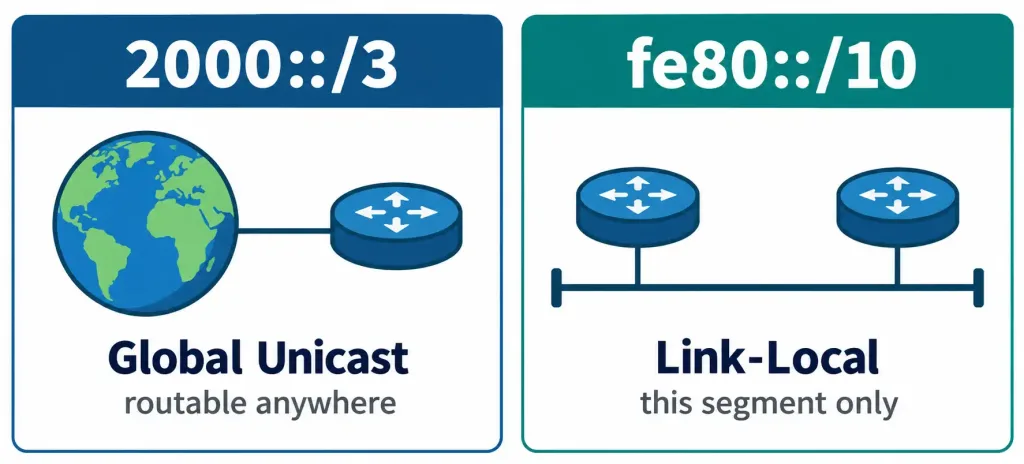
Every IPv6 interface has a link-local address, always, regardless of whether it also has a global unicast address for internet-facing communication. That’s worth sitting with for a second — it means a device can be completely unreachable from the internet and still have a fully functional IPv6 address for talking to its immediate neighbors.
Unique Local Addresses: IPv6’s Version of Private Addressing
Recall RFC 1918 private addressing from IPv4 — ranges like 192.168.0.0/16, reserved for internal use and never routed on the public internet. IPv6 has its own equivalent: Unique Local Addresses (ULA), drawn from the fc00::/7 block. Like RFC 1918 space, ULAs are meant for internal, private routing within an organization and aren’t intended to be globally routable across the internet. The parallel to link-local addresses is worth keeping straight, though — link-local is automatic and confined to a single segment, while a ULA is manually assigned and can be routed across an entire private internal network, much closer in spirit to how RFC 1918 addressing behaves in IPv4.
Loopback in IPv6
IPv6 has its own loopback address, playing the same role as 127.0.0.1 in IPv4: ::1. Pinging ::1 confirms a device’s own IPv6 stack is working, exactly like pinging 127.0.0.1 confirms the IPv4 stack. Same purpose, same diagnostic value, just a different, much shorter-looking address thanks to compression — ::1 is really 0000:0000:0000:0000:0000:0000:0000:0001 written out in full.
Putting the Address Types Together
A single device’s IPv6 configuration often shows several of these address types at once, and reading that configuration correctly means recognizing each one on sight. A laptop’s network adapter might show ::1 (loopback, always present, confirms the stack works), fe80::a1b2:c3d4:e5f6:7890 (link-local, automatically assigned, usable only on this segment), and 2001:db8:4:1::5 (a global unicast address, reachable from anywhere on the internet). If that same laptop is on a corporate network using internal-only IPv6 addressing, it might also show a ULA in the fc00::/7 range for routing between internal sites without ever touching the public internet. None of these four addresses conflict with each other — a single interface routinely holds all of them simultaneously, each serving its own distinct purpose.
Getting From IPv4 to IPv6: Three Transition Mechanisms
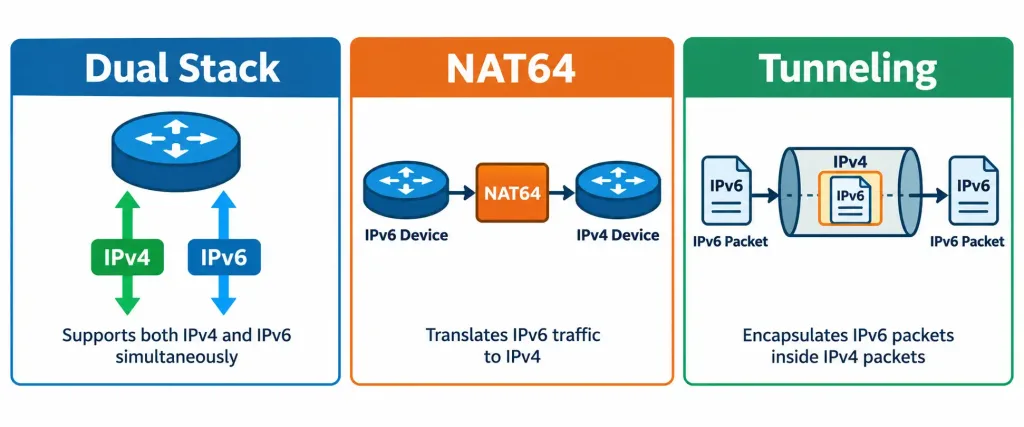
IPv4 and IPv6 don’t talk to each other natively. A pure IPv4 device can’t understand an IPv6 packet, and vice versa. Since the entire internet obviously couldn’t switch over in one instant, three transition mechanisms exist to bridge the gap during the (very long) migration period.
Dual stack is the simplest and most common approach: a device or network runs IPv4 and IPv6 side by side, simultaneously. Each protocol operates independently — the device has both an IPv4 address and an IPv6 address, and communicates using whichever one the destination supports. Most modern operating systems and networks run dual stack by default today, which is exactly why this is the mechanism you’ll encounter most often in practice.
NAT64 solves a narrower problem: letting an IPv6-only network reach an IPv4-only resource. It translates between the two protocols at the boundary, similar in spirit to the NAT covered back in Lesson 1.3.2 — except instead of translating private-to-public addresses within the same protocol, NAT64 translates across protocol versions entirely.
Tunneling encapsulates one protocol’s packets inside the other, letting traffic cross a network that only supports one of them. An IPv6 packet gets wrapped inside an IPv4 packet to cross an IPv4-only network segment, then unwrapped back into a native IPv6 packet on the other side. A couple of named tunneling methods — 6to4 and Teredo — show up in older documentation and occasionally on the exam, both doing exactly this kind of IPv6-over-IPv4 encapsulation.
Recognition-Level Verification Concepts
This objective leans on recognition more than configuration. A few patterns worth knowing on sight:
- An address starting with
fe80::is link-local, automatically present on every interface, never routed beyond the local segment. - An address starting with
2000::through3fff::(the2000::/3block) is a global unicast address, routable across the internet. ::1is loopback — functionally identical in purpose to IPv4’s127.0.0.1.- Device configuration showing both an IPv4 address and an IPv6 address on the same interface indicates dual stack in action.
Common Exam Traps
::can only be used once in a single address. Using it twice makes the address ambiguous and invalid — this is one of the most commonly tested notation rules.- IPv6 has no broadcast. Don’t describe any IPv6 behavior as “broadcasting” — multicast handles everything broadcast used to.
- Every interface gets a link-local address automatically, whether or not it has a global unicast address too. A device with only a link-local address can still function on its local segment, just not beyond it.
- Dual stack is the default, most common transition mechanism — don’t assume every network relies on tunneling or NAT64 just because IPv6 is in the picture. Most modern networks simply run both protocols side by side.
- NAT64 and tunneling solve different problems. NAT64 translates between IPv6 and IPv4 so they can actually communicate; tunneling carries one protocol’s traffic through a network that doesn’t understand it at all, without any translation happening at the protocol level.
- A Unique Local Address (ULA) is not the same as a link-local address, even though both sound similar and both stay off the public internet. Link-local is automatic and confined to one segment; a ULA is manually assigned and can be routed across an entire private network, much closer to how RFC 1918 addressing works in IPv4.
Lesson 1.8.1 Practice Questions
IPv6 Addressing & Transition Mechanisms · 17 questions · Network+ N10-009, Domain 1.0
How many bits make up an IPv6 address?
Which of the following is a valid compression of 2001:0db8:0000:0000:0000:ff00:0042:8329?
Why is an IPv6 address containing two separate :: sequences invalid?
Which two traffic types does IPv6 retain from IPv4?
Based on this interface configuration, what does the fe80:: address indicate?
A device is completely disconnected from the internet but still successfully communicates with other devices on its local segment using IPv6. Which address type makes this possible?
What is the IPv6 equivalent of IPv4's 127.0.0.1?
Which two of the following correctly describe dual stack?
An IPv6-only network needs to reach a legacy IPv4-only web server that will never be upgraded. Which transition mechanism is designed specifically for this?
Based on this description, which transition mechanism is being used?
What is a Unique Local Address (ULA) roughly equivalent to in IPv4 terms?
Which two of the following correctly distinguish a link-local address from a ULA?
A network engineer says, "IPv6 broadcasts a DHCP-equivalent discovery message to every device on the segment." Is this description accurate?
Which address range identifies a global unicast address?
A laptop shows four IPv6 addresses. Match the described behavior: which one lets it reach the public internet directly?
Which statement best describes the relationship between IPv6's address space size and IPv4's?
A device shows both an IPv4 address (192.168.1.20) and an IPv6 global unicast address on the same network interface simultaneously. What does this indicate?
Summary
IPv6 uses 128-bit addresses, written as eight hexadecimal hextets, to solve IPv4's address exhaustion problem for good.
Compression rules — dropping leading zeros and collapsing one run of zero hextets into :: — make IPv6 addresses shorter to write, but :: can only appear once per address.
IPv6 keeps unicast, multicast, and anycast but drops broadcast entirely, relying on multicast for everything IPv4 used broadcast for.
Global unicast addresses (2000::/3) are publicly routable; link-local addresses (fe80::/10) are automatically assigned to every interface but stay confined to the local segment.
Dual stack, NAT64, and tunneling are the three main ways IPv4 and IPv6 networks coexist during the transition — dual stack running both protocols side by side is by far the most common approach today.