Domain 1.0 | Networking Concepts — 23% of exam
Learning Objectives
By the end of this lesson, you will be able to:
- Describe the primary function of a firewall and compare packet-filtering, stateful, and next-generation firewall behavior
- Explain how firewall rules (ACL-style permit/deny statements) determine what traffic is allowed through a firewall
- Describe the function of an intrusion detection system (IDS) and distinguish network-based from host-based deployment
- Describe the function of an intrusion prevention system (IPS) and explain how it differs from an IDS in placement and response capability
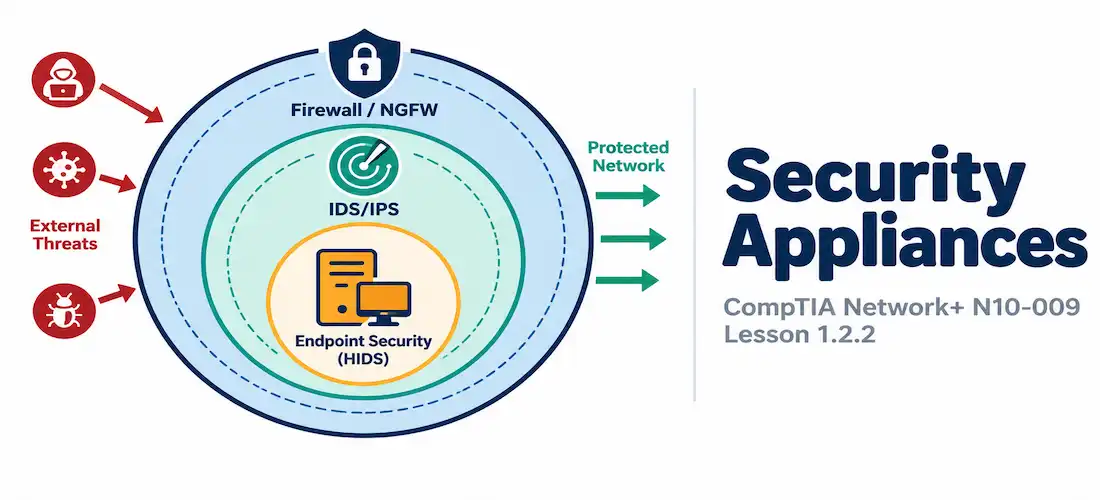
- Explain how firewalls, IDS, and IPS combine into a layered security architecture rather than functioning as isolated, competing tools
Key Terms
| Term | Definition |
|---|---|
| Firewall | A network security device that monitors and controls incoming and outgoing traffic based on a defined set of rules |
| ACL (Access Control List) | An ordered list of permit/deny rules, evaluated top-to-bottom, that a firewall or router uses to decide whether to allow or block traffic |
| Packet-Filtering Firewall | A firewall that makes allow/deny decisions per packet, based only on header information (source/destination IP, port, protocol), with no awareness of connection state |
| Stateful Firewall | A firewall that tracks the state of active connections in a state table, allowing it to automatically permit legitimate return traffic without a separate explicit rule |
| Next-Generation Firewall (NGFW) | A firewall that adds deep packet inspection, application awareness, integrated intrusion prevention, and often encrypted traffic inspection on top of traditional firewall functions |
| IDS (Intrusion Detection System) | A device or software that passively monitors traffic or system activity for malicious behavior or policy violations and generates alerts, without blocking traffic itself |
| IPS (Intrusion Prevention System) | A device that sits inline with traffic flow and can actively block, drop, or otherwise respond to detected malicious traffic in real time |
| NIDS (Network-based IDS) | An IDS that monitors traffic across a network segment, typically fed by a copy of traffic from a SPAN/mirror port or network TAP |
| HIDS (Host-based IDS) | An IDS installed on an individual endpoint that monitors local system activity such as file changes, log entries, and process behavior |
| Signature-Based Detection | A detection method that compares observed traffic against a database of known attack patterns |
| Anomaly-Based Detection | A detection method that establishes a baseline of normal behavior and flags deviations from that baseline |
| Inline Deployment | A deployment mode where all traffic must physically pass through the device, allowing it to actively block traffic (used by IPS and firewalls) |
| Out-of-Band Deployment | A deployment mode where a device receives only a copy of traffic and cannot directly block it in real time (used by traditional IDS) |
Explanation
Security Appliances as Part of the Bigger Picture
Lesson 1.2.1 covered the devices that make basic connectivity possible — routers, switches, access points, and wireless LAN controllers. This lesson turns to a different category of infrastructure device: security appliances, whose job is not to move traffic efficiently but to decide whether traffic should be allowed to move at all, and to detect or stop malicious activity that basic connectivity devices have no way of recognizing. The two device types covered here — firewalls and IDS/IPS systems — are the foundation of network-level security, and Network+ expects you to know what each one does, how they’re deployed, and how they differ from one another.
It’s worth being explicit about scope here: this lesson covers what these devices are and do at a conceptual level, consistent with Domain 1’s focus on networking concepts. Deeper security topics — encryption, authentication methods, specific attack types, and hardening techniques — are covered in Domain 4 (Network Security). Think of this lesson as building the vocabulary and mental model that Domain 4 will build on.
Firewalls: Controlling What’s Allowed
A firewall is a device — physical, virtual, or software-based — that monitors and controls network traffic according to a defined set of rules, establishing a boundary between a trusted network and an untrusted one (most commonly the boundary between an internal network and the Internet). Firewalls have existed since the late 1980s, and despite decades of new security technology, they remain a foundational, essentially universal control — very few networks of any size operate without one.
Firewall technology has evolved through several distinct generations, and Network+ expects you to recognize the differences:
- Packet-filtering firewalls examine each packet in isolation, checking only header information — source/destination IP address, port number, and protocol — against a list of rules. They’re fast because they never look at the actual payload, but this is also their core limitation: they have no memory of previous packets and can’t distinguish a legitimate reply to an outbound connection from an unsolicited inbound one.
- Stateful firewalls track the state of active connections in a state table. Once an internal host initiates an outbound connection, the firewall automatically permits the expected return traffic without needing a separate explicit rule for it, while still blocking unsolicited inbound attempts on the same port. This became the baseline expectation for enterprise firewalls and remains foundational today.
- Next-generation firewalls (NGFWs) add deep packet inspection (examining actual packet content, not just headers), application awareness (identifying traffic by the actual application generating it, regardless of which port it uses), integrated intrusion prevention capability, and often the ability to inspect encrypted (TLS) traffic. NGFWs represent the current mainstream standard for enterprise perimeter security.
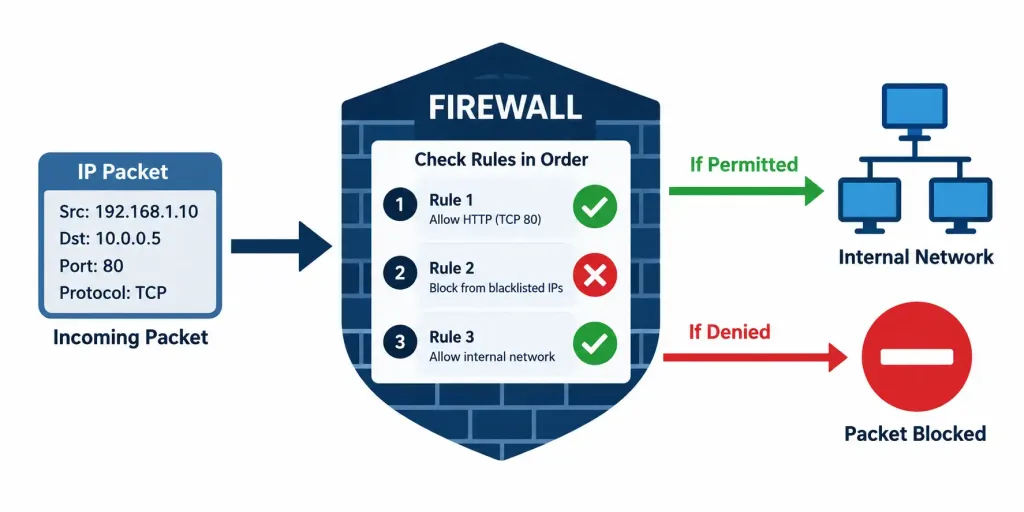
Regardless of generation, every firewall makes its allow/deny decisions using rules, commonly structured as an ordered access control list (ACL) of permit/deny statements. Rules are evaluated in order, typically top to bottom, and the first matching rule determines the outcome for that traffic — a detail that matters enormously in practice, since a broad rule placed too early in the list can silently override more specific rules that come after it. (ACL syntax and configuration are covered hands-on in Domain 4; here, the goal is understanding the concept of rule-based filtering.)
Intrusion Detection Systems: Watching for Trouble
A firewall’s job is access control — deciding what traffic is allowed in the first place. But a firewall has no way to catch an attack that uses traffic it has already been told to allow, such as malicious content hidden inside permitted web traffic, or an internal host that’s already been compromised and is now behaving suspiciously. This is the gap an intrusion detection system (IDS) fills.
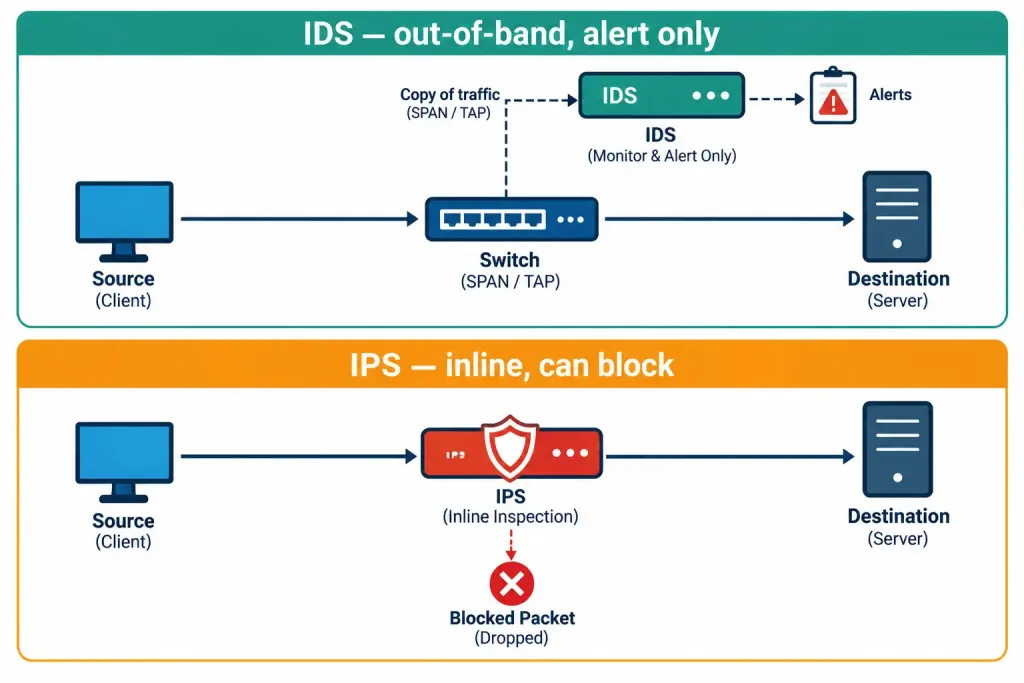
An IDS monitors traffic or system activity and generates an alert when it observes something matching a known attack pattern or deviating from expected behavior — but critically, a traditional IDS does not block anything itself. It is a passive, out-of-band device: it typically receives only a copy of traffic (fed via a switch’s SPAN/mirror port or a network TAP), which means it can watch everything without being able to interfere with the live flow of traffic, and without becoming a point of failure that could take down connectivity if it crashes.
IDS deployments fall into two categories based on where they watch:
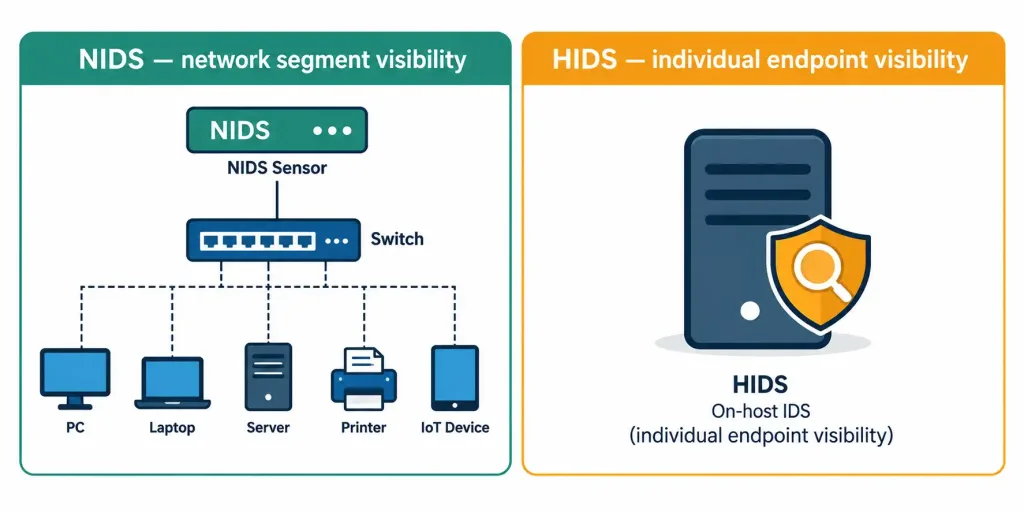
- Network-based IDS (NIDS) monitors traffic crossing a network segment, giving it visibility into patterns across many hosts at once — useful for spotting a scan or attack targeting multiple systems.
- Host-based IDS (HIDS) runs on an individual endpoint, watching local activity such as file system changes, log entries, and process behavior — useful for catching things a network-level view would miss entirely, such as unusual activity that never crosses the network boundary.
And IDS detection logic generally works one of two ways:
- Signature-based detection compares traffic against a database of known attack patterns. It’s highly accurate against known threats but blind to anything that doesn’t match an existing signature.
- Anomaly-based detection builds a baseline of “normal” behavior and flags deviations from it. This can catch previously unknown attacks, but tends to generate more false positives, since legitimate-but-unusual activity can also trigger an alert.
Intrusion Prevention Systems: From Alerting to Acting
An intrusion prevention system (IPS) takes everything an IDS does and adds the ability to actually act on what it detects — in real time. The defining architectural difference is deployment: while an IDS sits out-of-band and only watches a copy of traffic, an IPS sits inline, meaning all traffic must physically pass through it on its way to the destination. Because the IPS is directly in the traffic path, it can drop a malicious packet, block a source IP address, or reset a connection immediately, before the malicious traffic ever reaches its target.
This inline placement is a double-edged sword, and it’s a frequently tested concept: being inline is exactly what gives an IPS the power to actively block threats, but it also means the IPS becomes a potential single point of failure and adds a small amount of latency to every packet that passes through it. A misconfigured or overly aggressive IPS can block legitimate traffic (a false positive), and if the device itself fails, it can take connectivity down with it unless the deployment includes a fail-open mode or redundancy.
Firewall vs. IDS vs. IPS: Side-by-Side
| Device | Primary Function | Deployment | Can Block Traffic in Real Time? |
|---|---|---|---|
| Firewall | Access control — allow or deny traffic based on rules | Inline | Yes (by rule, before traffic is admitted) |
| IDS | Detection — alert on suspicious/malicious activity | Out-of-band (copy of traffic via SPAN/TAP) | No — alerts only |
| IPS | Detection + Prevention — alert and actively block | Inline | Yes (in real time, based on detected threats) |
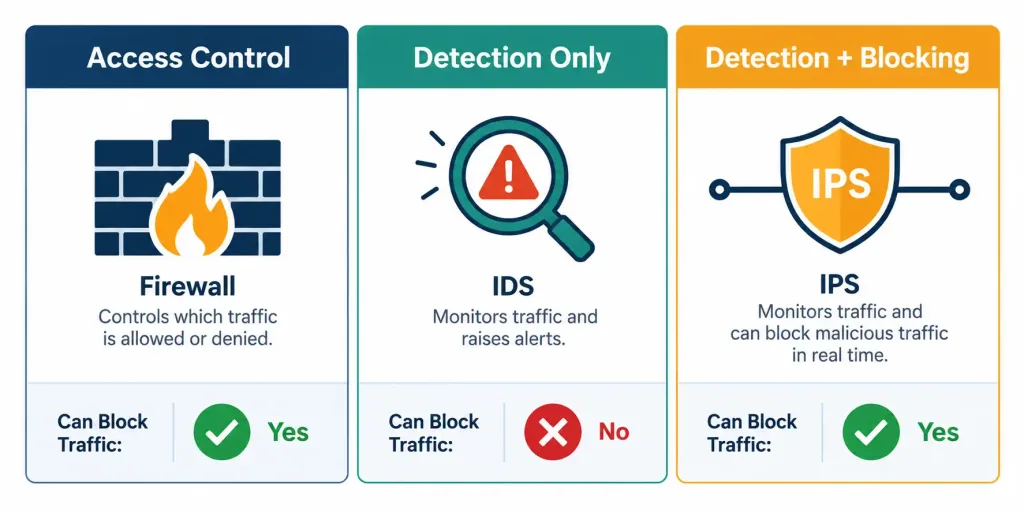
It’s worth noting that in real-world deployments, these categories increasingly blur together — most modern NGFWs include integrated IPS functionality, meaning a single appliance performs firewall filtering and inline threat prevention simultaneously rather than requiring separate boxes. For the exam, however, understand each function conceptually and independently, since scenario questions will describe behavior (blocking vs. alerting, inline vs. out-of-band) and expect you to identify which function is being described, regardless of how a real product happens to bundle them.
How These Devices Fit Into a Layered Defense
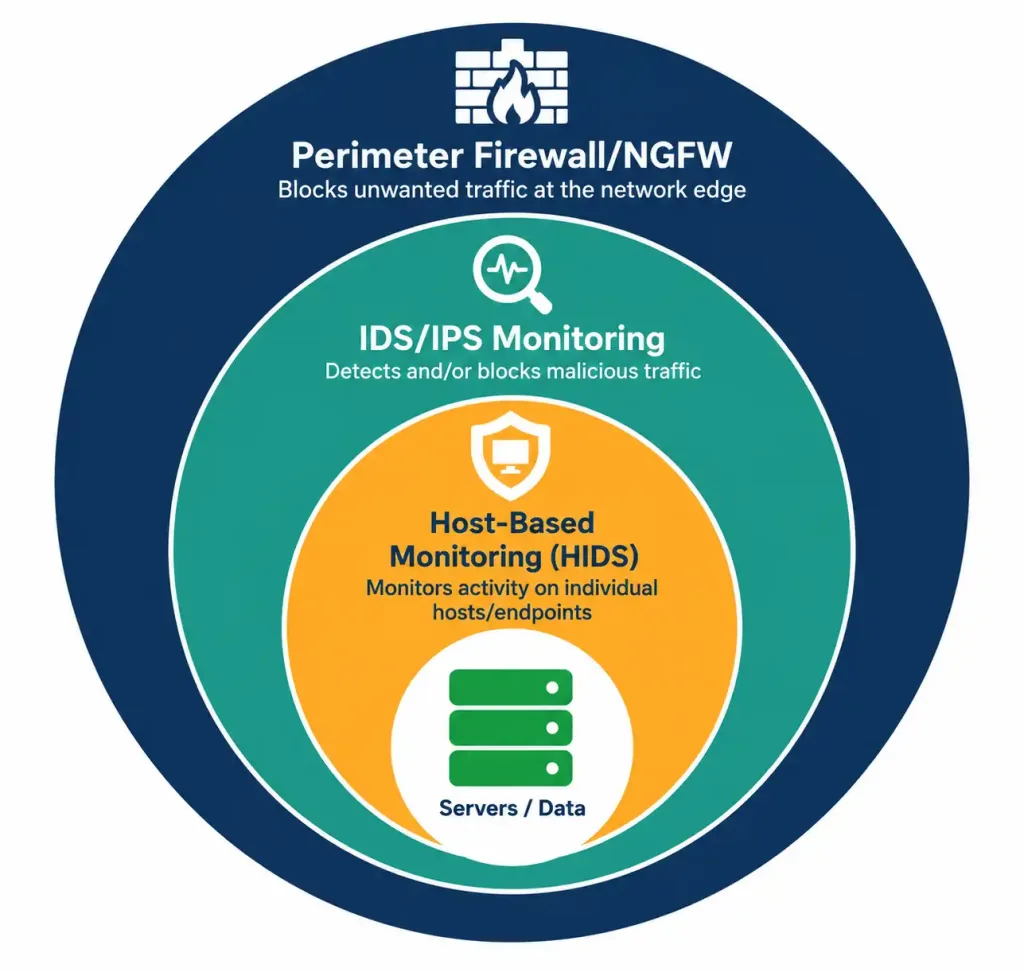
No single security appliance is sufficient on its own — this is the principle of defense in depth. A typical layered deployment places a firewall (often an NGFW) at the network perimeter, controlling what traffic is allowed in and out in the first place. Behind that perimeter, NIDS sensors or an inline IPS monitor traffic for attacks that used traffic the firewall was told to permit — for example, malicious content riding inside an allowed HTTPS connection.
HIDS agents on critical servers add endpoint-level visibility that a purely network-based view can’t provide. Each layer covers a gap the others leave open: a firewall can’t catch an attack disguised as legitimate traffic, an out-of-band IDS can’t stop an attack in progress, and neither one can see what’s happening inside an individual host the way an HIDS agent can.
For a deeper dive into how these controls extend into modern architectures — including next-generation firewalls, encrypted traffic inspection, and how Zero Trust principles are reshaping perimeter-based security models — see NetworkUstad’s Network Security Fundamentals: Firewalls, IDS/IPS & Zero Trust guide. Zero Trust itself is covered as its own Network+ objective later in this module (Lesson 1.8.3).
Recognition-Level Verification Concepts
This objective is descriptive/comparative, so there’s no hands-on firewall or IDS configuration to memorize yet — that begins in Domain 4. It is worth recognizing, conceptually, what output these devices typically produce:
- A firewall’s rule base is generally viewed as an ordered list of permit/deny statements, each specifying source, destination, port/protocol, and an action.
- An IDS or IPS typically produces an alert log — a timestamped entry showing the source and destination of suspicious traffic, the signature or rule that matched, and a severity rating.
You’ll work with actual rule syntax and alert output hands-on once you reach Domain 4’s security content.
Common Exam Traps
- “Detects” vs. “prevents” is the single most tested distinction in this lesson. An IDS detects and alerts; an IPS detects and actively blocks. If a scenario describes a device that only sends an alert with no blocking action, that’s an IDS, even if the question calls it something else.
- Out-of-band vs. inline maps directly onto IDS vs. IPS. If traffic must physically flow through the device for it to work, it’s inline (IPS or firewall behavior); if the device only ever sees a copy of traffic, it’s out-of-band (traditional IDS behavior).
- A firewall’s default behavior depends entirely on its rule set — there’s no universal “default allow” or “default deny.” Most modern firewall deployments follow an implicit “deny any” at the end of the rule list, but this is a configuration principle, not an inherent property of all firewalls.
- Don’t assume NIDS and HIDS are competing options — they’re complementary, covering network-level and host-level visibility respectively; a mature security architecture typically uses both.
- Signature-based and anomaly-based detection have opposite strengths and weaknesses — signature-based is accurate against known threats but blind to new ones; anomaly-based can catch novel attacks but produces more false positives. Don’t assume one is strictly “better.”
Lesson 1.2.2 Practice Questions
Security Appliances · 17 questions · Network+ N10-009, Domain 1.0
Which of the following best defines the primary function of a firewall?
A security analyst reviews a device's logs and finds that it generated an alert about a suspicious file transfer but took no action to stop the transfer. Which type of device generated this behavior?
Which statement correctly distinguishes a stateful firewall from a packet-filtering firewall?
Which two of the following are true about an IDS deployed out-of-band via a switch's SPAN port?
A packet arrives from an external source destined for 10.0.0.5 on TCP port 22 (SSH). Based on this ordered rule list, what happens to the packet?
An organization wants a device that can automatically block a detected SQL injection attempt before it reaches a web server, without waiting for a human analyst to review an alert first. Which type of device satisfies this requirement?
Which of the following is a key limitation of signature-based detection, as compared to anomaly-based detection?
Which two of the following are true about host-based IDS (HIDS), as compared to network-based IDS (NIDS)?
A network administrator configures a firewall rule set but forgets to add an explicit rule permitting a new internal application's outbound traffic. Assuming a typical implicit "deny any" rule sits at the end of the list, what will happen to that application's traffic?
Which statement accurately describes a next-generation firewall (NGFW) compared to a traditional stateful firewall?
Based on this log entry, what kind of device most likely produced it?
A security team wants visibility into attacks that specifically target internal server-to-server traffic within a data center, traffic that never crosses the perimeter firewall. Which deployment would best address this need?
What is the primary trade-off introduced by deploying an IPS inline rather than an IDS out-of-band?
Which two of the following are functions that an NGFW can perform beyond what a traditional stateful firewall does?
After reviewing incident reports, a security engineer notices that a signature-based IDS failed to detect a brand-new, never-before-seen attack technique. Which detection approach would have been more likely to flag this activity, and why?
Which of the following best summarizes the principle of "defense in depth" as it relates to firewalls, IDS, and IPS?
Based on this ordered rule list, what happens to a Telnet (TCP port 23) connection attempt from any source?
Summary
Firewalls control access by evaluating traffic against an ordered set of rules, evolving from packet-filtering to stateful to next-generation (NGFW) capability
IDS systems passively monitor traffic or host activity out-of-band and generate alerts, using signature-based, anomaly-based, or combined detection methods, without blocking traffic themselves
IPS systems perform the same detection work as an IDS but sit inline, giving them the ability to actively block malicious traffic in real time — at the cost of added latency and a potential single point of failure
NIDS and HIDS are complementary, not competing, deployment models — network-level and host-level visibility each catch things the other would miss
Firewalls, IDS, and IPS combine into a layered "defense in depth" architecture where each layer covers gaps the others leave open, a principle that carries forward into Domain 4's deeper security coverage and into Zero Trust architecture (Lesson 1.8.3)